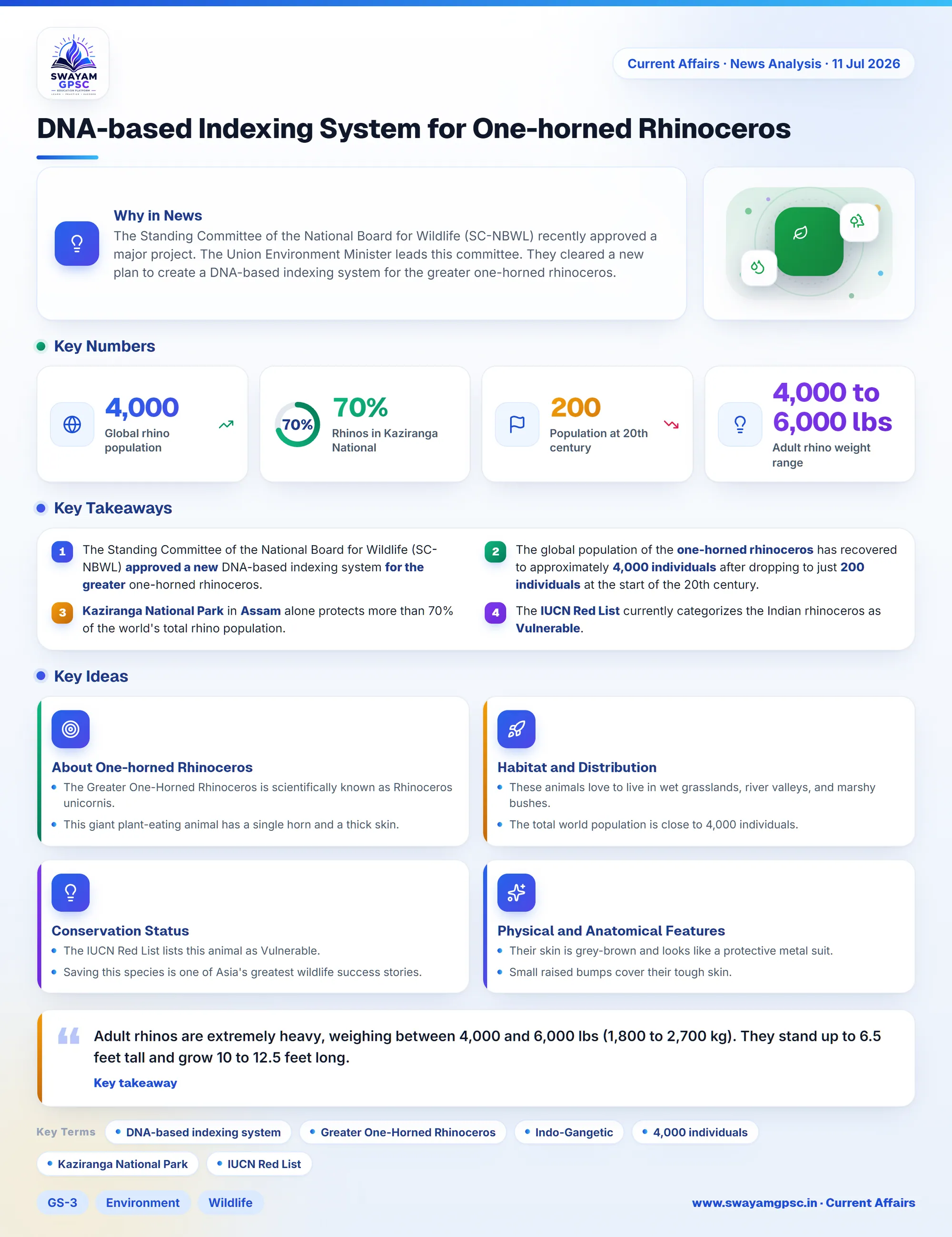
DNA-based Indexing System for One-horned Rhinoceros
#GS-3 #Environment #Wildlife #Biodiversity #Sustainable Development #National
Key takeaways
- The Standing Committee of the National Board for Wildlife (SC-NBWL) approved a new DNA-based indexing system for the greater one-horned rhinoceros.
- The global population of the one-horned rhinoceros has recovered to approximately 4,000 individuals after dropping to just 200 individuals at the start of the 20th century.
- Kaziranga National Park in Assam alone protects more than 70% of the world's total rhino population.
- The IUCN Red List currently categorizes the Indian rhinoceros as Vulnerable.
- The distinctive horn of the one-horned rhinoceros grows 8 to 25 inches long and consists entirely of compressed keratin fibers without any bony core.
Why in News
- The Standing Committee of the National Board for Wildlife (SC-NBWL) recently approved a major project. The Union Environment Minister leads this committee. They cleared a new plan to create a DNA-based indexing system for the greater one-horned rhinoceros.
About One-horned Rhinoceros
- The Greater One-Horned Rhinoceros is scientifically known as Rhinoceros unicornis. It is the biggest among all living rhino species on earth.
- This giant plant-eating animal has a single horn and a thick skin. It lives mainly in the river-fed plains of the Indian subcontinent.
Habitat and Distribution
- These animals love to live in wet grasslands, river valleys, and marshy bushes. They are found mainly in the Indo-Gangetic and Brahmaputra plains.
- The total world population is close to 4,000 individuals. Most of them live in northeast India and the protected Terai grasslands of Nepal.
- Kaziranga National Park in Assam alone protects more than 70% of all rhinos living in the world today.
Conservation Status
- The IUCN Red List lists this animal as Vulnerable.
- Saving this species is one of Asia's greatest wildlife success stories. Long ago, hunting and clearing of forests for farming reduced their number to just 200 individuals by the start of the 20th century.
Physical and Anatomical Features
- Their skin is grey-brown and looks like a protective metal suit. Deep skin folds run across their neck, shoulders, and sides.
- Small raised bumps cover their tough skin. These deep skin folds contain many blood vessels that help cool their bodies during hot summer days.
- Adult rhinos are extremely heavy, weighing between 4,000 and 6,000 lbs (1,800 to 2,700 kg). They stand up to 6.5 feet tall and grow 10 to 12.5 feet long.
The Single Horn and Prehensile Lip
- Unlike African rhinos that have two horns, the Indian rhino has only a single black horn. This horn grows 8 to 25 inches long.
- The horn is made entirely of compressed keratin fibers. It does not have any hard bone inside it.
- They have a flexible upper lip. This lip helps them grab tall grasses and pluck leaves easily from low branches.
Diet, Social Matrix, and Behavior
- They eat only plants and grass. Their daily food includes tall elephant grass, water plants, fruits, and tender branches.
- Rhinos like to live alone. They roam around areas that overlap with other rhinos without fighting over territory.
- Even though they live alone, many rhinos will gather peacefully near muddy water holes or rich grass fields to cool down and stay away from insects.