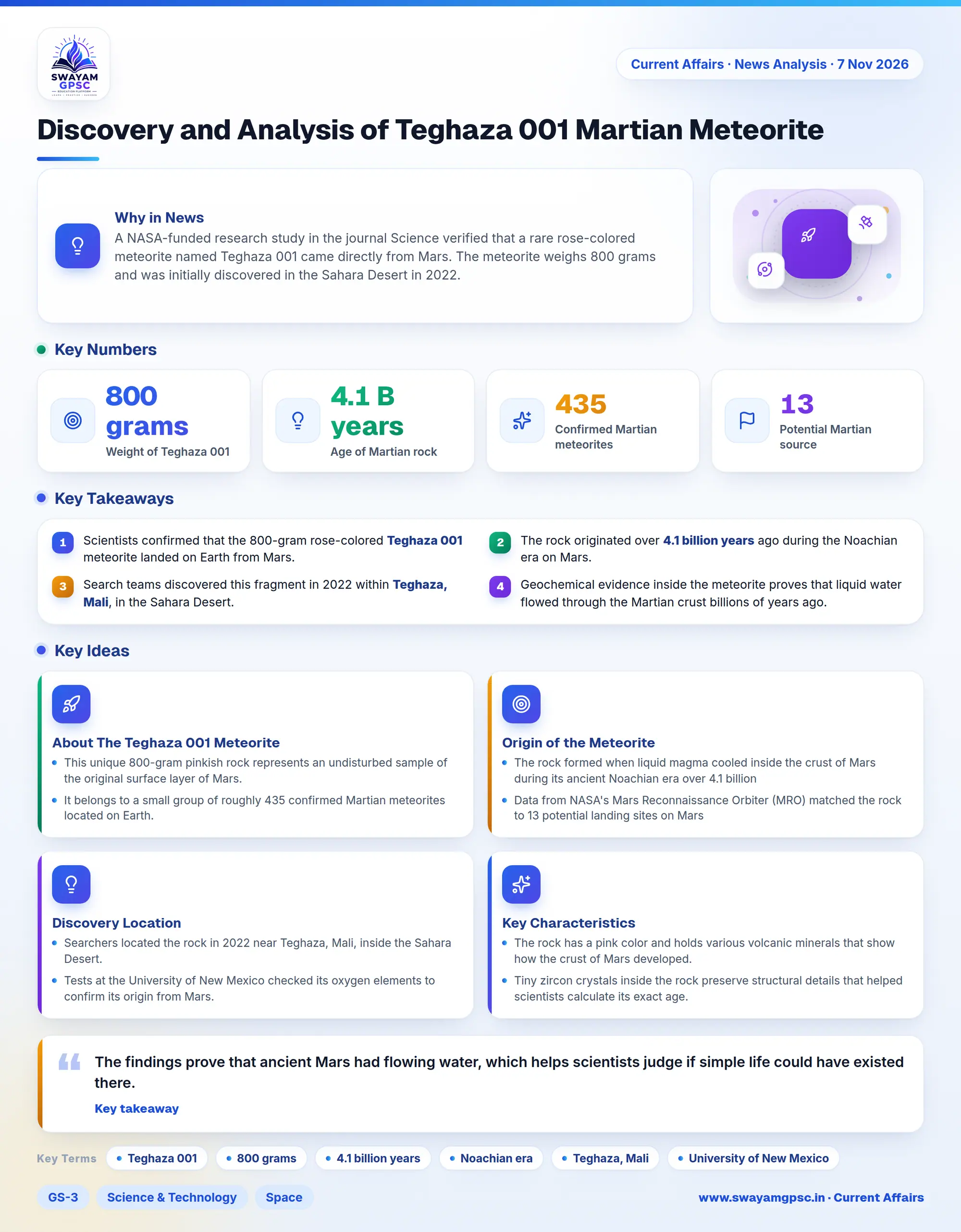
Discovery and Analysis of Teghaza 001 Martian Meteorite
#GS-3 #Science & Technology #Space #Teghaza 001 Meteorite #Mars Reconnaissance Orbiter #NASA
Key takeaways
- Scientists confirmed that the 800-gram rose-colored Teghaza 001 meteorite landed on Earth from Mars.
- The rock originated over 4.1 billion years ago during the Noachian era on Mars.
- Search teams discovered this fragment in 2022 within Teghaza, Mali, in the Sahara Desert.
- Geochemical evidence inside the meteorite proves that liquid water flowed through the Martian crust billions of years ago.
Why in News
- A NASA-funded research study in the journal Science verified that a rare rose-colored meteorite named Teghaza 001 came directly from Mars.
- The meteorite weighs 800 grams and was initially discovered in the Sahara Desert in 2022.
- Scientific measurements reveal that this space rock formed on Mars more than 4.1 billion years ago.
About The Teghaza 001 Meteorite
- This unique 800-gram pinkish rock represents an undisturbed sample of the original surface layer of Mars.
- It belongs to a small group of roughly 435 confirmed Martian meteorites located on Earth.
- Geologists consider this discovery a key key to understanding the earliest geological history of Mars.
Origin of the Meteorite
- The rock formed when liquid magma cooled inside the crust of Mars during its ancient Noachian era over 4.1 billion years ago.
- Data from NASA's Mars Reconnaissance Orbiter (MRO) matched the rock to 13 potential landing sites on Mars, mainly in its southern highlands.
- A powerful asteroid or comet impact knocked the rock off Mars, sending it through space until it fell to Earth.
Discovery Location
- Searchers located the rock in 2022 near Teghaza, Mali, inside the Sahara Desert.
- Tests at the University of New Mexico checked its oxygen elements to confirm its origin from Mars.
Key Characteristics
- The rock has a pink color and holds various volcanic minerals that show how the crust of Mars developed.
- Tiny zircon crystals inside the rock preserve structural details that helped scientists calculate its exact age.
- Researchers applied a precise rubidium-strontium dating method to inspect mineral grains without damaging the sample.
- Chemical traces inside the meteorite confirm that liquid water moved through the Martian crust around 4.1 billion years ago.
- The sample contains clues about how the surface rocks, water, and air of Mars affected each other long ago.
Significance
- The findings prove that ancient Mars had flowing water, which helps scientists judge if simple life could have existed there.
- Having a real piece of Mars allows scientists to run direct laboratory tests on Earth without waiting for space missions to bring back samples.