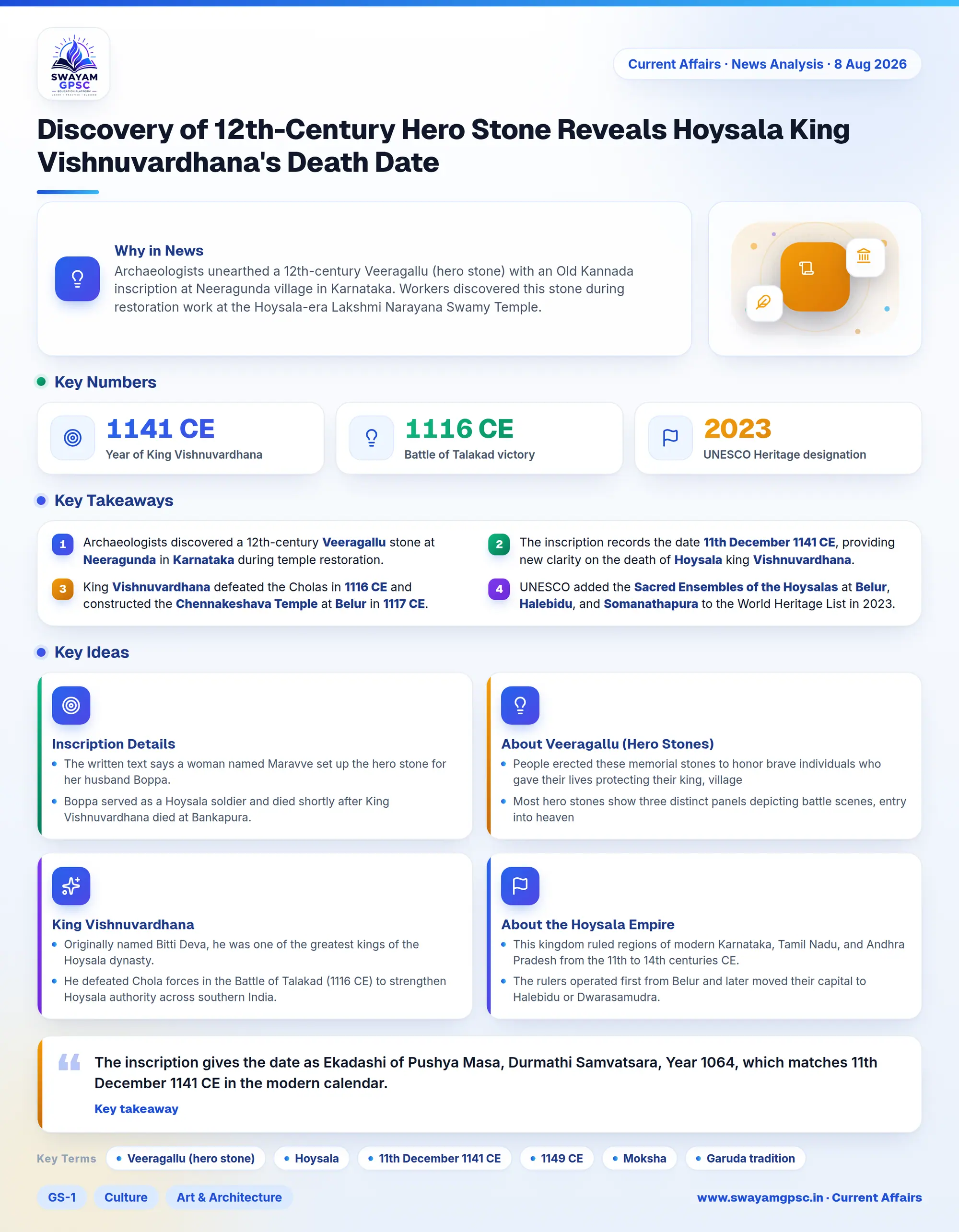
Discovery of 12th-Century Hero Stone Reveals Hoysala King Vishnuvardhana's Death Date
#GS-1 #Culture #Art & Architecture #Heritage #History #Medieval India #Current Events #National #Veeragallu #Hoysala Dynasty
Key takeaways
- Archaeologists discovered a 12th-century Veeragallu stone at Neeragunda in Karnataka during temple restoration.
- The inscription records the date 11th December 1141 CE, providing new clarity on the death of Hoysala king Vishnuvardhana.
- King Vishnuvardhana defeated the Cholas in 1116 CE and constructed the Chennakeshava Temple at Belur in 1117 CE.
- UNESCO added the Sacred Ensembles of the Hoysalas at Belur, Halebidu, and Somanathapura to the World Heritage List in 2023.
Why in News
- Archaeologists unearthed a 12th-century Veeragallu (hero stone) with an Old Kannada inscription at Neeragunda village in Karnataka.
- Workers discovered this stone during restoration work at the Hoysala-era Lakshmi Narayana Swamy Temple.
- This find can solve a long historical debate about when the Hoysala ruler Vishnuvardhana actually died.
Inscription Details
- The written text says a woman named Maravve set up the hero stone for her husband Boppa.
- Boppa served as a Hoysala soldier and died shortly after King Vishnuvardhana died at Bankapura.
- The inscription gives the date as Ekadashi of Pushya Masa, Durmathi Samvatsara, Year 1064, which matches 11th December 1141 CE in the modern calendar.
- If experts confirm this date, it settles the debate between earlier claims of 1149 CE or 1152 CE.
About Veeragallu (Hero Stones)
- People erected these memorial stones to honor brave individuals who gave their lives protecting their king, village, or cattle.
- Most hero stones show three distinct panels depicting battle scenes, entry into heaven, and worship before a deity for Moksha.
- These stones reflect the Garuda tradition, where loyal royal guards sacrificed their lives after their king passed away.
King Vishnuvardhana
- Originally named Bitti Deva, he was one of the greatest kings of the Hoysala dynasty.
- He defeated Chola forces in the Battle of Talakad (1116 CE) to strengthen Hoysala authority across southern India.
- He built the famous Chennakeshava Temple at Belur in 1117 CE, originally called Vijaya Narayana Temple, to mark his 1116 CE victory over Cholas.
- Saint Ramanujacharya influenced him to accept Srivaishnavism, though the king continued supporting Jainism and Shaivism.
About the Hoysala Empire
- This kingdom ruled regions of modern Karnataka, Tamil Nadu, and Andhra Pradesh from the 11th to 14th centuries CE.
- The rulers operated first from Belur and later moved their capital to Halebidu or Dwarasamudra.
- Hoysala architecture features Vesara-style elements, including star-shaped ground plans, Jagati raised platforms, and detailed soapstone carvings.
- UNESCO inscribed the Sacred Ensembles of the Hoysalas at Belur, Halebidu, and Somanathapura as a World Heritage Site in 2023.