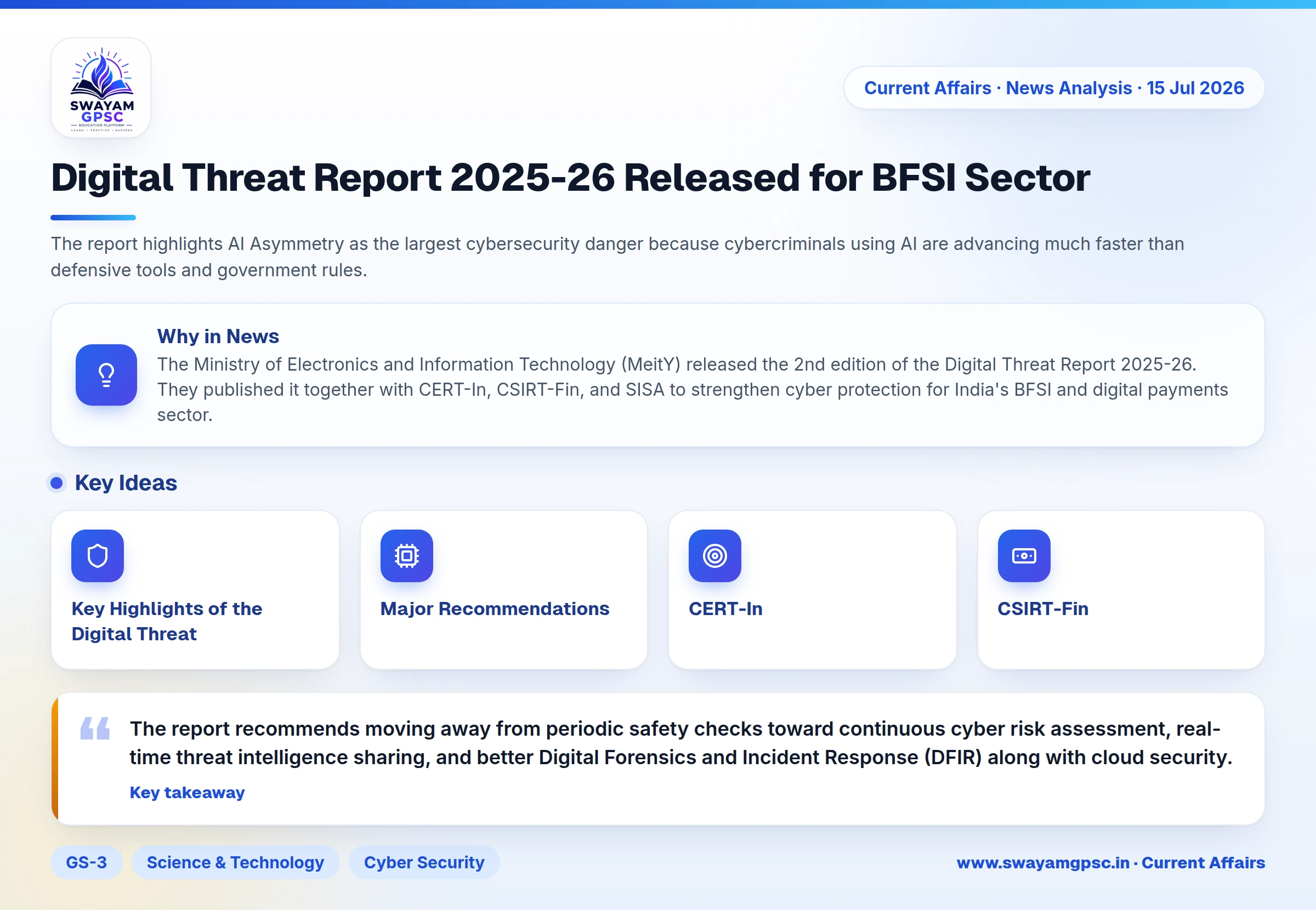
Digital Threat Report 2025-26 Released for BFSI Sector
#GS-3 #Science & Technology #Cyber Security #Economy #Banking #Current Events #National
Why in News
- The Ministry of Electronics and Information Technology (MeitY) released the 2nd edition of the Digital Threat Report 2025-26.
- They published it together with CERT-In, CSIRT-Fin, and SISA to strengthen cyber protection for India's BFSI and digital payments sector.
Key Highlights of the Digital Threat Report 2025-26
- The report highlights AI Asymmetry as the largest cybersecurity danger because cybercriminals using AI are advancing much faster than defensive tools and government rules.
- Attackers with low resources can now use AI tools to run fast automated attacks, significantly raising risks for banks and financial institutions.
- AI Asymmetry represents a growing gap where hackers use AI to create attacks much faster than companies can spot or stop them.
- The time gap between finding a cyber vulnerability and hacking it has decreased rapidly, with attacks that once took years now happening within months or even weeks.
- Modern cyberattacks no longer rely on simple system break-ins, shifting to social engineering, password theft, supply chain bugs, cloud weaknesses, and fake user sessions.
- The report introduces the 4-Layer Gap Archetype Framework to explain cyber failures through a connected chain of vulnerabilities rather than a single mistake.
- This analysis framework allows companies to pinpoint deep operational vulnerabilities and guide their security budgets wisely.
- The report outlines an 18-month Cyber Resilience Roadmap to help organisations upgrade basic security controls, track continuous risks, share threat data, and build strong defence systems.
Major Recommendations
- The report recommends moving away from periodic safety checks toward continuous cyber risk assessment, real-time threat intelligence sharing, and better Digital Forensics and Incident Response (DFIR) along with cloud security.
- It advises financial firms to adopt AI-powered defense tools and stresses better coordination among regulatory bodies, banks, and security agencies to keep digital payments safe.
CERT-In
- The Indian Computer Emergency Response Team (CERT-In) serves as the national nodal agency for managing cybersecurity threats under MeitY.
- Formed under the Information Technology (Amendment) Act, 2008, it collects threat data, issues alerts, coordinates emergency responses, and guides security practices across India.
CSIRT-Fin
- The Computer Security Incident Response Team in Finance (CSIRT-Fin) is the dedicated cybersecurity agency for India's financial sector.
- It handles threat prevention, incident management, and security checks across banking, securities, insurance, and pension channels.
- It broadcasts threat warnings, handles emergency response efforts, checks overall resilience, and educates regulated financial firms on cybersecurity.
SISA
- SISA is an Indian-founded global cybersecurity firm focusing on financial services and digital payment systems.
- Combining AI, cybersecurity, and payment safety, it provides breach intelligence, digital forensics, and incident control to institutions in over 40 countries.
Frequently Asked Questions (FAQs)
- What is the Digital Threat Report 2025-26? It is a study published by MeitY, CERT-In, CSIRT-Fin, and SISA to evaluate digital hazards in the BFSI sector and protect financial payments.
- What is AI Asymmetry? It is the growing imbalance where cyber attackers use AI to evolve faster than current defensive systems and government regulations.
- What is CERT-In? It is India's primary national agency for tackling cybersecurity incidents under MeitY, recognized under the Information Technology (Amendment) Act, 2008.
- What is CSIRT-Fin? It is the cybersecurity response unit for India's financial landscape, safeguarding banking, insurance, stock markets, and pension funds.
- What are the key recommendations of the Digital Threat Report 2025-26? The report calls for continuous risk monitoring, AI-based defenses, fast intelligence sharing, and secure cloud networks for the financial sector.