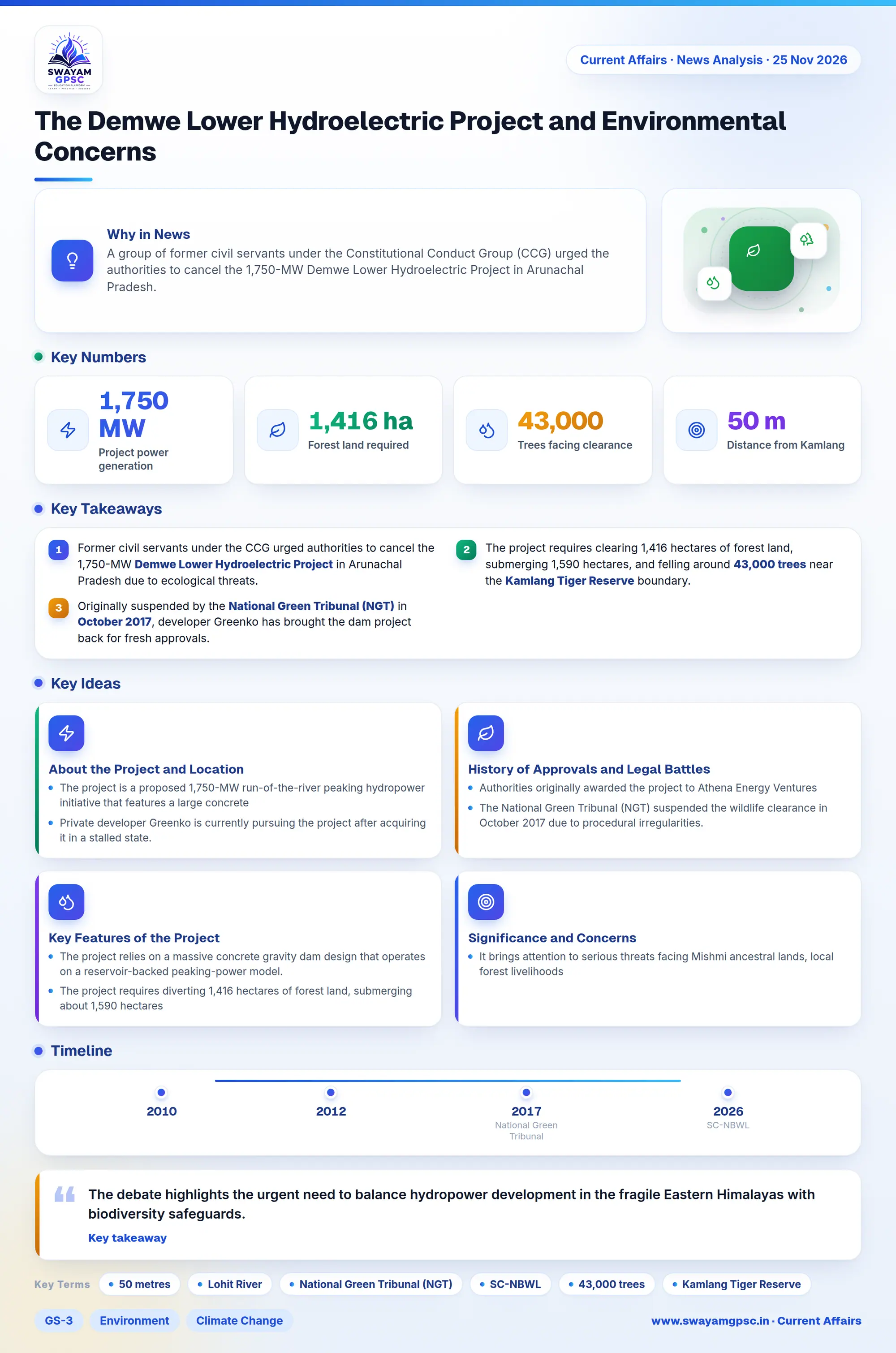
The Demwe Lower Hydroelectric Project and Environmental Concerns
#GS-3 #Environment #Climate Change #Biodiversity #Wildlife #Hydroelectric Project #Conservation
Key takeaways
- Former civil servants under the CCG urged authorities to cancel the 1,750-MW Demwe Lower Hydroelectric Project in Arunachal Pradesh due to ecological threats.
- The project requires clearing 1,416 hectares of forest land, submerging 1,590 hectares, and felling around 43,000 trees near the Kamlang Tiger Reserve boundary.
- Originally suspended by the National Green Tribunal (NGT) in October 2017, developer Greenko has brought the dam project back for fresh approvals.
Why in News
- A group of former civil servants under the Constitutional Conduct Group (CCG) urged the authorities to cancel the 1,750-MW Demwe Lower Hydroelectric Project in Arunachal Pradesh.
About the Project and Location
- The project is a proposed 1,750-MW run-of-the-river peaking hydropower initiative that features a large concrete gravity dam.
- Private developer Greenko is currently pursuing the project after acquiring it in a stalled state.
- The project sits in the Lohit district of Arunachal Pradesh, right downstream of the sacred Parashuram Kund pilgrimage site.
- It is located within 50 metres of the boundary of the Kamlang Tiger Reserve.
- The dam is planned across the Lohit River, which is a major eastern tributary of the Brahmaputra River originating in eastern Tibet.
History of Approvals and Legal Battles
- Authorities originally awarded the project to Athena Energy Ventures, granting initial environmental clearance in 2010 and forest clearances by 2012 despite dissent from independent members.
- The National Green Tribunal (NGT) suspended the wildlife clearance in October 2017 due to procedural irregularities.
- Greenko later acquired the project and brought it back before the SC-NBWL for a fresh clearance review in July 2026.
Key Features of the Project
- The project relies on a massive concrete gravity dam design that operates on a reservoir-backed peaking-power model.
- The project requires diverting 1,416 hectares of forest land, submerging about 1,590 hectares, and cutting down around 43,000 trees.
- The submergence zone reaches into the Eco-Sensitive Zone of the Kamlang Tiger Reserve and impacts downstream areas like Dibru-Saikhowa National Park in Assam.
- The plant will hold back river water for almost 20 hours daily and then release sudden power surges up to 1,729 cubic metres per second.
- These operations threaten critical habitats of endangered wildlife, including the White-Bellied Heron, Bengal Florican, Gangetic River Dolphin, Mishmi Takin, Red Panda, Eastern Hoolock Gibbon, and four big cat species.
Significance and Concerns
- The debate highlights the urgent need to balance hydropower development in the fragile Eastern Himalayas with biodiversity safeguards.
- It brings attention to serious threats facing Mishmi ancestral lands, local forest livelihoods, and the sacred Parashuram Kund site.