Demarcation of Ecologically Sensitive Areas in India
#GS-3 #Environment #Sustainable Development #Biodiversity #EIA #Geography #Resources #Current Events #National #Gujarat
Key takeaways
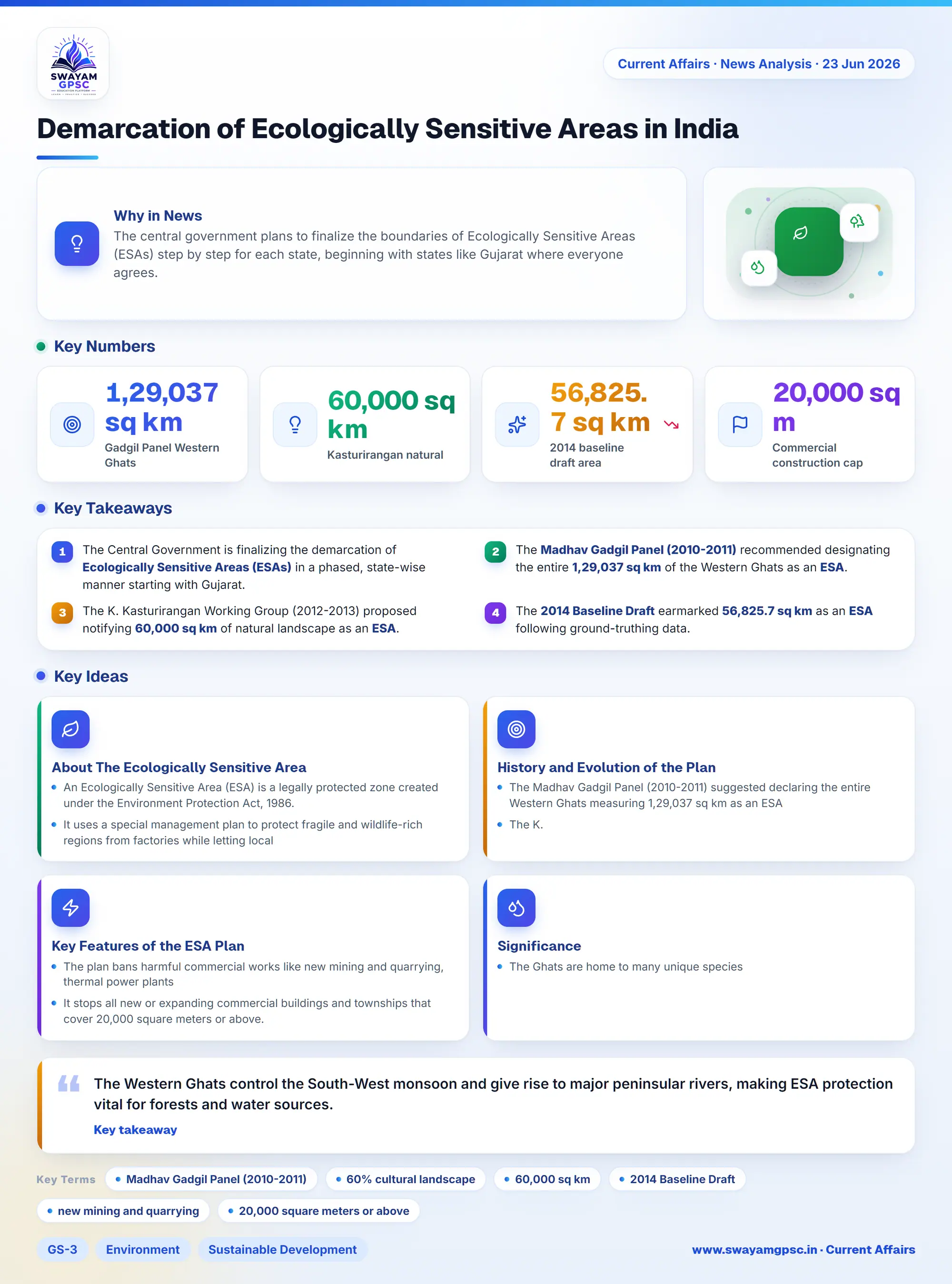
- The Central Government is finalizing the demarcation of Ecologically Sensitive Areas (ESAs) in a phased, state-wise manner starting with Gujarat.
- The Madhav Gadgil Panel (2010-2011) recommended designating the entire 1,29,037 sq km of the Western Ghats as an ESA.
- The K. Kasturirangan Working Group (2012-2013) proposed notifying 60,000 sq km of natural landscape as an ESA.
- The 2014 Baseline Draft earmarked 56,825.7 sq km as an ESA following ground-truthing data.
- The plan strictly bans red-category industries and commercial construction projects with a built-up area of 20,000 square meters or above.
Why in News
- The central government plans to finalize the boundaries of Ecologically Sensitive Areas (ESAs) step by step for each state, beginning with states like Gujarat where everyone agrees.
About The Ecologically Sensitive Area
- An Ecologically Sensitive Area (ESA) is a legally protected zone created under the Environment Protection Act, 1986.
- It uses a special management plan to protect fragile and wildlife-rich regions from factories while letting local people do sustainable development.
History and Evolution of the Plan
- The Madhav Gadgil Panel (2010-2011) suggested declaring the entire Western Ghats measuring 1,29,037 sq km as an ESA with strict rules everywhere.
- The K. Kasturirangan Working Group (2012-2013) disagreed with a blanket rule and divided the region into a 60% cultural landscape and a 40% natural landscape.
- It suggested notifying only 60,000 sq km of natural landscape as an ESA.
- The 2014 Baseline Draft by the Ministry of Environment, Forests and Climate Change proposed 56,825.7 sq km as an ESA after using ground data from Kerala.
- The Sanjay Kumar Committee (2022-2026) was set up to check village land records, solve state objections, and create a state-wise plan.
Key Features of the ESA Plan
- The plan bans harmful commercial works like new mining and quarrying, thermal power plants, and polluting red-category industries.
- It stops all new or expanding commercial buildings and townships that cover 20,000 square meters or above.
- The new draft lets the centre publish ESA boundaries for one state at a time instead of waiting for all six states to agree.
- It uses satellite pictures and state land records to match local boundaries and fix mistakes.
- It offers central grants and payments for ecosystem services to reward local people who protect nature.
Significance
- The Western Ghats control the South-West monsoon and give rise to major peninsular rivers, making ESA protection vital for forests and water sources.
- The Ghats are home to many unique species, and ESA rules protect wildlife paths and forests from getting broken up or damaged.