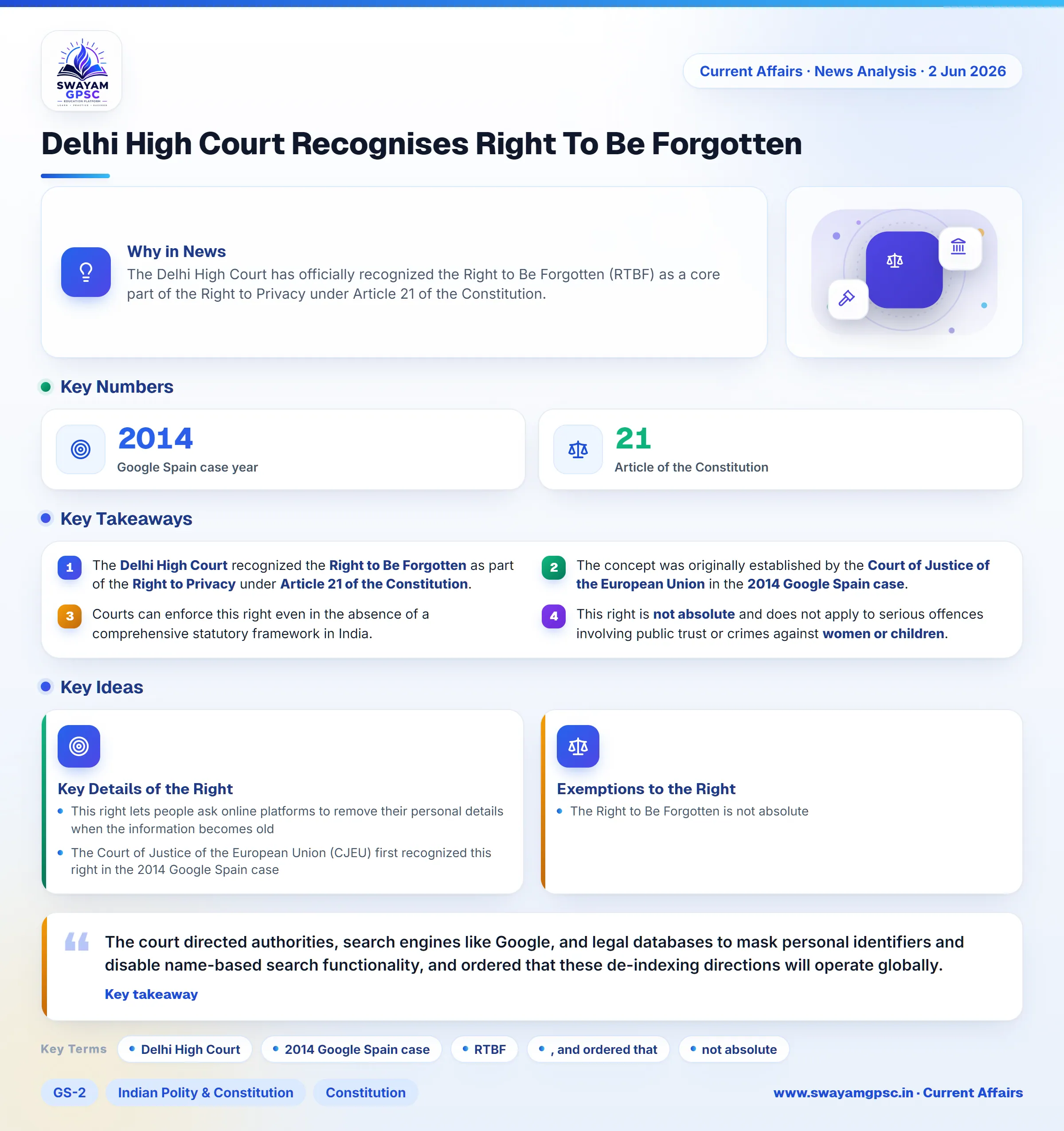
Delhi High Court Recognises Right To Be Forgotten
#GS-2 #Indian Polity & Constitution #Constitution #Fundamental Rights #Judgements & Cases #Current Events #National #Right To Be Forgotten #Right to Privacy
Key takeaways
- The Delhi High Court recognized the Right to Be Forgotten as part of the Right to Privacy under Article 21 of the Constitution.
- The concept was originally established by the Court of Justice of the European Union in the 2014 Google Spain case.
- Courts can enforce this right even in the absence of a comprehensive statutory framework in India.
- This right is not absolute and does not apply to serious offences involving public trust or crimes against women or children.
Why in News
- The Delhi High Court has officially recognized the Right to Be Forgotten (RTBF) as a core part of the Right to Privacy under Article 21 of the Constitution.
Key Details of the Right to Be Forgotten
- This right lets people ask online platforms to remove their personal details when the information becomes old, unnecessary, or violates their privacy.
- The Court of Justice of the European Union (CJEU) first recognized this right in the 2014 Google Spain case, stating that search engines must delete irrelevant data upon request.
- The court stated that the RTBF lets citizens clear their personal records from the internet when keeping them online no longer helps the public interest.
- The court noted that even without a comprehensive statutory framework in India for the RTBF, constitutional courts have the power to recognize and enforce this right.
- The court directed authorities, search engines like Google, and legal databases to mask personal identifiers and disable name-based search functionality, and ordered that these de-indexing directions will operate globally.
- While court records must remain open for transparency, the court ruled that it does not mandate that a private citizen's name must act as a permanent, searchable key via commercial search engines.
- Open justice ensures transparency, not the perpetual amplification of an individual's personal or legal struggles.
- People who are acquitted, discharged, or have their cases settled can ask for their updated status to be shown correctly online.
- The court stated that names can be hidden in public copies of judgments, but the actual legal reasoning and full records must be kept safe for proper legal use.
Exemptions to the Right
- The Right to Be Forgotten is not absolute, and courts can refuse relief in serious cases like convictions for offences against women or children and offences involving breach of public trust by public servants, elected representatives or persons in fiduciary positions.