The Defence Decade Transformation and Self-Reliance (2014-2026)
#GS-3 #Economy #Infrastructure #Science & Technology #Growth
Key takeaways
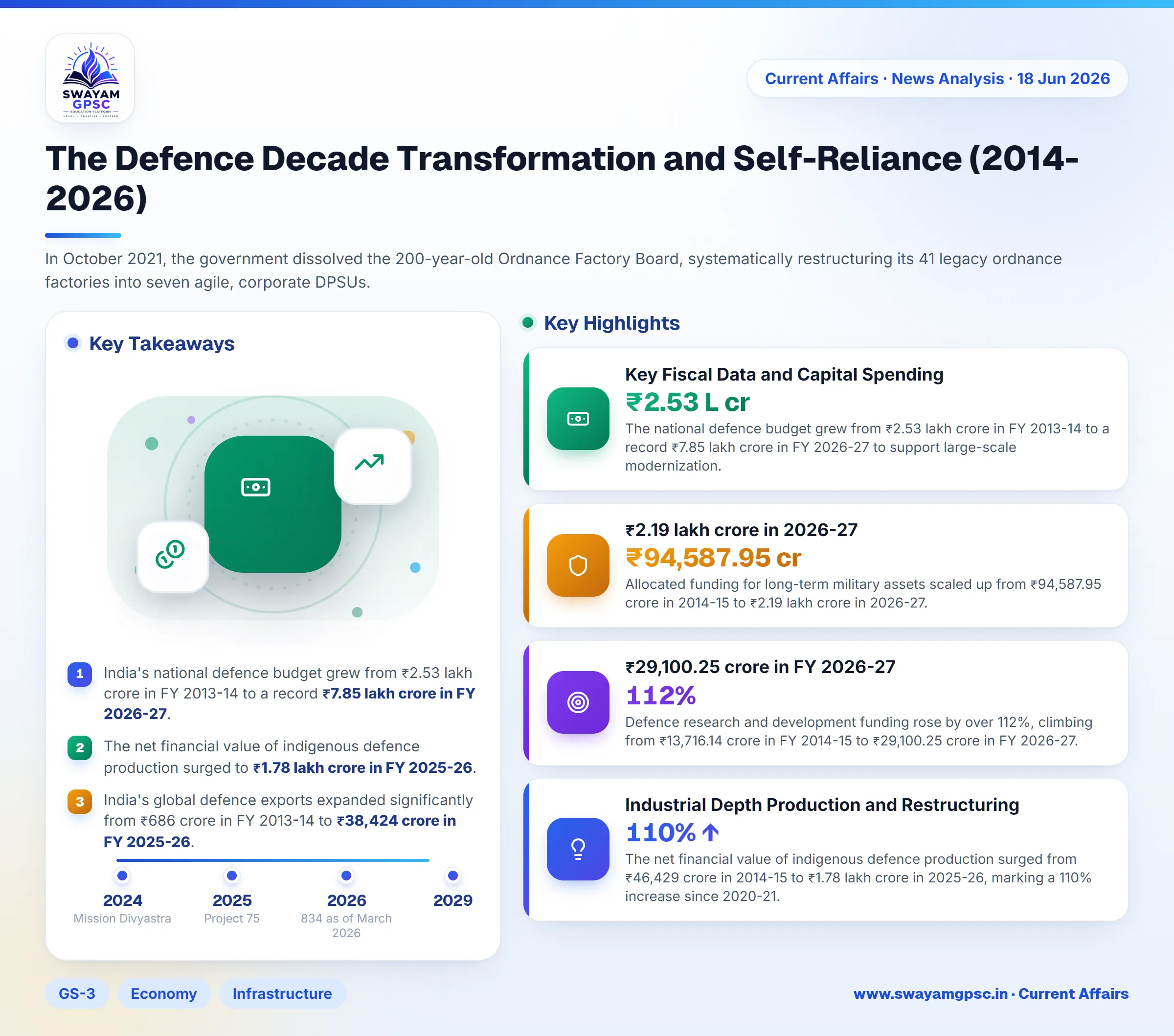
- India's national defence budget grew from ₹2.53 lakh crore in FY 2013-14 to a record ₹7.85 lakh crore in FY 2026-27.
- The net financial value of indigenous defence production surged to ₹1.78 lakh crore in FY 2025-26.
- India's global defence exports expanded significantly from ₹686 crore in FY 2013-14 to ₹38,424 crore in FY 2025-26.
- The Ministry of Defence enacted five Positive Indigenisation Lists to halt imports on 5,012 specialized parts.
About The Defence Decade Transformation
- Over the past twelve years, India has shifted from buying military equipment from foreign countries to building weapons at home. Guided by Atmanirbhar Bharat and Make in India, the Ministry of Defence has removed old rules to create a transparent and innovation-driven manufacturing system.
Key Fiscal Data and Capital Spending
- The national defence budget grew from ₹2.53 lakh crore in FY 2013-14 to a record ₹7.85 lakh crore in FY 2026-27 to support large-scale modernization.
- Allocated funding for long-term military assets scaled up from ₹94,587.95 crore in 2014-15 to ₹2.19 lakh crore in 2026-27.
- Defence research and development funding rose by over 112%, climbing from ₹13,716.14 crore in FY 2014-15 to ₹29,100.25 crore in FY 2026-27.
Industrial Depth Production and Restructuring
- The net financial value of indigenous defence production surged from ₹46,429 crore in 2014-15 to ₹1.78 lakh crore in 2025-26, marking a 110% increase since 2020-21.
- While DPSUs contributed 76% of aggregate manufacturing output, private sector participation grew to 24% of the total industrial mix.
- The total volume of active legal defence industrial licenses issued rose from 258 in 2015 to 834 as of March 2026 to drive ease of doing business.
- In October 2021, the government dissolved the 200-year-old Ordnance Factory Board, systematically restructuring its 41 legacy ordnance factories into seven agile, corporate DPSUs.
- Following policy changes that permitted up to 74% FDI via the automatic route and 100% through the government route, India logged ₹6,670.59 crore in direct foreign inflows by March 2026.
Exploding Global Export Footprints
- India's global defence exports expanded from a minimal baseline of ₹686 crore in FY 2013-14 to a milestone ₹38,424 crore in FY 2025-26.
- Manufactured items and battlefield-ready sub-systems are now actively exported to over 80 sovereign countries.
- The active baseline of domestic manufacturing firms participating in global contracts expanded to 145 specialized entities.
- India has reversed its import dependence, moving from buying 65% to 70% of equipment abroad to manufacturing nearly 65% of its defence inventory at home.
Key Trends in Indian Defence Governance
- The iDEX initiative actively brought in MSMEs and start-ups, signing 551 specific design contracts by March 2026.
- The Ministry of Defence enacted five Positive Indigenisation Lists, halting imports on 5,012 specialized parts and generating ₹9,782 crore in domestic orders via the Srijan Portal.
- Establishing dedicated Defence Industrial Corridors helped pull in investment commitments worth ₹42,057 crore in Uttar Pradesh and ₹32,699 crore in Tamil Nadu by April 2026.
- The Srijan DEEP platform systematically logs over 41,000 verified suppliers with a unique reference number to secure supply chain resilience.
- Opening advanced DRDO testing facilities to private industries via a unified Defence Testing Portal has made cross-verification highly transparent.
Positive Indicators and Technological Milestones
- During Mission Shakti in 2019, India demonstrated high-altitude anti-satellite capabilities by destroying a target satellite in low earth orbit.
- Mission Divyastra successfully tested a long-range strategic missile system equipped with MIRV in 2024.
- In 2026, India conducted a successful 12-minute ground test of an actively cooled scramjet full-scale combustor, backed by a new Hypersonic Wind Tunnel in Hyderabad.
- The Defence Acquisition Council granted acceptances of necessity worth over ₹6 lakh crore, including 97 indigenous Tejas Mk-1A fighter jets and 156 Prachand Light Combat Helicopters.
- The Project 75 milestone in 2025 completed the delivery of all six Kalvari-class Scorpene submarines built by Mazagon Dock Shipbuilders Limited in collaboration with France.
Challenges
- Translating complex laboratory prototypes developed by DRDO into mass-manufactured systems by private MSMEs can face industrial delays.
- Negotiating sensitive technology-sharing agreements with foreign suppliers requires deep regulatory checks to keep intellectual property independent.
- Building a steady workforce for precision military manufacturing demands extensive training updates for entry-level technicians.
- While mega investments are committed at the central level, the physical construction of factories can hit speed bumps due to state-level land conversions and municipal clearances.
Way Forward
- India must maintain aggressive global outreach to meet the central government target of ₹50,000 crore in annual defence exports by 2029.
- The government should expeditiously finalize and implement the draft Defence Acquisition Procedure 2026 to mandate a strict 60% minimum indigenous content requirement across capital purchases.
- It is necessary to allocate the newly sanctioned ₹500 crore corpus under the TDF explicitly toward emerging defense lines like quantum computing, AI, and autonomous drone swarms.
- India should leverage frameworks like the India-US TRUST initiative and the MAHASAGAR doctrine to position itself as a key net security provider across the Indo-Pacific.