Deendayal Port Wins Major Port of the Year Award
#GS-3 #Economy #Infrastructure #Current Events #Gujarat #Deendayal Port #Maritime Trade
Key takeaways
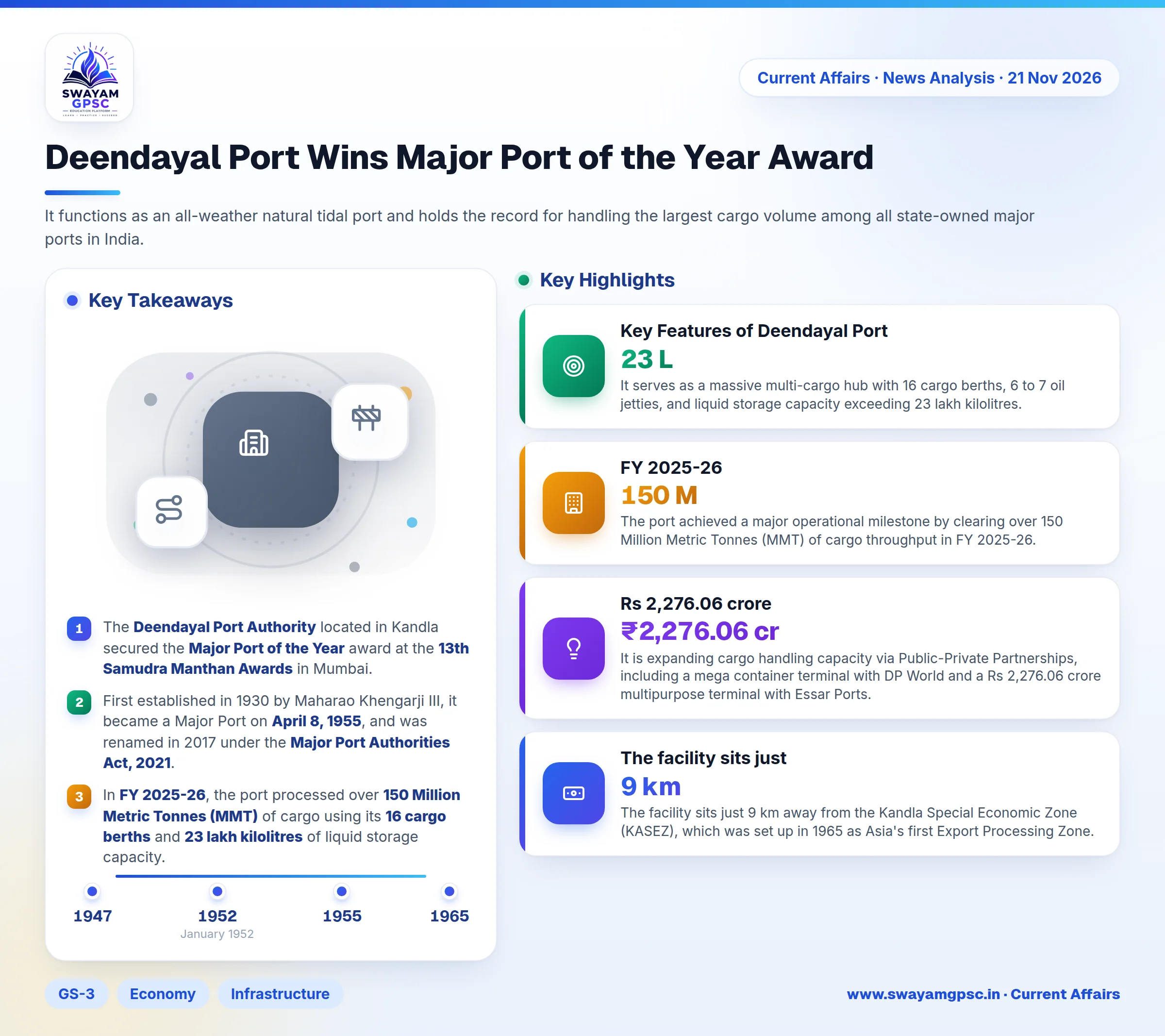
- The Deendayal Port Authority located in Kandla secured the Major Port of the Year award at the 13th Samudra Manthan Awards in Mumbai.
- First established in 1930 by Maharao Khengarji III, it became a Major Port on April 8, 1955, and was renamed in 2017 under the Major Port Authorities Act, 2021.
- In FY 2025-26, the port processed over 150 Million Metric Tonnes (MMT) of cargo using its 16 cargo berths and 23 lakh kilolitres of liquid storage capacity.
- The port is expanding through a Rs 2,276.06 crore multipurpose terminal project with Essar Ports and sits just 9 km from the historic 1965 Kandla SEZ.
Why in News
- The Deendayal Port Authority (DPA) in Kandla received the prestigious Major Port of the Year award.
- Bhandarkar Publications presented this award during the 13th edition of the Samudra Manthan Awards held in Mumbai.
About Deendayal Port
- Deendayal Port is one of India's 12 Major Ports under the Ministry of Ports, Shipping and Waterways.
- It functions as an all-weather natural tidal port and holds the record for handling the largest cargo volume among all state-owned major ports in India.
Location of the Port
- The port stands along the Kandla Creek on the northern shore of the Gulf of Kutch in Kutch district, Gujarat.
- It also operates a specialized offshore oil terminal located at Vadinar.
Historical Background
- Maharao Khengarji III of Kutch built the initial RCC jetty at Old Kandla in 1930.
- India expanded Kandla Port after the 1947 Partition to compensate for the loss of Karachi Port.
- Jawaharlal Nehru laid the foundation stone in January 1952, and the facility gained official Major Port status on April 8, 1955.
- The government renamed Kandla Port as Deendayal Port in 2017 to honor Pandit Deendayal Upadhyaya.
- The port transformed into the Deendayal Port Authority under the Major Port Authorities Act, 2021.
Core Objective
- The primary goal is to build affordable, smart, and efficient maritime logistics infrastructure for trade.
- It focuses on accelerating industrial expansion and green-energy initiatives across northern and western India.
Key Features of Deendayal Port
- The port operates inside the sheltered Kandla Creek, protecting ships from harsh monsoon waves and enabling non-stop 24x7 operations throughout the year.
- It serves as a massive multi-cargo hub with 16 cargo berths, 6 to 7 oil jetties, and liquid storage capacity exceeding 23 lakh kilolitres.
- The port achieved a major operational milestone by clearing over 150 Million Metric Tonnes (MMT) of cargo throughput in FY 2025-26.
- It is expanding cargo handling capacity via Public-Private Partnerships, including a mega container terminal with DP World and a Rs 2,276.06 crore multipurpose terminal with Essar Ports.
- The facility sits just 9 km away from the Kandla Special Economic Zone (KASEZ), which was set up in 1965 as Asia's first Export Processing Zone.
Strategic Significance
- The port offers the shortest sea trade routes to northern and western states like Gujarat, Rajasthan, Punjab, and Haryana for trading with the Middle East, Europe, and Africa.
- It advances national targets under the Maritime India Vision 2030 and the National Green Hydrogen Mission by building green hydrogen export facilities and upgrading to smart port tech.