Deen Dayal Upadhyaya Grameen Kaushalya Yojana 2.0
#GS-2 #Governance & Social Justice #Poverty #GS-3 #Economy #Employment #Government Policies & Interventions
Key takeaways
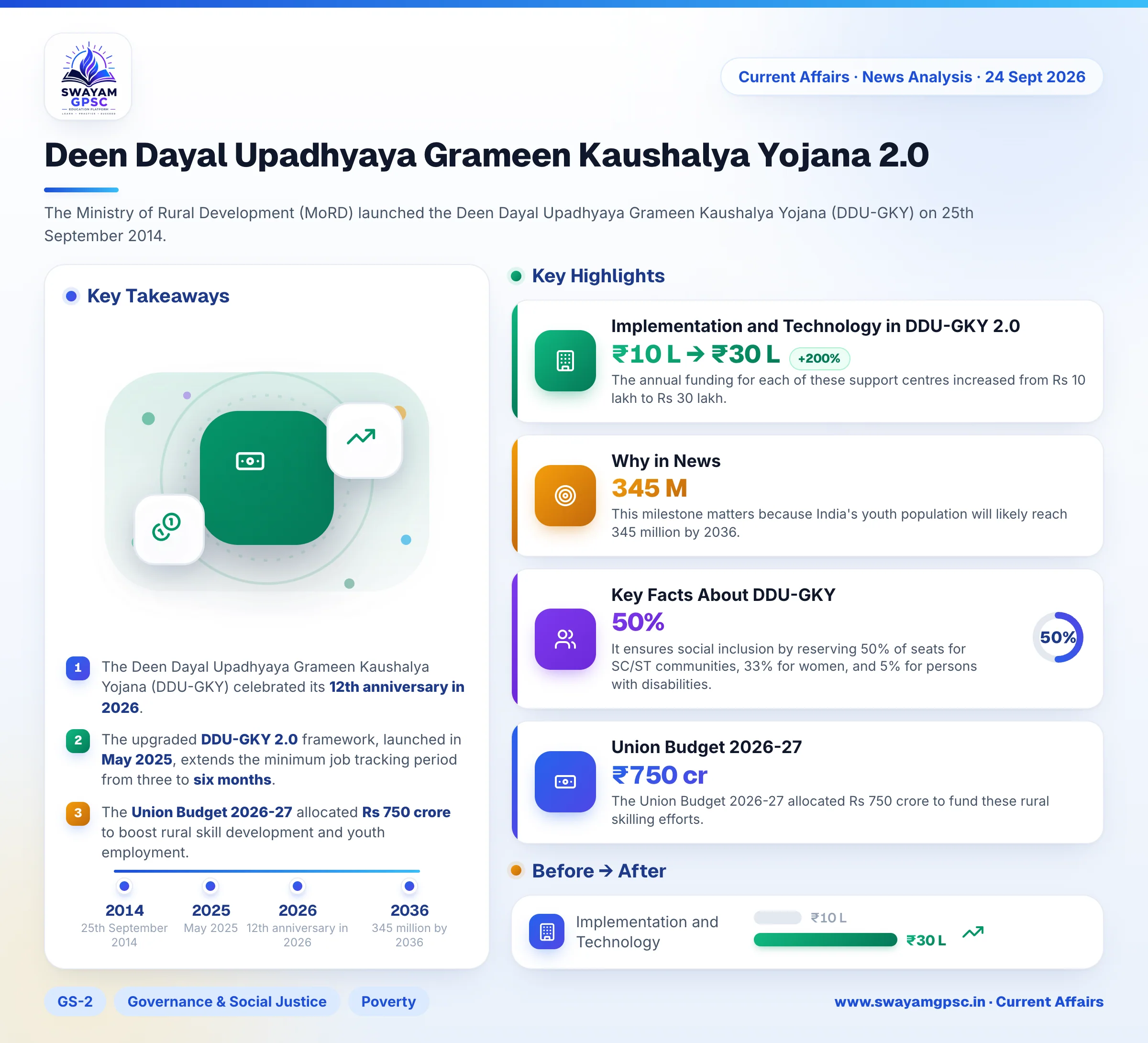
- The Deen Dayal Upadhyaya Grameen Kaushalya Yojana (DDU-GKY) celebrated its 12th anniversary in 2026.
- The upgraded DDU-GKY 2.0 framework, launched in May 2025, extends the minimum job tracking period from three to six months.
- The Union Budget 2026-27 allocated Rs 750 crore to boost rural skill development and youth employment.
- Since 2014-15, the scheme has trained over 18.47 lakh rural youth and placed more than 12.43 lakh candidates in jobs.
- Additionally, 647 Rural Self-Employment Training Institutes (RSETIs) have trained 63.47 lakh candidates since 2009.
Why in News
- The Deen Dayal Upadhyaya Grameen Kaushalya Yojana (DDU-GKY) celebrates its 12th anniversary in 2026.
- This scheme helps rural youth find jobs by offering training that matches industry needs.
- This milestone matters because India's youth population will likely reach 345 million by 2036.
- This means we must quickly expand skill development and job opportunities for rural youth.
Key Facts About DDU-GKY
- The Ministry of Rural Development (MoRD) launched the Deen Dayal Upadhyaya Grameen Kaushalya Yojana (DDU-GKY) on 25th September 2014.
- The government started this scheme under the National Rural Livelihoods Mission to provide job-linked training.
- The scheme specifically helps rural youth aged 15-35 years who come from poor families.
- It ensures social inclusion by reserving 50% of seats for SC/ST communities, 33% for women, and 5% for persons with disabilities.
- The government updated the program guidelines in May 2025 to launch DDU-GKY 2.0.
- The new framework focuses heavily on high-quality training, sustainable jobs, and helping candidates stay employed.
- The scheme now covers diverse fields like aerospace and aviation, agriculture, green jobs, and healthcare.
- The Union Budget 2026-27 allocated Rs 750 crore to fund these rural skilling efforts.
Special Initiatives under DDU-GKY 2.0
- The Roshni Initiative provides residential skill training in districts affected by Left-Wing Extremism.
- This initiative ensures that at least 40% of the trained candidates are women.
- The Himayat Initiative is a special program that supports youth in Jammu & Kashmir and Ladakh.
- The central government provides 100% funding for Himayat to help youth get jobs or start businesses.
- The government reserves 10% of the DDU-GKY budget for the North Eastern Region to tackle regional challenges.
- Training agencies working in difficult areas receive a Special Area Allowance equal to 10% of the base training cost.
Implementation and Technology in DDU-GKY 2.0
- The upgraded program handles the entire employment cycle from training and placement to career growth.
- The minimum training duration remains 576 hours but includes 396 hours of technical domain training.
- Candidates also receive 180 hours of mandatory non-domain training to improve their general skills.
- The scheme increased the minimum tracking period for job placements from three months to six months.
- State missions organize Job Melas at local levels to connect trained youth directly with employers.
- The government provides up to Rs 50,000 for village-level job fairs and Rs 1 lakh for block-level fairs.
- The government sets up Migration Support Centres to help workers who move to new cities for work.
- The annual funding for each of these support centres increased from Rs 10 lakh to Rs 30 lakh.
- The scheme uses an end-to-end digital platform to track everything from candidate registration to final placements.
- This digital system uses face-authenticated attendance and connects with the Skill India Digital Hub.
- Several states have rolled out the new program quickly during 2025-26.
- For example, Goa started the first batches, while Andhra Pradesh trained over 12,000 candidates in three months.
Key Milestones Achieved Under DDU-GKY
- The scheme operates across 31 States and Union Territories through a strong network of training centres.
- The ecosystem includes 749 approved projects and 760 active training centres run by 455 Project Implementing Agencies.
- Since its launch in 2014-15, the scheme has trained over 18.47 lakh rural youth across 36 sectors.
- More than 12.43 lakh candidates have successfully secured job placements after completing their training.
- The program has trained over 9.71 lakh women and helped more than 6.34 lakh women get jobs.
Other Initiatives Supporting Rural Youth Entrepreneurship
- The government also runs Rural Self-Employment Training Institutes (RSETIs) to encourage self-employment.
- These institutes provide free residential training and handholding support to unemployed rural youth.
- The program targets youth aged 18-50 years from poor households and DAY-NRLM families.
- The government aims to build a dedicated training center in every district of India.
- Currently, 647 RSETIs are active across 634 districts in 33 States and Union Territories.
- Since 2009, these institutes have trained 63.47 lakh candidates and settled 45.60 lakh into stable livelihoods.
Conclusion
- DDU-GKY 2.0 shifts the focus from basic skill training to creating long-term, sustainable livelihoods.
- This effort helps build a skilled rural workforce to support the national vision of Viksit Bharat @2047.