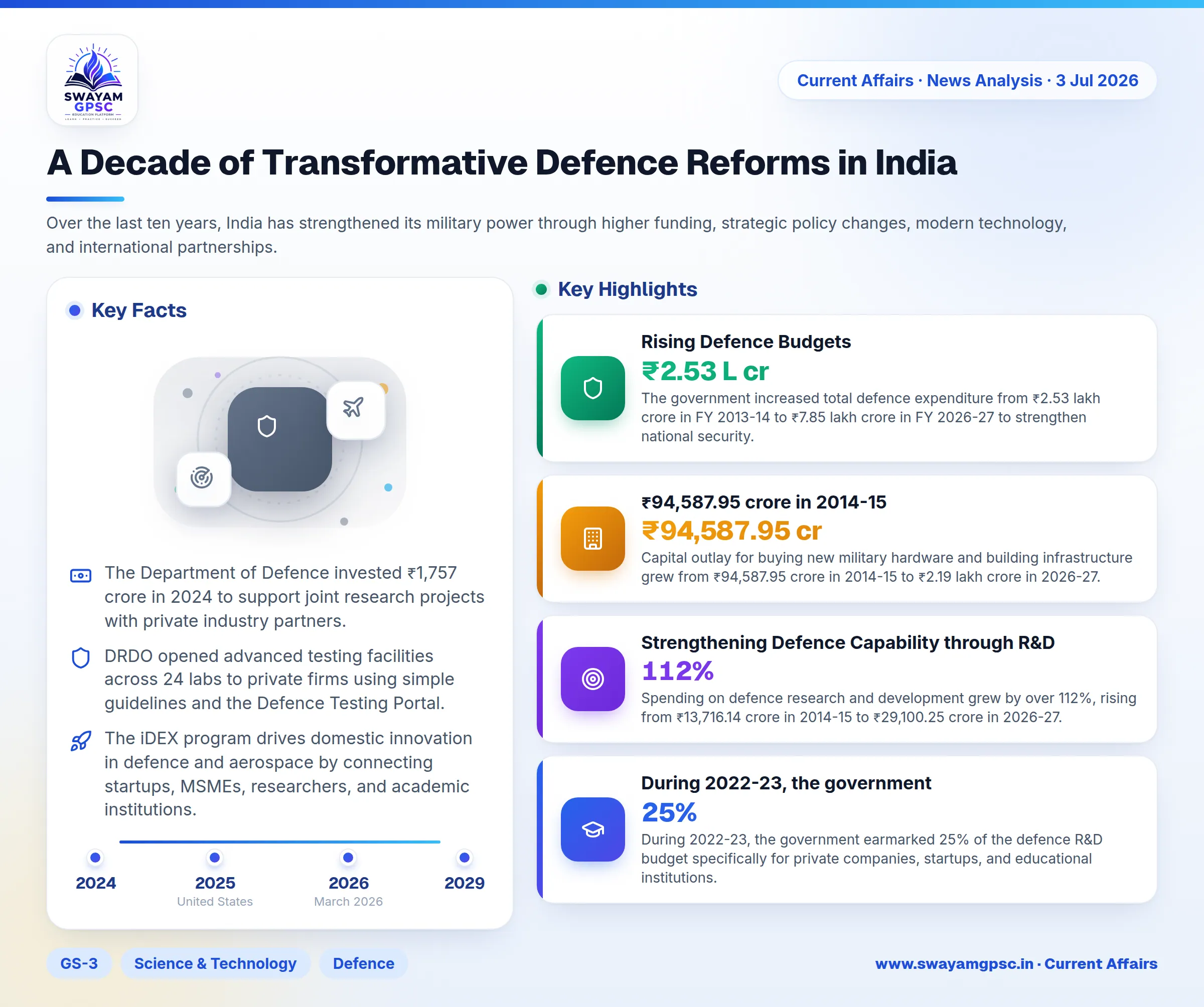
A Decade of Transformative Defence Reforms in India
#GS-3 #Science & Technology #Defence #Economy #Growth #Infrastructure #Current Events #National #Atmanirbhar Bharat #Defence Sector Reforms
Why in News
- Over the last ten years, India has strengthened its military power through higher funding, strategic policy changes, modern technology, and international partnerships.
- The nation is shifting away from relying heavily on foreign weapons to creating a self-sufficient domestic defence manufacturing system under Atmanirbhar Bharat and Viksit Bharat 2047.
Rising Defence Budgets
- The government increased total defence expenditure from ₹2.53 lakh crore in FY 2013-14 to ₹7.85 lakh crore in FY 2026-27 to strengthen national security.
- Capital outlay for buying new military hardware and building infrastructure grew from ₹94,587.95 crore in 2014-15 to ₹2.19 lakh crore in 2026-27.
Strengthening Defence Capability through R&D
- Spending on defence research and development grew by over 112%, rising from ₹13,716.14 crore in 2014-15 to ₹29,100.25 crore in 2026-27.
- During 2022-23, the government earmarked 25% of the defence R&D budget specifically for private companies, startups, and educational institutions.
- The Department of Defence invested ₹1,757 crore in 2024 to support joint research projects with private industry partners.
- DRDO opened advanced testing facilities across 24 labs to private firms using simple guidelines and the Defence Testing Portal.
Innovations for Defence Excellence
- The iDEX program drives domestic innovation in defence and aerospace by connecting startups, MSMEs, researchers, and academic institutions.
- Through the Defence Innovation Organisation (DIO), funding was approved for iDEX at ₹498.78 crore for 2021-22 to 2025-26 and ADITI scheme at ₹750 crore for 2023-24 to 2025-26.
- By March 2026, iDEX had partnered with 676 startups and innovators, signing 551 contracts for new technology designs.
Development cum Production Partner Model
- DRDO created the DcPP model to partner with local manufacturers during both the design and production stages of defence technology.
- A network of more than 2,200 companies now supplies essential military components and equipment across India.
- By March 2026, 134 companies joined as production partners, signing 2,180 technology transfer agreements and opening over 2,780 patents for industry adoption.
Technology Development Fund
- Executed by DRDO, the Technology Development Fund (TDF) helps startups and MSMEs build original military technology inside the country.
- The fund offers grants up to ₹50 crore per project, supported by an extra corpus of ₹500 crore focused on high-tech advanced solutions.
- By June 2026, 80 projects valued at ₹334 crore were under execution, including two technology payloads successfully launched aboard PSLV rockets.
DRDO Industry Academia Centres of Excellence
- DRDO launched 15 DIA-CoE research centres across top universities to combine academic knowledge with industrial manufacturing.
- These research hubs target 82 specialized research areas to build next-generation equipment for defence forces.
- Industry Interaction Groups (IIGs) were formed inside laboratories to speed up technology transfers to private manufacturers.
Defence Acquisition Reforms for Self-Reliance
- The Defence Acquisition Council (DAC) reformed buying procedures to favor items made inside India under DAP 2020.
- Rules now mandate high levels of local content whenever military services order new hardware.
- The DAC approved Acceptance of Necessity (AoN) for domestic defence systems worth over ₹6 lakh crore.
- Major deals include 97 Tejas Mk-1A jets for ₹62,000 crore, 156 LCH Prachand helicopters for ₹62,700 crore, and 26 Rafale Marine aircraft.
Building Human Capability for Technological Self-Reliance
- DRDO set up five Young Scientists Laboratories (DYSLs) in 2020 and planned a sixth laboratory for 2026 to empower young researchers.
- The structure of DRDO was consolidated into 36 focused laboratories to maximize work efficiency and technical specialization.
- High-budget projects now assign technical experts on a flexible, project-specific basis to access special skills.
- A dedicated training centre at Pilkhuwa, Uttar Pradesh delivers specialized courses in fire safety and firefighting technology.
Agnipath Scheme
- Launched on 15th June 2022, the Agnipath Scheme recruits young people as Agniveers for a four-year term to keep forces young and tech-ready.
- Recruits get rigorous training, skill certificates, and educational options through IGNOU and NIOS to support their career after service.
Expansion of Defence Industrial Ecosystem
- India signed 193 defence contracts worth ₹2,09,050 crore in FY 2024-25 and deals worth ₹1.82 lakh crore in FY 2025-26.
- Total domestic defence production rose to ₹1,78,000 crore in 2025-26, registering a 15.6% annual growth rate and a 110% jump since FY 2020-21.
- Public sector units (DPSUs) accounted for 76% of output in 2025-26, while the private sector share grew to 24%.
- Driven by Make in India, annual defence exports expanded by over 5500%, growing from ₹686 crore in 2013-14 to ₹38,424 crore in 2025-26.
- Indian defence goods are sold to over 80 countries, supported by a network of 145 certified exporting companies.
- The government set a target to reach ₹50,000 crore in annual defence exports by 2029.
- The overall defence ecosystem now comprises 16 DPSUs, nearly 500 licensed companies, and about 17,000 MSMEs.
- In October 2021, the government replaced the Ordnance Factory Board (OFB) by reorganizing its 41 factories into seven new DPSUs.
- Industrial licences granted for defence production rose from 258 in 2015 to 834 by 2026.
- Defence Industrial Corridors in Uttar Pradesh and Tamil Nadu drew total investments of ₹42,057 crore and ₹32,699 crore respectively.
Key Defence Sector Reforms under Atmanirbhar Bharat
- Industrial licence validity was extended in 2015 from 7 years to 15 years, and under the updated Arms Act, licences now remain valid for a company's lifetime.
- The modernized Defence Exim Portal provides fast online approvals, real-time tracking, and verified registrations for exporters.
- The Ministry created the Srijan Defence Portal in 2020 alongside Positive Indigenisation Lists in 2021 to ban foreign imports of selected military items.
- The Srijan DEEP digital directory lists over 41,000 vendors and 2.7 lakh products to build strong domestic supply chains.
- Direct foreign investment limits were raised in 2020 to 74% through the automatic route and up to 100% with government approval.
- Total FDI inflow reached ₹6,670.59 crore by March 2026, facilitating joint manufacturing partnerships with global defence firms.
Major Strategic and Global Defence Achievements
- With the United States, India signed landmark pacts including LEMOA (2016), COMCASA (2018), and BECA (2020), supported by recent initiatives like iCET (2023) and TRUST (2025).
- Defense cooperation with Russia remains strong through S-400 delivery, Su-30MKI upgrades, joint Exercise INDRA, and localized repair services.
- India signed a new Security and Defence Partnership (2026) with the European Union to collaborate on cyber security, space, and naval safety.
- Partnership with France deepened through 26 Rafale-M aircraft approvals, Scorpene submarines, and production deals under the Horizon 2047 framework.
- Military ties with Japan expanded via the ACSA (2020) logistics agreement and joint naval drills like JIMEX 2025.
- Ties with the UAE developed into a formal alliance following the Strategic Defence Partnership agreement (2026).
- Cooperation with Australia under the Comprehensive Strategic Partnership (2020) enhanced maritime monitoring and joint drills.
- At the SCO forum, India focused on anti-terrorism measures and stopping terror finance while maintaining strategic autonomy.
- Engagement with ASEAN via ADMM-Plus (2025) and missile sales like BrahMos strengthened ties with Vietnam, the Philippines, and Indonesia.
- Within the QUAD, India active participation in Malabar exercises and the Quad-at-Sea Mission (2025) reinforced Indo-Pacific security.
- Under maritime visions SAGAR (2015) and MAHASAGAR (2025), India serves as a key security provider across the Indian Ocean Region.
Conclusion
- Over the past decade, India's defence domain moved away from heavy reliance on imports toward complete strategic self-reliance.
- Strong budget allocations, technological innovation, and expanding global partnerships have created a resilient domestic defence ecosystem.
- This structural progress brings India closer to its target of becoming a modern, self-reliant military power under Viksit Bharat 2047.