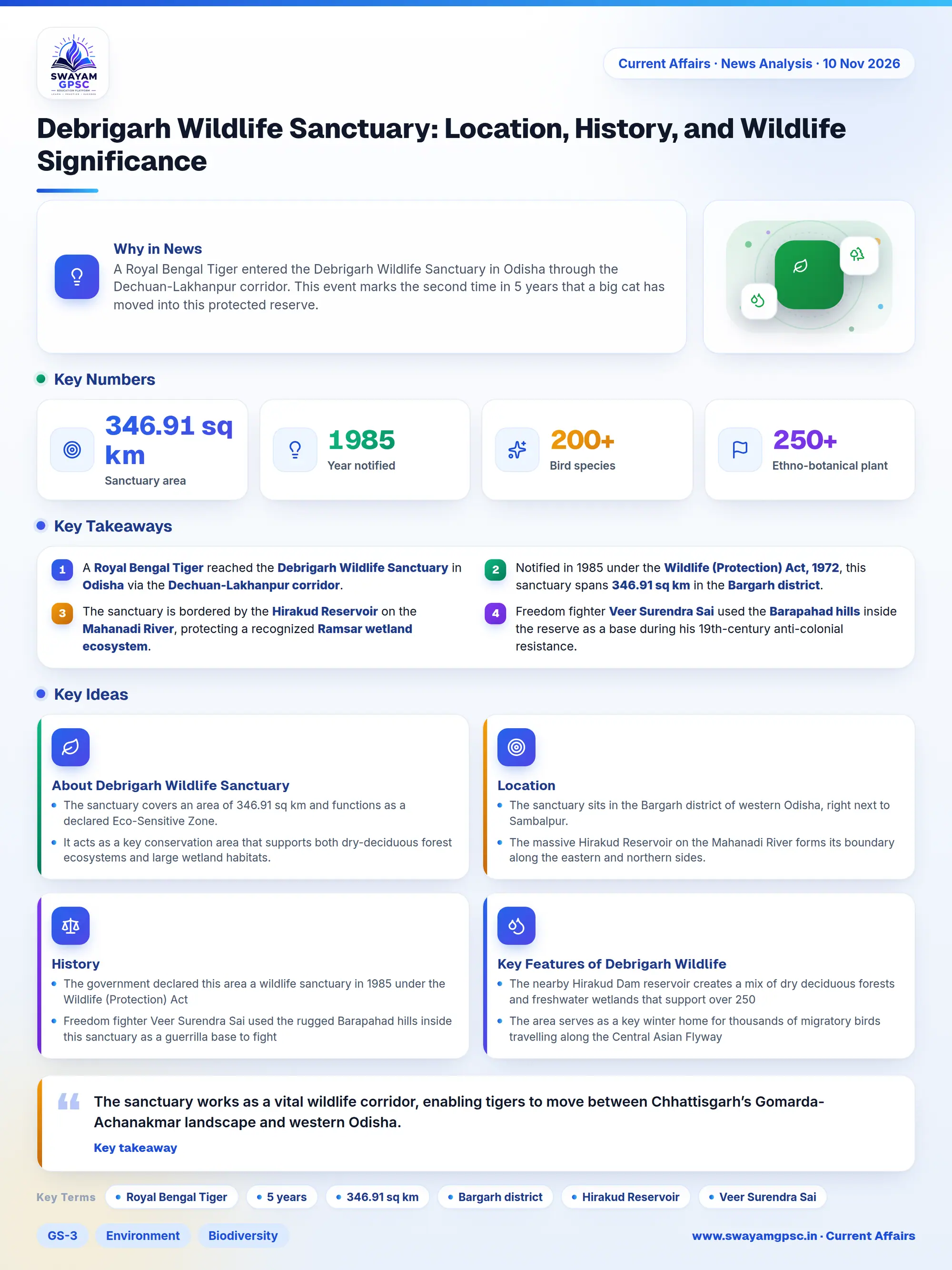
Debrigarh Wildlife Sanctuary: Location, History, and Wildlife Significance
#GS-3 #Environment #Biodiversity #Wildlife #Debrigarh Wildlife Sanctuary #Ramsar Sites
Key takeaways
- A Royal Bengal Tiger reached the Debrigarh Wildlife Sanctuary in Odisha via the Dechuan-Lakhanpur corridor.
- Notified in 1985 under the Wildlife (Protection) Act, 1972, this sanctuary spans 346.91 sq km in the Bargarh district.
- The sanctuary is bordered by the Hirakud Reservoir on the Mahanadi River, protecting a recognized Ramsar wetland ecosystem.
- Freedom fighter Veer Surendra Sai used the Barapahad hills inside the reserve as a base during his 19th-century anti-colonial resistance.
- The sanctuary houses over 200 bird species along the Central Asian Flyway and supports 40+ mammal and 40+ reptile species.
Why in News
- A Royal Bengal Tiger entered the Debrigarh Wildlife Sanctuary in Odisha through the Dechuan-Lakhanpur corridor.
- This event marks the second time in 5 years that a big cat has moved into this protected reserve.
About Debrigarh Wildlife Sanctuary
- The sanctuary covers an area of 346.91 sq km and functions as a declared Eco-Sensitive Zone.
- It acts as a key conservation area that supports both dry-deciduous forest ecosystems and large wetland habitats.
Location
- The sanctuary sits in the Bargarh district of western Odisha, right next to Sambalpur.
- The massive Hirakud Reservoir on the Mahanadi River forms its boundary along the eastern and northern sides.
History
- The government declared this area a wildlife sanctuary in 1985 under the Wildlife (Protection) Act, 1972 to protect central Indian wildlife.
- Freedom fighter Veer Surendra Sai used the rugged Barapahad hills inside this sanctuary as a guerrilla base to fight British forces during the 19th century.
Key Features of Debrigarh Wildlife Sanctuary
- The nearby Hirakud Dam reservoir creates a mix of dry deciduous forests and freshwater wetlands that support over 250 plant species with traditional medicinal uses.
- The area serves as a key winter home for thousands of migratory birds travelling along the Central Asian Flyway, hosting more than 200 bird species.
- The sanctuary supports rich wildlife across 40+ mammal species and 40+ reptile species, including leopards, Indian gaurs, sambar, spotted deer, wild dogs, and chowsingha.
- It maintains one of the highest herbivore prey densities in western Odisha, made possible by relocating forest villages to remove human pressure and animal conflicts.
Significance
- The sanctuary works as a vital wildlife corridor, enabling tigers to move between Chhattisgarh’s Gomarda-Achanakmar landscape and western Odisha.
- It helps protect the Hirakud Reservoir Ramsar wetland ecosystem by controlling soil erosion, preventing factory expansion, and safeguarding local fish populations.