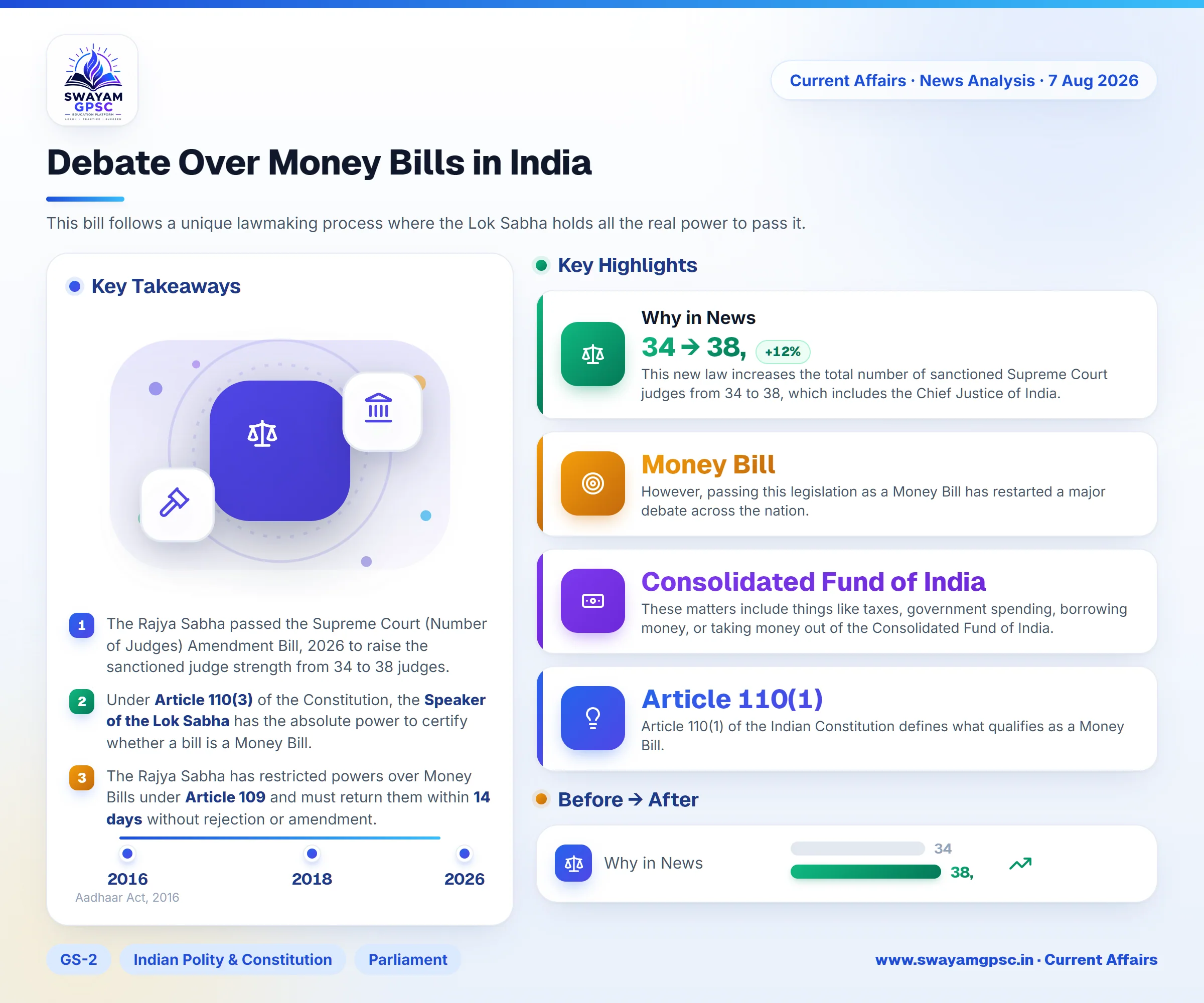
Debate Over Money Bills in India
#GS-2 #Indian Polity & Constitution #Parliament #Constitution #Current Events #National #Money Bill
Key takeaways
- The Rajya Sabha passed the Supreme Court (Number of Judges) Amendment Bill, 2026 to raise the sanctioned judge strength from 34 to 38 judges.
- Under Article 110(3) of the Constitution, the Speaker of the Lok Sabha has the absolute power to certify whether a bill is a Money Bill.
- The Rajya Sabha has restricted powers over Money Bills under Article 109 and must return them within 14 days without rejection or amendment.
- A 7-judge Constitution Bench of the Supreme Court is currently reviewing the legal validity of passing major laws like the Aadhaar Act, 2016 as Money Bills.
Why in News
- The Rajya Sabha recently cleared the Supreme Court (Number of Judges) Amendment Bill, 2026 to increase the court's capacity.
- This new law increases the total number of sanctioned Supreme Court judges from 34 to 38, which includes the Chief Justice of India.
- However, passing this legislation as a Money Bill has restarted a major debate across the nation.
- Many experts criticize the government for using this method to avoid detailed discussions and voting in the Rajya Sabha.
What is a Money Bill?
- A Money Bill is a special type of law in India that deals only with government financial matters.
- These matters include things like taxes, government spending, borrowing money, or taking money out of the Consolidated Fund of India.
- This bill follows a unique lawmaking process where the Lok Sabha holds all the real power to pass it.
- On the other hand, the Rajya Sabha plays a very limited role and can only give suggestions.
Constitutional Provisions
- Article 110(1) of the Indian Constitution defines what qualifies as a Money Bill.
- A bill gets this status only if it contains rules about taxes, government borrowing, or managing the Consolidated Fund of India and the Contingency Fund of India.
- Under Article 110(3), the Speaker of the Lok Sabha has the final power to decide if a bill is a Money Bill.
- No one can challenge this decision once the Speaker certifies it, making the decision absolute.
- Article 109 sets the special rules for passing these bills in the Parliament.
- This article says that a Money Bill cannot start in the Rajya Sabha, and the Upper House must send it back within 14 days.
Key Features of a Money Bill
- A Money Bill can only be introduced in the Lok Sabha on the prior approval of the President of India.
- When the bill goes to the Rajya Sabha or the President, it must carry a physical certificate signed by the Speaker of the Lok Sabha.
- The Rajya Sabha cannot reject or change a Money Bill, and it must return the bill within 14 days.
- If the Rajya Sabha fails to return the bill within this time, the bill is considered passed by both houses.
- The Lok Sabha has the complete freedom to accept or reject any recommendation made by the Rajya Sabha.
- There is no option for a joint sitting of both Houses under Article 108 if they disagree on a Money Bill.
Challenges
- Opposition parties accuse the ruling government of using the Money Bill route as a trick to bypass parliamentary scrutiny.
- They believe governments use the incidental matters clause under Article 110(1)(g) to bypass the Rajya Sabha on major non-financial laws.
- Critics point out that a bill must deal exclusively with financial matters to be certified as a Money Bill.
- Adding small financial details, like salaries of judges, to a large regulatory law stretches the constitutional definition too far.
- Several controversial laws passed as Money Bills are currently facing legal challenges in the Supreme Court.
- These include the Aadhaar Act, 2016, changes to the Prevention of Money Laundering Act (PMLA), and the Tribunals Reforms Framework.
- In the 2018 Aadhaar case, Justice D.Y. Chandrachud wrote in his dissent that passing non-financial structural laws as Money Bills is a fraud on the Constitution.
- Currently, a 7-judge Constitution Bench of the Supreme Court is reviewing this matter to set clear rules.