Death Penalty: Supreme Court's Evolving Jurisprudence
#GS-2 #Judiciary #Government Policies & Interventions #Issues Arising Out of Design & Implementation of Policies #Indian Polity & Constitution #Governance & Social Justice #Current Events #National
Key takeaways
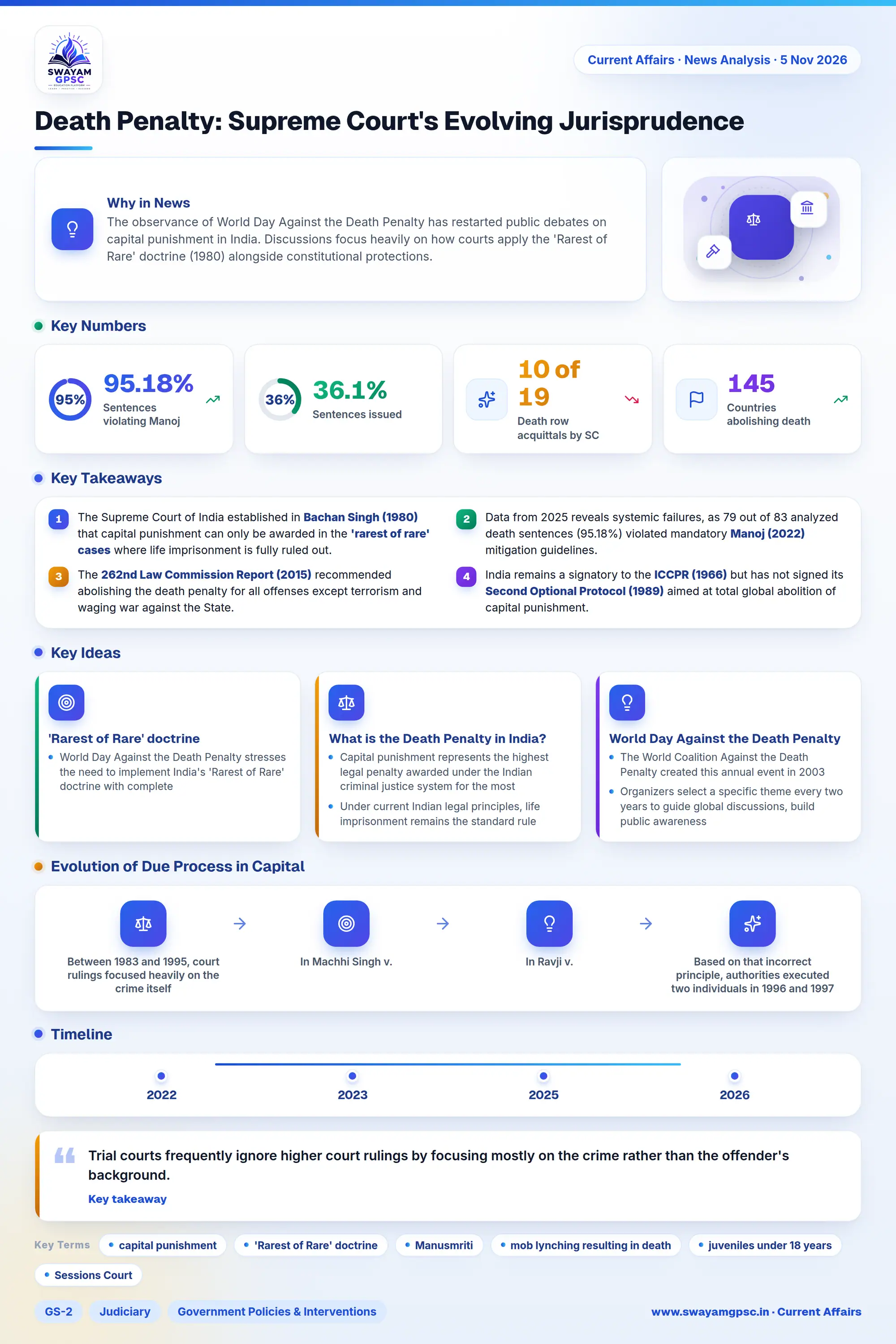
- The Supreme Court of India established in Bachan Singh (1980) that capital punishment can only be awarded in the 'rarest of rare' cases where life imprisonment is fully ruled out.
- Data from 2025 reveals systemic failures, as 79 out of 83 analyzed death sentences (95.18%) violated mandatory Manoj (2022) mitigation guidelines.
- The 262nd Law Commission Report (2015) recommended abolishing the death penalty for all offenses except terrorism and waging war against the State.
- India remains a signatory to the ICCPR (1966) but has not signed its Second Optional Protocol (1989) aimed at total global abolition of capital punishment.
Why in News
- The observance of World Day Against the Death Penalty has restarted public debates on capital punishment in India.
- Discussions focus heavily on how courts apply the 'Rarest of Rare' doctrine (1980) alongside constitutional protections.
- The Supreme Court recently stressed that courts must strictly follow fair procedures and due process while deciding capital sentences.
Summary
- World Day Against the Death Penalty stresses the need to implement India's 'Rarest of Rare' doctrine with complete fairness and procedural safeguards.
- Despite Supreme Court guidelines, issues like rushed sentencing, weak investigations, and ignoring a convict's chance of reform risk executing innocent people.
What is the Death Penalty in India?
- Capital punishment represents the highest legal penalty awarded under the Indian criminal justice system for the most severe crimes.
- Under current Indian legal principles, life imprisonment remains the standard rule, while the death sentence acts as an exceptional measure.
- The punishment stems from retributive justice concepts, appearing historically in the Manusmriti and later structured under the Indian Penal Code (1860).
- Section 354(3) of the former Code of Criminal Procedure (CrPC), 1973, now reflected in Section 393(3) of the Bharatiya Nagarik Suraksha Sanhita (BNSS), 2023, requires judges to write down special reasons whenever they award a capital sentence.
- The Bharatiya Nyaya Sanhita (BNS), 2023 keeps capital punishment in place and adds new offenses like mob lynching resulting in death and minor rape, covering around 14 grave offenses overall.
- In the landmark Bachan Singh v. State of Punjab (1980) case, a Supreme Court Constitution Bench confirmed the death penalty's legal validity while placing strict limits on judicial discretion.
- This judgment established the 'rarest of rare' doctrine, ruling that judges can only impose death when life imprisonment is completely ruled out as an option.
- The framework requires judges to balance aggravating factors like crime brutality against mitigating factors such as the criminal's social, mental, and economic history.
- Indian laws provide clear humanitarian exclusions that prohibit executing juveniles under 18 years, pregnant women, and persons with mental illness.
- A death sentence given by a Sessions Court cannot be executed right away, because the High Court must first confirm it, after which the convict can appeal to the Supreme Court.
- Convicts facing execution can file a Mercy Petition to request a pardon, reprieve, or sentence reduction from the President of India under Article 72 or a Governor under Article 161.
- If a review petition gets rejected, convicts can still file a Curative Petition, which was established in Rupa Ashok Hurra v. Ashok Hurra (2002) as a final judicial check against severe injustice.
Evolution of Due Process in Capital Sentencing
- Between 1983 and 1995, court rulings focused heavily on the crime itself, which weakened the protective guidelines set earlier in the Bachan Singh case.
- In Machhi Singh v. State of Punjab (1983), the court shifted attention away from the individual offender and focused primarily on how the crime occurred.
- In Ravji v. State of Rajasthan (1995), a two-judge bench incorrectly decided that sentence severity depended only on the crime rather than the criminal's situation.
- Based on that incorrect principle, authorities executed two individuals in 1996 and 1997, which 14 retired judges later called the gravest miscarriage of justice in independent India.
- The Supreme Court acknowledged this historical mistake during the Santosh Kumar Bariyar v. State of Maharashtra (2009) case.
- The bench declared the Ravji judgment per incuriam, meaning judges decided it without considering existing binding laws, because it overlooked the Bachan Singh rules.
- The Court clarified that life imprisonment is ruled out only when the State proves beyond doubt that the criminal cannot be reformed.
- To fix trial court errors where judges sentenced people without checking background details, the Supreme Court created formal rules for gathering mitigating evidence.
- The ruling in Manoj v. State of Madhya Pradesh (2022) made it mandatory to collect psychological, psychiatric, prison conduct, and socio-economic reports before giving a death sentence.
- Between 2025 and 2026, the Supreme Court elevated sentencing procedures from simple statutory guidance into enforceable fundamental rights.
- In Vasanta Sampat Dupare v. Union of India (2025), the court declared that detailed background hearings under the Manoj guidelines directly flow from Article 14 and Article 21 of the Constitution.
- Death sentences passed without these detailed hearings violate the Constitution and can be reopened even after normal legal appeals end.
- In Waris v. State of Madhya Pradesh (2026), the court upheld a conviction for child rape and murder but commuted the death sentence because the State failed to prove the convict could not reform.
- The judgment reinforced that extreme crime brutality alone does not automatically justify ruling out life imprisonment.
World Day Against the Death Penalty
- The World Coalition Against the Death Penalty created this annual event in 2003, observing it on 10th October to join civil society and legal experts against capital punishment.
- Organizers select a specific theme every two years to guide global discussions, build public awareness, and provide useful tools for legal advocacy.
- The chosen theme for 2026 is 'Stories for Life', which focuses attention on personal experiences of affected individuals and families rather than abstract numbers.
- Human rights groups argue that capital punishment damages core human dignity and carries an unfixable risk of executing innocent people due to judicial mistakes.
- By the end of 2025, about 145 countries had ended capital punishment in law or practice, though several nations still maintain the practice and execute convicts.
International Human Rights Framework
- Article 3 of the Universal Declaration of Human Rights (UDHR, 1948) protects the right to life and liberty, while Article 5 bans cruel or degrading punishments.
- Article 6 of the International Covenant on Civil and Political Rights (ICCPR, 1966) protects life rights and limits executions only to the most serious crimes in countries retaining the penalty, with India being a party to this agreement.
- The Second Optional Protocol to the ICCPR (1989) stands as the primary international treaty aimed at ending capital punishment worldwide, though India has not signed it.
Persistent Challenges in the Current Sentencing System
- Trial courts frequently ignore higher court rulings by focusing mostly on the crime rather than the offender's background.
- Out of 128 death sentences in 2025, an analysis of 83 cases showed that 79 cases (95.18%) failed to follow the Manoj sentencing safeguards.
- A 2026 Muzaffarnagar court review revealed that a single trial judge passed 23 death sentences across 9 cases by focusing on crime brutality while ignoring mitigating evidence.
- A national study covering 306 death sentences between 2018 and 2020 found that 36.1% of sentences were handed down on the exact day of conviction, leaving no time to collect mitigating facts.
- Appellate courts frequently overturn lower court decisions, with nearly one-third of death sentences reviewed by High Courts and the Supreme Court over ten years ending in full acquittals.
- In 2025, the Supreme Court acquitted accused individuals in 10 out of 19 death cases, pointing out poor police investigations, forced confessions, and weak forensic evidence.
- Capital punishment impacts poor communities unevenly, as most death row prisoners come from economically weak backgrounds and lack proper legal representation during trial.
Measures Needed to Reform India's Capital Punishment Framework
- The 262nd Law Commission Report (2015) recommended ending the death penalty for regular crimes while keeping it only for terrorism offenses and waging war against the nation.
- India should establish state-funded Mitigation Specialists to independently examine an accused person's background, living conditions, and mental health as required under the Manoj guidelines.
- To prevent 'Death Row Syndrome' caused by long delays in processing mercy petitions, India must legally adopt the Shatrughan Chauhan vs Union of India (2014) rules to set strict decision timelines for the President and Governors under Articles 72 and 161.
- The BNSS, 2023 should be updated to explicitly bar capital punishment for individuals with severe mental illnesses or intellectual disabilities, aligning with UN ECOSOC rules and the UN Convention on the Rights of Persons with Disabilities (CRPD).
- Courts should rely more on intermediate options like full life imprisonment without parole instead of execution, as demonstrated in Waris v. State of Madhya Pradesh (2026).
Way Forward
- Capital punishment validity relies on fair court procedures, genuine chances for reform, and strict protections under Article 21.
- India must build clear systems for collecting offender background details so judicial decisions rely on constitutional values rather than emotional public reactions.