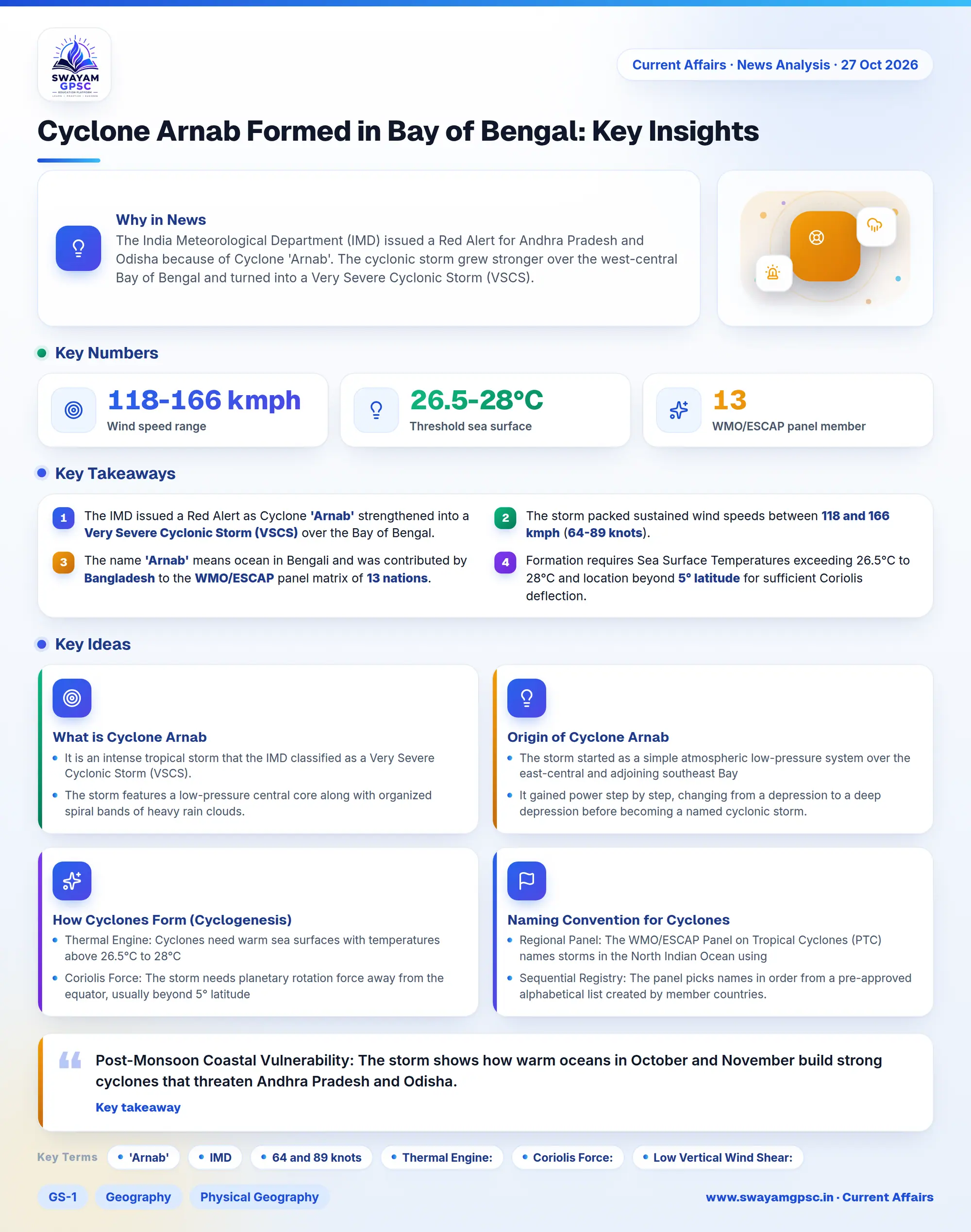
Cyclone Arnab Formed in Bay of Bengal: Key Insights
#GS-1 #Geography #Physical Geography #Disaster Geography #GS-3 #Environment #Disaster Management #Disaster Preparedness #Current Events #National #Cyclone Arnab
Key takeaways
- The IMD issued a Red Alert as Cyclone 'Arnab' strengthened into a Very Severe Cyclonic Storm (VSCS) over the Bay of Bengal.
- The storm packed sustained wind speeds between 118 and 166 kmph (64-89 knots).
- The name 'Arnab' means ocean in Bengali and was contributed by Bangladesh to the WMO/ESCAP panel matrix of 13 nations.
- Formation requires Sea Surface Temperatures exceeding 26.5°C to 28°C and location beyond 5° latitude for sufficient Coriolis deflection.
- Disaster relief groups like NDRF, APSDMA, and OSDMA are deployed to execute evacuations along the Andhra Pradesh and Odisha coasts.
Why in News
- The India Meteorological Department (IMD) issued a Red Alert for Andhra Pradesh and Odisha because of Cyclone 'Arnab'.
- The cyclonic storm grew stronger over the west-central Bay of Bengal and turned into a Very Severe Cyclonic Storm (VSCS).
What is Cyclone Arnab
- It is an intense tropical storm that the IMD classified as a Very Severe Cyclonic Storm (VSCS).
- The storm features a low-pressure central core along with organized spiral bands of heavy rain clouds.
- It carries sustained surface winds blowing at speeds between 64 and 89 knots or 118 to 166 kmph.
Origin of Cyclone Arnab
- The storm started as a simple atmospheric low-pressure system over the east-central and adjoining southeast Bay of Bengal.
- It gained power step by step, changing from a depression to a deep depression before becoming a named cyclonic storm.
- After forming, the storm moved in a west-northwest direction into the west-central Bay of Bengal.
How Cyclones Form (Cyclogenesis)
- Thermal Engine: Cyclones need warm sea surfaces with temperatures above 26.5°C to 28°C, which release heat as moist air rises.
- Coriolis Force: The storm needs planetary rotation force away from the equator, usually beyond 5° latitude, to spin counter-clockwise.
- Low Vertical Wind Shear: Weak changes in wind speed at higher altitudes allow the rising cloud column to stay together without breaking.
- Upper-Level Divergence: Strong outward airflow at the top of the storm pumps out rising air, which lowers pressure at the eye and pulls in strong surface winds.
Naming Convention for Cyclones
- Regional Panel: The WMO/ESCAP Panel on Tropical Cyclones (PTC) names storms in the North Indian Ocean using recommendations from 13 member nations.
- Sequential Registry: The panel picks names in order from a pre-approved alphabetical list created by member countries.
- The name 'Arnab' means ocean in Bengali, and Bangladesh contributed this name to the official list.
Significance of Cyclone Arnab
- Post-Monsoon Coastal Vulnerability: The storm shows how warm oceans in October and November build strong cyclones that threaten Andhra Pradesh and Odisha.
- Cascading Inland Disruptions: Moving inland can cause heavy unseasonal rains, flash floods, and serious crop losses across northern India.
- Zero-Casualty Disaster Governance: The crisis tests disaster management groups like APSDMA, OSDMA, and NDRF to evacuate people quickly and prevent loss of life.