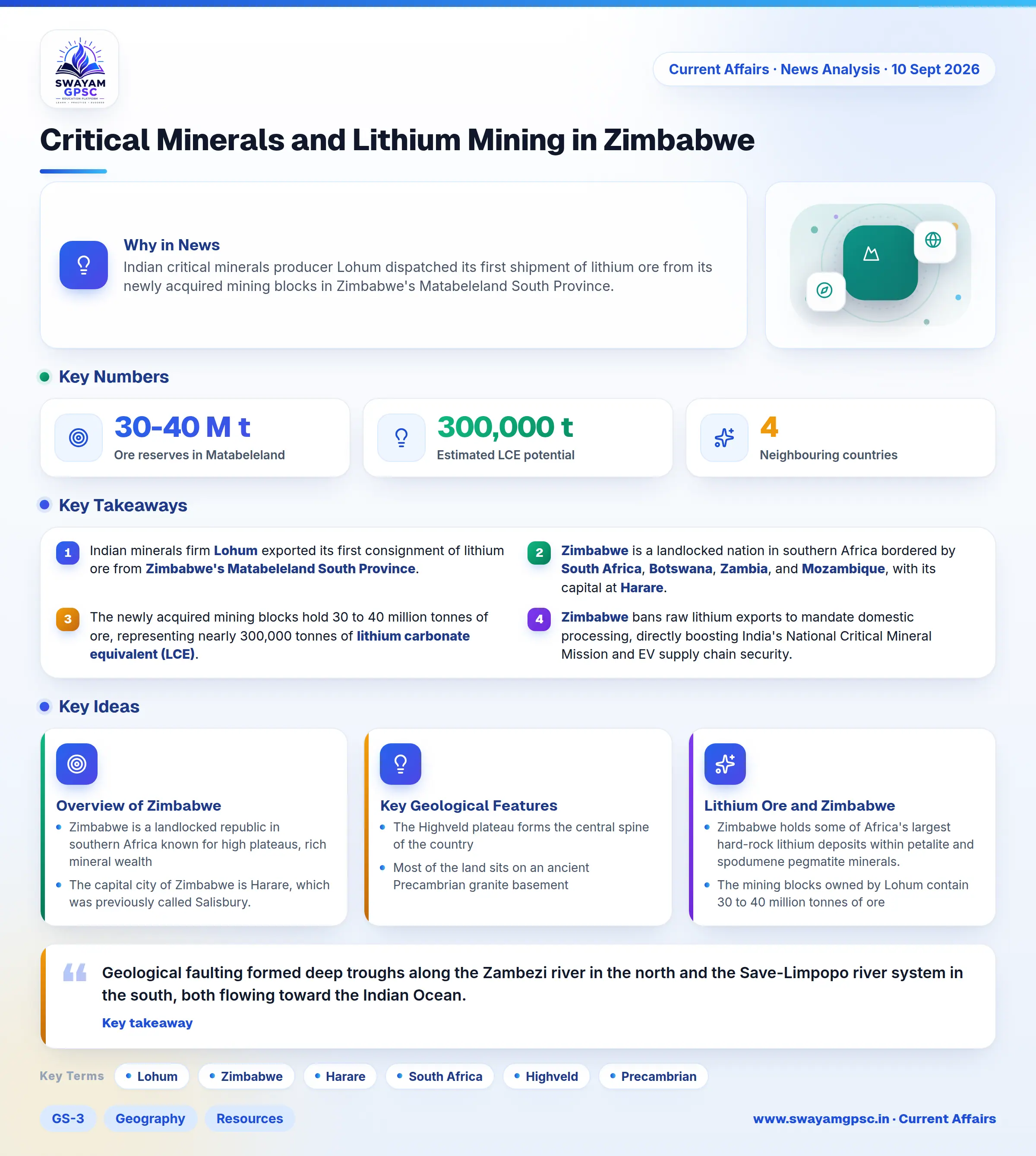
Critical Minerals and Lithium Mining in Zimbabwe
#GS-3 #Geography #Resources #Physical Geography #GS-2 #Current Events #International #Critical Minerals #Mapping
Key takeaways
- Indian minerals firm Lohum exported its first consignment of lithium ore from Zimbabwe's Matabeleland South Province.
- Zimbabwe is a landlocked nation in southern Africa bordered by South Africa, Botswana, Zambia, and Mozambique, with its capital at Harare.
- The newly acquired mining blocks hold 30 to 40 million tonnes of ore, representing nearly 300,000 tonnes of lithium carbonate equivalent (LCE).
- Zimbabwe bans raw lithium exports to mandate domestic processing, directly boosting India's National Critical Mineral Mission and EV supply chain security.
Why in News
- Indian critical minerals producer Lohum dispatched its first shipment of lithium ore from its newly acquired mining blocks in Zimbabwe's Matabeleland South Province.
Overview of Zimbabwe
- Zimbabwe is a landlocked republic in southern Africa known for high plateaus, rich mineral wealth, and gaining independence in April 1980.
- The capital city of Zimbabwe is Harare, which was previously called Salisbury.
- It shares land borders with four neighboring countries: South Africa, Botswana, Zambia, and Mozambique.
Key Geological Features
- The Highveld plateau forms the central spine of the country, sloping down into the Middleveld and lower Lowveld regions.
- Most of the land sits on an ancient Precambrian granite basement, where weathering creates rounded rocky hills called kopjes.
- A narrow rock formation called The Great Dyke runs across the country, holding large reserves of chromium, nickel, platinum group metals, and asbestos.
- Geological faulting formed deep troughs along the Zambezi river in the north and the Save-Limpopo river system in the south, both flowing toward the Indian Ocean.
Lithium Ore and Zimbabwe
- Zimbabwe holds some of Africa's largest hard-rock lithium deposits within petalite and spodumene pegmatite minerals.
- The mining blocks owned by Lohum contain 30 to 40 million tonnes of ore, equal to roughly 300,000 tonnes of lithium carbonate equivalent (LCE).
- The country bans raw lithium exports to promote local processing and build domestic industrial capacity.
- These mining assets help India secure critical mineral supply chains for electric vehicle batteries and the National Critical Mineral Mission.