Critical Minerals in India: Moving Beyond Extraction to Material Security
#GS-3 #Economy #Infrastructure #Environment #Sustainable Development #GS-1 #Geography #Resources #Mobilization of Resources #Distribution of Key Natural Resources #National Critical Mineral Mission #Critical Minerals #Material Security
Key takeaways
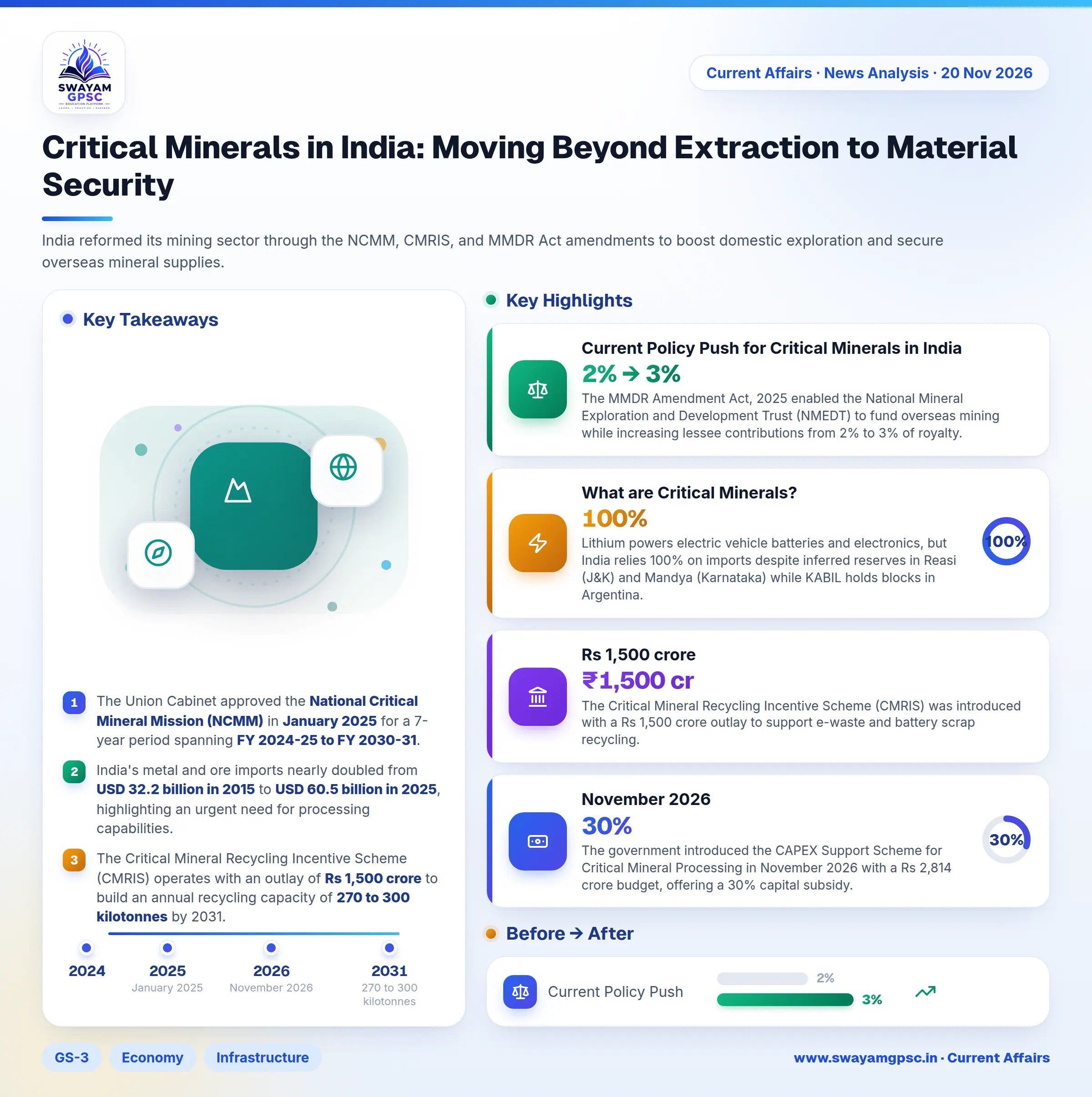
- The Union Cabinet approved the National Critical Mineral Mission (NCMM) in January 2025 for a 7-year period spanning FY 2024-25 to FY 2030-31.
- India's metal and ore imports nearly doubled from USD 32.2 billion in 2015 to USD 60.5 billion in 2025, highlighting an urgent need for processing capabilities.
- The Critical Mineral Recycling Incentive Scheme (CMRIS) operates with an outlay of Rs 1,500 crore to build an annual recycling capacity of 270 to 300 kilotonnes by 2031.
- The government introduced a 30% capital subsidy under the Rs 2,814 crore CAPEX Support Scheme in November 2026 to boost domestic lithium and nickel processing.
Why in News
- India expanded its mineral policy through the National Critical Mineral Mission (NCMM) and updated its mining laws.
- Auctioning mineral blocks alone cannot ensure industrial readiness.
- Experts recommend shifting focus from basic mineral extraction to processing, refining, and recycling.
Summary
- India reformed its mining sector through the NCMM, CMRIS, and MMDR Act amendments to boost domestic exploration and secure overseas mineral supplies.
- The country needs stronger processing, refining, recycling, urban mining, and strategic stockpiling to build self-reliant industrial supply chains.
What are Critical Minerals?
- Critical minerals are metallic or non-metallic elements essential for advanced modern technologies.
- Countries define these minerals based on their economic importance, lack of substitutes, and high supply risks.
- Supply disruptions of these minerals can harm a nation's economy, national security, and key industries.
- Securing processed inputs is vital for India's Net Zero 2070 climate goal, clean energy transition, and Make in India initiative.
- Lithium powers electric vehicle batteries and electronics, but India relies 100% on imports despite inferred reserves in Reasi (J&K) and Mandya (Karnataka) while KABIL holds blocks in Argentina.
- Cobalt is crucial for aerospace superalloys and battery cathodes, yet India imports nearly 100% of its supply, holding only small deposits in Sukinda Valley (Odisha).
- Nickel is essential for stainless steel and batteries, but domestic demand relies on imports alongside minor lateritic resources in Odisha and Nagaland.
- Rare Earth Elements are vital for defense radars and wind turbines, where India holds monazite sands in Kerala, Tamil Nadu, Odisha, and Andhra Pradesh but lacks value-added processing.
- Graphite is key for battery anodes and steel electrodes, with India producing moderate raw amounts in Arunachal Pradesh, Jharkhand, Odisha, and J&K while importing battery-grade spherical graphite.
Current Policy Push for Critical Minerals in India
- The Cabinet approved the National Critical Mineral Mission (NCMM) in January 2025 for a 7-year period from FY 2024-25 to FY 2030-31.
- NCMM targets 1,200 domestic exploration projects, mineral processing parks, 9 Centres of Excellence, and fast-track clearances on the PARIVESH portal.
- The Critical Mineral Recycling Incentive Scheme (CMRIS) was introduced with a Rs 1,500 crore outlay to support e-waste and battery scrap recycling.
- CMRIS targets an annual recycling capacity of 270 to 300 kilotonnes to yield 40 kilotonnes of critical minerals, recovering 400 kilotonnes from industrial waste by 2031.
- One-third of the CMRIS budget is reserved for startups, excluding basic black mass producers from receiving financial incentives.
- The government introduced the CAPEX Support Scheme for Critical Mineral Processing in November 2026 with a Rs 2,814 crore budget, offering a 30% capital subsidy.
- The Directorate General of Foreign Trade (DGFT) banned exports of lithium-ion battery black mass in 2026 to keep raw materials inside the country.
- The MMDR Amendment Act, 2023 listed 24 critical and strategic minerals under Part D of the First Schedule, allowing the Central Government to directly auction blocks.
- The MMDR Amendment Act, 2025 enabled the National Mineral Exploration and Development Trust (NMEDT) to fund overseas mining while increasing lessee contributions from 2% to 3% of royalty.
- The MMDR Amendment Act, 2026 added Section 9D to restrict state governments from imposing additional taxes or cesses on mineral rights.
- Union Budgets from FY 2024-25 through FY 2026-27 exempted critical minerals and processing equipment from basic customs duty.
- The Union Budget 2026-27 announced Dedicated Rare Earth Corridors across Odisha, Kerala, Andhra Pradesh, and Tamil Nadu.
- The government approved the Rare Earth Permanent Magnet (REPM) Manufacturing Scheme in November 2025 to produce 6,000 tonnes of magnets annually.
- Khanij Bidesh India Limited (KABIL) acquires overseas mineral assets, supported by India's entry into the Minerals Security Partnership (MSP) and the Quad Critical Minerals Initiative.
Challenges to India's Critical Minerals Sector
- Current policy focuses heavily on upstream mineral exploration rather than midstream and downstream refining and component manufacturing.
- Owning raw mineral mines does not guarantee usable industrial inputs without domestic refining capacity.
- India remains vulnerable to global shocks because refining control creates supply chain dominance.
- NITI Aayog's Trade Watch report (2026) revealed that metals and ores imports grew from USD 32.2 billion in 2015 to USD 60.5 billion in 2025.
- UNCTAD reported in 2026 that DR Congo produces 74% of global cobalt, while Indonesia supplies 67% of mined nickel.
- OECD data showed that nearly 70% of global cobalt and manganese exports faced trade restrictions between 2022 and 2024.
- Operationalizing new mines takes years due to delays in environmental approvals, land acquisition, and infrastructure development.
- India generated 3.8 million metric tonnes of e-waste in 2024, but recycling remains unorganized and informal.
- Recyclers struggle to secure traceable waste streams, while manufacturers hesitate to use recovered minerals due to quality concerns.
- Changing battery technologies make it difficult to determine which minerals to stockpile in national reserves.
- India attracted only USD 3.5 billion in FDI for mining between 2000 and 2025, representing less than 0.5% of total foreign direct investment.
- A 2026 UN University assessment noted that 16% of global critical mineral extraction takes place in high water-stress regions.
- Executing capital-intensive refining technologies remains more complex than reaching basic exploration targets.
Way Forward
- Develop domestic mineral processing parks alongside every mineral auction round.
- Measure policy success by the tonnage of refined materials delivered to domestic factories rather than the number of blocks auctioned.
- Formalize urban mining networks using Extended Producer Responsibility (EPR) and the CMRIS framework.
- Establish clear quality standards for secondary minerals recovered from e-waste and industrial slag.
- Use the 2026 black mass export ban to build an integrated domestic recycling ecosystem.
- Create dynamic, rotating strategic reserves of usable processed metals managed by industry partners.
- Offer tax incentives and institutional funding through NIIF and EXIM Bank to attract private investment into refining R&D.
- Implement the National Mineral Policy, 2019 alongside the Pradhan Mantri Khanij Kshetra Kalyan Yojana (PMKKKY) to support mining-affected communities.