COP31 Antalya Accords Draft and Key Climate Negotiations
#GS-3 #Environment #Climate Change #Sustainable Development #Current Events #International
Key takeaways
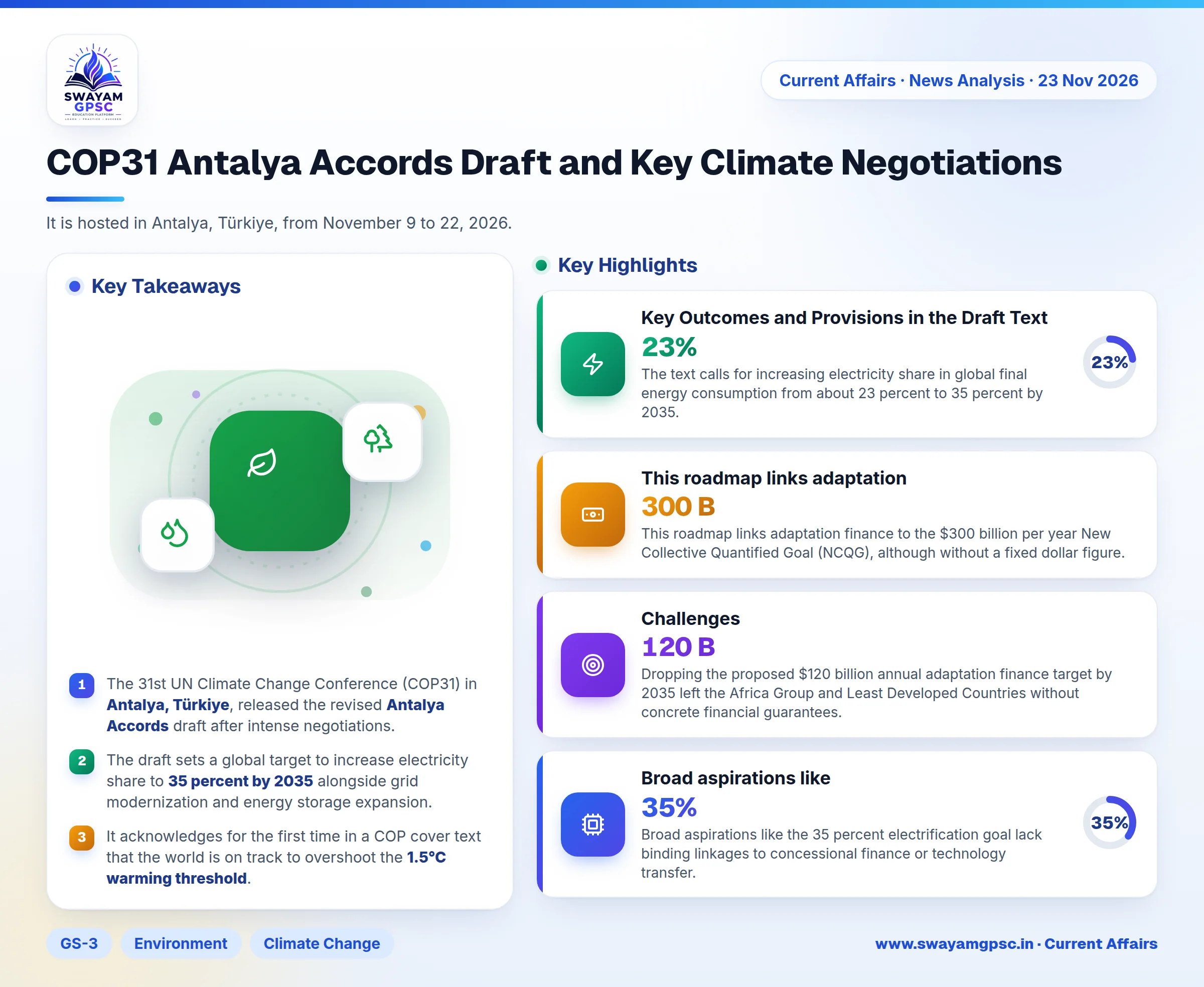
- The 31st UN Climate Change Conference (COP31) in Antalya, Türkiye, released the revised Antalya Accords draft after intense negotiations.
- The draft sets a global target to increase electricity share to 35 percent by 2035 alongside grid modernization and energy storage expansion.
- It acknowledges for the first time in a COP cover text that the world is on track to overshoot the 1.5°C warming threshold.
- The text proposes the Antalya-to-Addis Ababa Adaptation Finance Roadmap linked to the $300 billion per year New Collective Quantified Goal (NCQG).
Why in News
- The 31st UN Climate Change Conference (COP31) in Antalya, Türkiye, entered a second day of intense overtime negotiations.
- Negotiations continued after the Presidency circulated a revised 10-page draft cover decision known as the Antalya Accords.
About the Antalya Accords Draft
- The event marks the 31st session of the Conference of the Parties to the United Nations Framework Convention on Climate Change (UNFCCC).
- It is hosted in Antalya, Türkiye, from November 9 to 22, 2026.
- The conference operates under a unique co-presidency arrangement.
- Turkish Environment Minister Murat Kurum serves as the COP31 President.
- Australian Climate Change Minister Chris Bowen serves as the President of Negotiations.
Key Outcomes and Provisions in the Draft Text
- The text calls for increasing electricity share in global final energy consumption from about 23 percent to 35 percent by 2035.
- This electrification target is paired with grid modernization, energy storage, and clean energy expansion.
- It advances a collective aspiration to accelerate Carbon Capture, Utilisation and Storage deployment to gigatonne scale by 2035, specifically for hard-to-abate industrial sectors.
- It acknowledges for the first time in a COP cover text that the world is on track to overshoot the 1.5°C warming threshold of the Paris Agreement.
- It calls for action to limit the scale and duration of this overshoot and proposes a high-level scientific panel.
- It proposes the Antalya-to-Addis Ababa Adaptation Finance Roadmap to scale up adaptation finance.
- This roadmap links adaptation finance to the $300 billion per year New Collective Quantified Goal (NCQG), although without a fixed dollar figure.
- It introduces a standalone provision recognizing equitable Just Transition pathways.
- It establishes a formal two-year work programme on mountains and climate change to protect glacier-dependent communities.
- It explicitly recalls developed countries legal finance obligations under Article 9.1 of the Paris Agreement.
- It calls for stronger coordination and predictable resources for the Fund for Responding to Loss and Damage.
- It retains language urging international cooperation to ensure unilateral measures like the Carbon Border Adjustment Mechanism (CBAM) do not discriminate against developing countries.
Positive Outcomes
- It brings critical structural enablers like transmission networks, energy storage, and system flexibility to the forefront of global energy transition planning.
- It breaks diplomatic taboo by formally recognizing the reality of 1.5°C overshoot and establishes a dedicated scientific panel to track warming trajectories.
- It institutionalizes global attention on fragile mountain ecosystems and downstream water security through a dedicated two-year UNFCCC work programme.
- It preserves Article 9.1 obligations on developed nation finance and creates a multilateral avenue to scrutinize unilateral green trade barriers.
Challenges
- Stripping out direct commitments to transition away from coal, oil, and gas triggered fierce opposition from the EU, Panama, and Pacific Island nations.
- Critics warned that the text retreats from the COP28 Dubai consensus.
- Elevating gigatonne-scale CCUS without parallel fossil fuel reduction commitments drew criticism from scientists as political cover for continued oil and gas expansion.
- Dropping the proposed $120 billion annual adaptation finance target by 2035 left the Africa Group and Least Developed Countries without concrete financial guarantees.
- Broad aspirations like the 35 percent electrification goal lack binding linkages to concessional finance or technology transfer.
- Prolonged overtime sessions, walkout threats, and friction between developed blocs and developing coalitions strained trust in the UNFCCC consensus process.
Way Forward
- Define clear baselines, grant-based public finance shares, and simplified access rules ahead of COP32 in Addis Ababa.
- Establish strict verification standards ensuring carbon capture is restricted to genuinely hard-to-abate sectors rather than delaying renewable energy substitution.
- Channel blended finance and multilateral development bank reforms toward grid modernization and battery storage in emerging economies.
- Utilize the UNFCCC dialogue to harmonize carbon accounting standards and prevent unilateral mechanisms like CBAM from penalizing developing economies.
- Reform UNFCCC agenda-setting and drafting protocols to prevent late-night procedural deadlocks and preserve multilateral credibility.
Conclusion
- The conference in Antalya breaks new ground by acknowledging the 1.5°C overshoot reality and spotlighting grid electrification.
- However, its evasion of explicit fossil fuel transition commitments and quantified adaptation finance exposes deep geopolitical fault lines.
- Bridging the trust deficit between developed nations, fossil-fuel producers, and the Global South ahead of COP32 will be decisive in turning aspirational text into equitable climate action.