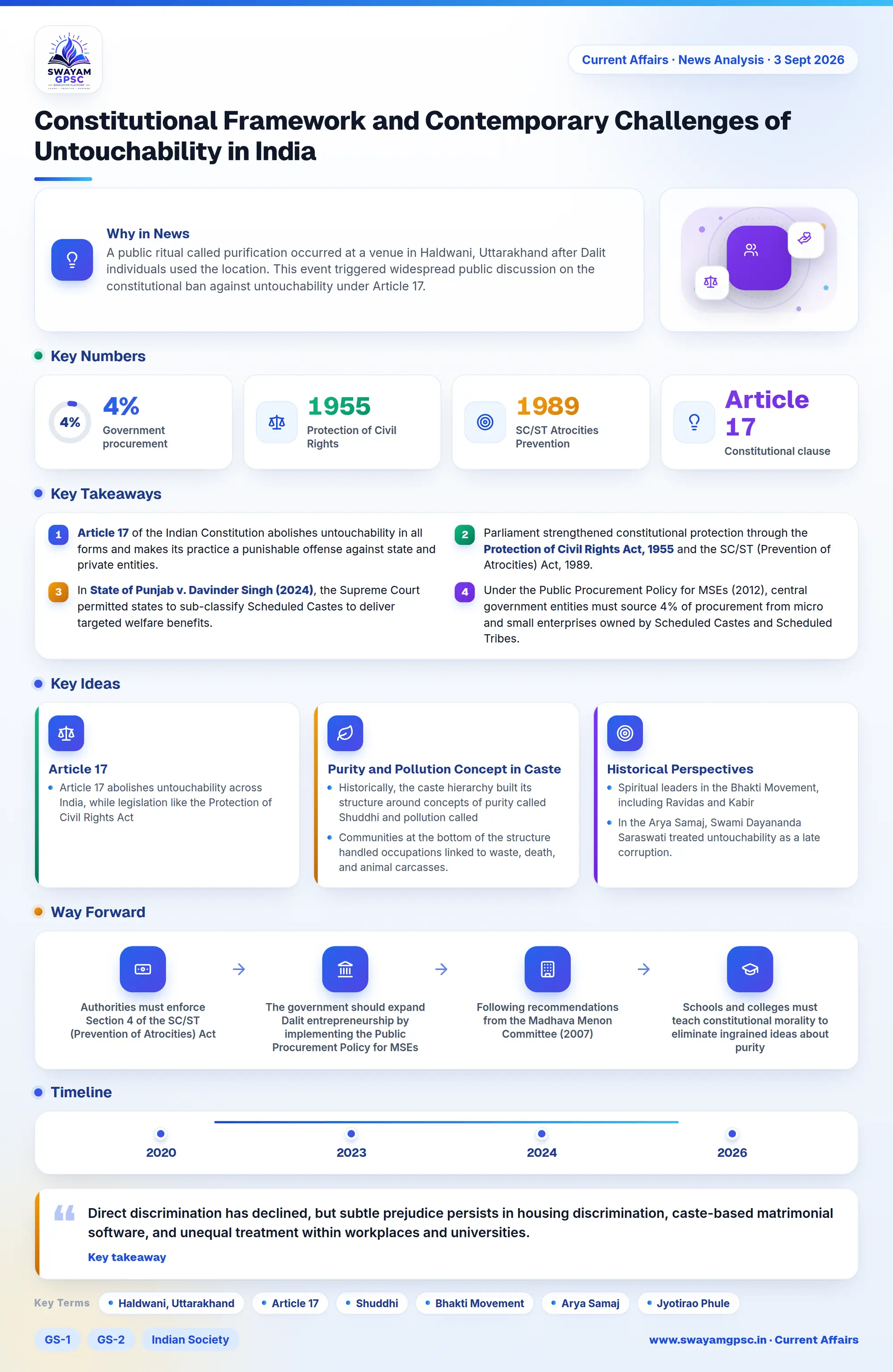
Constitutional Framework and Contemporary Challenges of Untouchability in India
#GS-1 #GS-2 #Indian Society #Social Justice #Vulnerable Sections #Indian Polity & Constitution #Constitution #Judiciary #Governance & Social Justice #Poverty #Current Events #National #Scheduled Castes
Key takeaways
- Article 17 of the Indian Constitution abolishes untouchability in all forms and makes its practice a punishable offense against state and private entities.
- Parliament strengthened constitutional protection through the Protection of Civil Rights Act, 1955 and the SC/ST (Prevention of Atrocities) Act, 1989.
- In State of Punjab v. Davinder Singh (2024), the Supreme Court permitted states to sub-classify Scheduled Castes to deliver targeted welfare benefits.
- Under the Public Procurement Policy for MSEs (2012), central government entities must source 4% of procurement from micro and small enterprises owned by Scheduled Castes and Scheduled Tribes.
Why in News
- A public ritual called purification occurred at a venue in Haldwani, Uttarakhand after Dalit individuals used the location. This event triggered widespread public discussion on the constitutional ban against untouchability under Article 17.
Summary
- Article 17 abolishes untouchability across India, while legislation like the Protection of Civil Rights Act, 1955 and the SC/ST (Prevention of Atrocities) Act, 1989 works to eradicate caste-based discrimination.
- Legal protections exist, yet subtle discrimination, economic vulnerability, and social segregation continue to persist. Overcoming these issues requires strict law enforcement, economic growth, constitutional values, and social integration.
Purity and Pollution Concept in Caste System
- Historically, the caste hierarchy built its structure around concepts of purity called Shuddhi and pollution called Ashuddhi.
- Communities at the bottom of the structure handled occupations linked to waste, death, and animal carcasses. Society used these roles to reinforce ideas of impurity and untouchability.
- Beliefs about ritual purity led to social segregation and isolated living areas. These rules forced Dalit communities to build homes outside main village boundaries.
- Traditional practices treated physical contact or association with lower-caste individuals as polluting. This belief triggered mandatory cleansing rituals and discriminatory exclusion.
Historical Perspectives on Untouchability
- Spiritual leaders in the Bhakti Movement, including Ravidas and Kabir, rejected caste discrimination through devotion and equality.
- In the Arya Samaj, Swami Dayananda Saraswati treated untouchability as a late corruption. He launched the Shuddhi Movement to purify marginalized groups and reintegrate them into Hindu society.
- Social reformer Jyotirao Phule founded the Satyashodhak Samaj in 1873. He connected untouchability to economic exploitation and promoted education as the primary tool for social power.
- Sri Narayana Guru challenged caste practices during the Aruvipuram consecration in 1888. He spread the core message of One Caste, One Religion, One God for Humankind.
- Periyar started the Self-Respect Movement in 1925 with a focus on reason and equality. His movement urged people to reject religious authority based on caste identity.
- Mahatma Gandhi described untouchability as a moral wrong. He worked for social integration through the Harijan Sevak Sangh, temple entry campaigns, and social reforms.
Constitutional and Legal Framework
- Article 17 forms part of the Right to Equality (Articles 14 to 18). It abolishes untouchability completely and allows actions against private individuals as well as government authorities.
- The Constitution intentionally leaves untouchability undefined. This design lets legal authorities handle changing forms of social prejudice over time.
- Parliament passed the Untouchability (Offences) Act, 1955, which later received the title Protection of Civil Rights Act, 1955, to give functional strength to Article 17.
- The Protection of Civil Rights Act, 1955 sets strict punishments for practicing or encouraging untouchability, including imposing social or religious restrictions.
- Under the SC/ST (Prevention of Atrocities) Act, 1989, Section 7(1)(d) punishes anyone who insults a Scheduled Caste member on the basis of untouchability.
- To charge someone under Section 7(1)(d), the law requires proof that the insult directly links to untouchability rather than ordinary personal conflict.
- The National Commission for Scheduled Castes (NCSC) operates under Article 338 as a constitutional body. It holds civil court powers to protect rights and investigate complaints.
Key Judicial Pronouncements
- In Surya Narayan Choudhary v. State of Rajasthan (1989), the Rajasthan High Court ruled that forcing Dalits through a purification ritual before temple entry violated Articles 14, 15, and 17.
- In Hitesh Verma v. State of Uttarakhand (2020), the Supreme Court decided that an insult to an SC or ST individual is not automatically a crime under the SC/ST (Prevention of Atrocities) Act, 1989 unless the act links directly to caste identity.
- In Sukanya Shantha v. Union of India (2024), the Supreme Court struck down caste discrimination rules in prison manuals, stating that untouchability extends beyond physical distance to include exclusion based on touch or presence.
- In Gunjan @ Girija Kumari v. State (NCT of Delhi) (2026), the Supreme Court affirmed that offences under the SC/ST (Prevention of Atrocities) Act, 1989 must occur within public view.
Challenges
- Direct discrimination has declined, but subtle prejudice persists in housing discrimination, caste-based matrimonial software, and unequal treatment within workplaces and universities.
- Caste systems create unequal ranks among marginalized groups. In State of Punjab v. Davinder Singh (2024), the Supreme Court overruled E.V. Chinnaiah (2004) to permit state sub-classification of Scheduled Castes for fair benefit distribution.
- Police officers sometimes register cases under the Bharatiya Nyaya Sanhita (BNS), 2023 instead of applying the SC/ST (Prevention of Atrocities) Act, 1989, which weakens legal protection.
- Rural power imbalances make witnesses afraid to testify in court, leading many witnesses to retract their statements.
- Investigating officers and lower courts often lack awareness, making it difficult to prove caste-based intent in legal trials.
- Landless workers depend on dominant castes for employment, which exposes them to social boycotts and forces informal settlements guided by local Khap Panchayats.
- Electoral politics gives political power to marginalized communities, but candidates often rely on caste voting blocks, which solidifies social divisions.
Way Forward
- Authorities must enforce Section 4 of the SC/ST (Prevention of Atrocities) Act, 1989 to punish public officials who fail to register or investigate complaints.
- The government should expand Dalit entrepreneurship by implementing the Public Procurement Policy for MSEs (2012) alongside schemes like Stand-Up India and the Venture Capital Fund for Scheduled Castes.
- Following recommendations from the Madhava Menon Committee (2007), India should set up a statutory Equal Opportunity Commission to penalize private sector discrimination.
- Schools and colleges must teach constitutional morality to eliminate ingrained ideas about purity and pollution from a young age.
- The state must protect inter-caste couples by expanding financial support through the Dr Ambedkar Scheme for Social Integration through Inter-Caste Marriages.
- States need to set up exclusive special courts for daily trials under the SC/ST (Prevention of Atrocities) Act, 1989 to clear pending cases quickly.
Conclusion
- Social reformer Dr. B.R. Ambedkar observed that caste is a mindset rather than a physical barrier. Eliminating untouchability requires economic independence, strong legal enforcement, and adherence to constitutional morality.