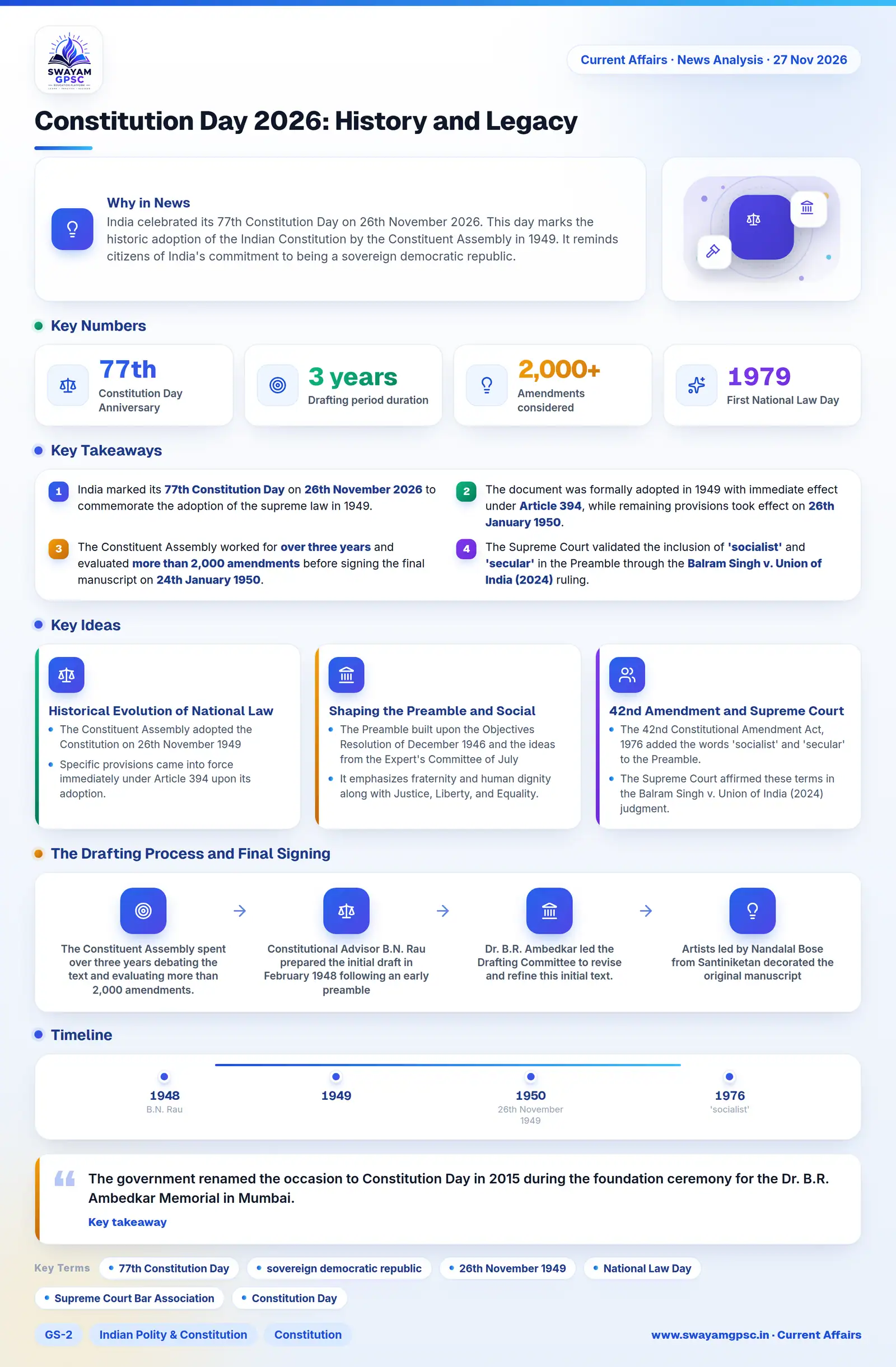
Constitution Day 2026: History and Legacy
#GS-2 #Indian Polity & Constitution #Constitution #Current Events #National
Key takeaways
- India marked its 77th Constitution Day on 26th November 2026 to commemorate the adoption of the supreme law in 1949.
- The document was formally adopted in 1949 with immediate effect under Article 394, while remaining provisions took effect on 26th January 1950.
- The Constituent Assembly worked for over three years and evaluated more than 2,000 amendments before signing the final manuscript on 24th January 1950.
- The Supreme Court validated the inclusion of 'socialist' and 'secular' in the Preamble through the Balram Singh v. Union of India (2024) ruling.
Why in News
- India celebrated its 77th Constitution Day on 26th November 2026.
- This day marks the historic adoption of the Indian Constitution by the Constituent Assembly in 1949.
- It reminds citizens of India's commitment to being a sovereign democratic republic.
Historical Evolution of National Law Day
- The Constituent Assembly adopted the Constitution on 26th November 1949, but full enforcement began on 26th January 1950.
- Specific provisions came into force immediately under Article 394 upon its adoption.
- Before 2015, India celebrated this date as National Law Day.
- Former Supreme Court Bar Association president Laxmi Mall Singhvi started National Law Day in 1979.
- The government renamed the occasion to Constitution Day in 2015 during the foundation ceremony for the Dr. B.R. Ambedkar Memorial in Mumbai.
The Drafting Process and Final Signing
- The Constituent Assembly spent over three years debating the text and evaluating more than 2,000 amendments.
- Constitutional Advisor B.N. Rau prepared the initial draft in February 1948 following an early preamble structure from October 1947.
- Dr. B.R. Ambedkar led the Drafting Committee to revise and refine this initial text.
- Artists led by Nandalal Bose from Santiniketan decorated the original manuscript, which was handwritten in both English and Hindi.
- Assembly members signed the final document on 24th January 1950, the exact day Dr. Rajendra Prasad became India's first President.
Shaping the Preamble and Social Revolution
- The Preamble built upon the Objectives Resolution of December 1946 and the ideas from the Expert's Committee of July 1946.
- It emphasizes fraternity and human dignity along with Justice, Liberty, and Equality.
- Early anti-caste movements influenced the Constitution to serve as a tool for peaceful social revolution.
42nd Amendment and Supreme Court Rulings
- The 42nd Constitutional Amendment Act, 1976 added the words 'socialist' and 'secular' to the Preamble.
- The Supreme Court affirmed these terms in the Balram Singh v. Union of India (2024) judgment.
- The court stated that 'secular' means equal respect for all faiths and 'socialist' means eliminating exploitation.
Rights, Duties, and Constitutional Values
- The Constitution acts as the highest legal framework of India and guarantees Fundamental Rights.
- It incorporates Fundamental Duties under Part IVA to remind citizens of their core responsibilities.
- Citizens should practice constitutional values and fraternity daily in their homes and educational institutions.