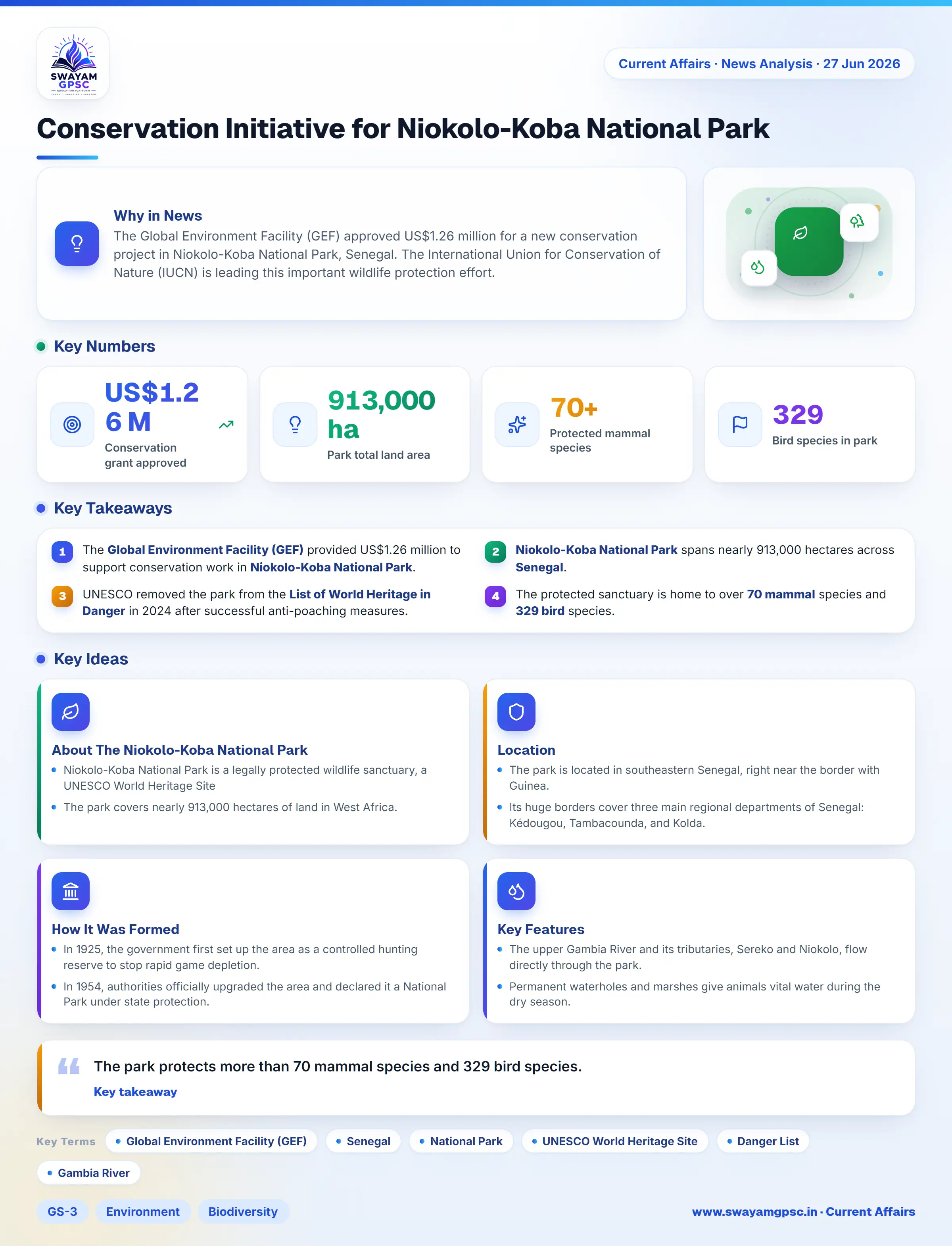
Conservation Initiative for Niokolo-Koba National Park
#GS-3 #Environment #Biodiversity #Wildlife #Sustainable Development #Current Events #International
Key takeaways
- The Global Environment Facility (GEF) provided US$1.26 million to support conservation work in Niokolo-Koba National Park.
- Niokolo-Koba National Park spans nearly 913,000 hectares across Senegal.
- UNESCO removed the park from the List of World Heritage in Danger in 2024 after successful anti-poaching measures.
- The protected sanctuary is home to over 70 mammal species and 329 bird species.
Why in News
- The Global Environment Facility (GEF) approved US$1.26 million for a new conservation project in Niokolo-Koba National Park, Senegal.
- The International Union for Conservation of Nature (IUCN) is leading this important wildlife protection effort.
About The Niokolo-Koba National Park
- Niokolo-Koba National Park is a legally protected wildlife sanctuary, a UNESCO World Heritage Site, and an international Biosphere Reserve.
- The park covers nearly 913,000 hectares of land in West Africa.
- It preserves one of the largest and most important remaining Sudanian savanna ecosystems in the region.
Location
- The park is located in southeastern Senegal, right near the border with Guinea.
- Its huge borders cover three main regional departments of Senegal: Kédougou, Tambacounda, and Kolda.
How It Was Formed
- In 1925, the government first set up the area as a controlled hunting reserve to stop rapid game depletion.
- In 1954, authorities officially upgraded the area and declared it a National Park under state protection.
- In 1981, the park gained recognition as a UNESCO World Heritage Site for its outstanding biodiversity.
- In 2007, UNESCO placed the park on the List of World Heritage in Danger because of poaching, mining, and dam projects.
- In 2024, following strong anti-poaching work and environmental fixes, UNESCO officially removed the park from the Danger List.
Key Features
- The upper Gambia River and its tributaries, Sereko and Niokolo, flow directly through the park.
- Permanent waterholes and marshes give animals vital water during the dry season.
- The landscape features low-lying plains, rugged volcanic hills, and crystalline uplands.
- Mount Assirik stands proudly as the highest point inside the park.
- The park protects Sudanian savanna ecosystems, including open woodlands, bamboo forests, gallery forests, and marshy depressions.
- An invasive shrub named Mimosa pigra is spreading quickly and harming native grasslands.
Significance
- The park protects more than 70 mammal species and 329 bird species.
- Rare animals living here include the critically endangered Western Giant Eland, elephants, lions, leopards, chimpanzees, and wild dogs.
- The forests and wetlands protect the upper Gambia River basin and help regulate water flow.
- These natural areas reduce floods and support downstream farming across West Africa.