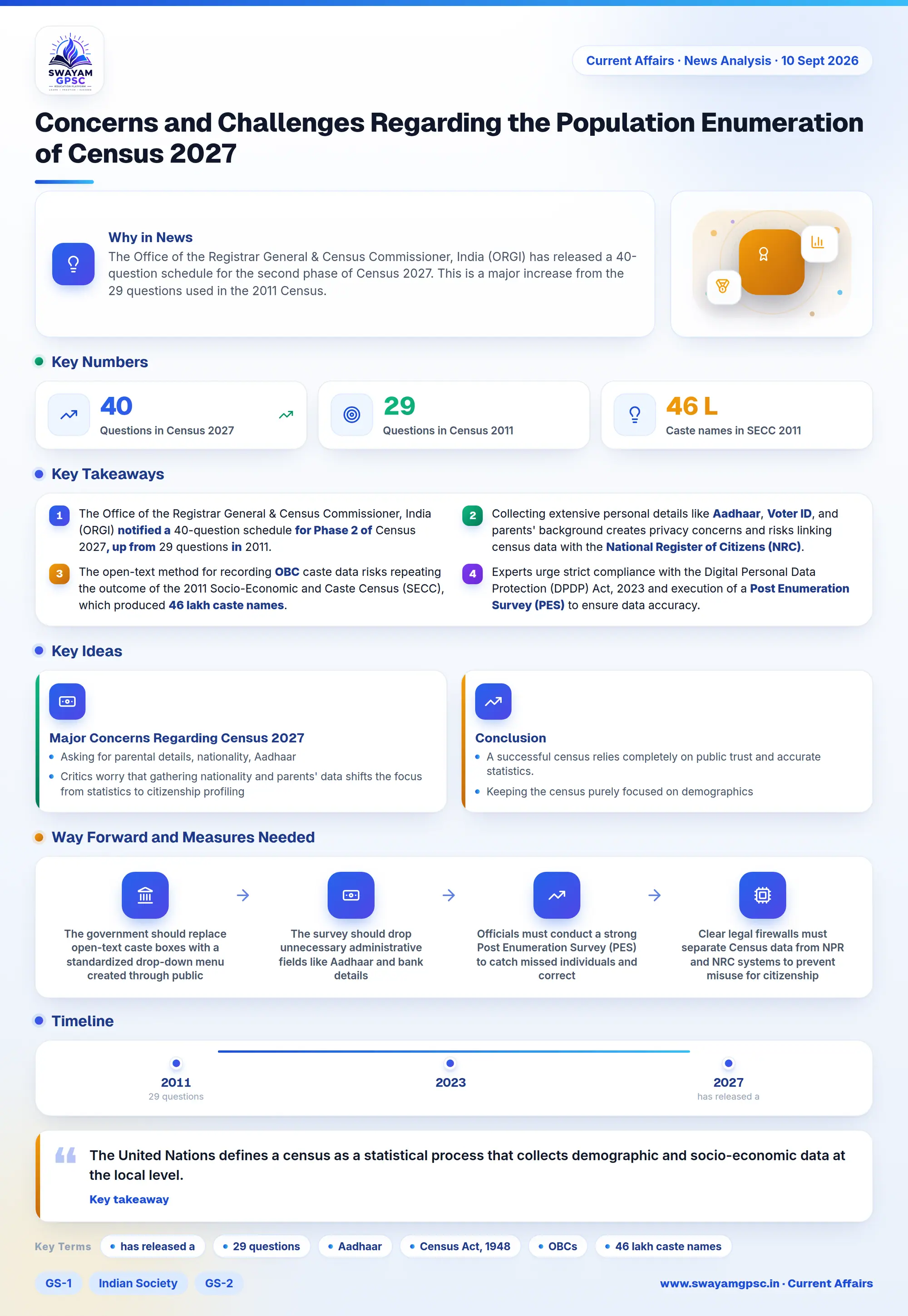
Concerns and Challenges Regarding the Population Enumeration of Census 2027
#GS-1 #Indian Society #GS-2 #Governance & Social Justice #Government Policies & Interventions #National #Census 2027 #Data Privacy #DPDP Act 2023
Key takeaways
- The Office of the Registrar General & Census Commissioner, India (ORGI) notified a 40-question schedule for Phase 2 of Census 2027, up from 29 questions in 2011.
- Collecting extensive personal details like Aadhaar, Voter ID, and parents' background creates privacy concerns and risks linking census data with the National Register of Citizens (NRC).
- The open-text method for recording OBC caste data risks repeating the outcome of the 2011 Socio-Economic and Caste Census (SECC), which produced 46 lakh caste names.
- Experts urge strict compliance with the Digital Personal Data Protection (DPDP) Act, 2023 and execution of a Post Enumeration Survey (PES) to ensure data accuracy.
Why in News
- The Office of the Registrar General & Census Commissioner, India (ORGI) has released a 40-question schedule for the second phase of Census 2027.
- This is a major increase from the 29 questions used in the 2011 Census.
- The new form asks for personal details like Aadhaar, Voter ID, mobile numbers, parents' details, and bank account numbers.
- These new questions have sparked debates over why the government needs so much personal information for a basic demographic survey.
Major Concerns Regarding Census 2027
- The United Nations defines a census as a statistical process that collects demographic and socio-economic data at the local level.
- Asking for parental details, nationality, Aadhaar, and passport numbers makes the survey look like the National Population Register (NPR).
- Critics worry that gathering nationality and parents' data shifts the focus from statistics to citizenship profiling for the National Register of Citizens (NRC).
- The United Nations Fundamental Principles of Official Statistics state that individual census data must remain strictly confidential.
- Although the Census Act, 1948 guarantees privacy, people fear that data sharing with administrative databases could breach this confidentiality.
- Scheduled Castes and Scheduled Tribes will select their category from a fixed list, but OBCs must write their caste in an open text box.
- Spelling differences, sub-caste names, and regional terms will create millions of duplicated or unverified caste entries.
- A similar open-text method in the 2011 Socio-Economic and Caste Census (SECC) generated around 46 lakh caste names, making data analysis very difficult.
- Without a fixed drop-down menu or validation system, this data will be too messy to help in policymaking.
- Personal details like Voter ID, Aadhaar, and Covid-19 vaccination locations offer no real value for general socio-economic planning.
- Since Census 2027 will be India's first digital and self-enumerated census, storing linkable personal data increases the risk of data leaks.
- Experts warn that tracking individuals instead of gathering anonymous group data harms privacy and enables state surveillance.
- Answering 40 questions puts a heavy burden on household heads who may not know all personal details for every family member.
- Institutional places like hostels and old-age homes will struggle because administrators do not hold full background records for all residents.
- The traditional de facto enumeration method might miss migrant workers who are away from home during the census count.
Way Forward and Measures Needed
- The government should replace open-text caste boxes with a standardized drop-down menu created through public consultation.
- The survey should drop unnecessary administrative fields like Aadhaar and bank details, keeping only simple Yes/No questions for financial inclusion.
- Officials must conduct a strong Post Enumeration Survey (PES) to catch missed individuals and correct inaccurate responses.
- Clear legal firewalls must separate Census data from NPR and NRC systems to prevent misuse for citizenship tracking.
- The digital census platform must strictly follow the Digital Personal Data Protection (DPDP) Act, 2023 to stop unauthorized data cross-linking.
- Strong cybersecurity steps like end-to-end encryption, regular safety audits, and access controls must protect citizen data from leaks.
Conclusion
- A successful census relies completely on public trust and accurate statistics.
- Keeping the census purely focused on demographics, away from political debates and unnecessary personal data collection, is vital for proper governance.