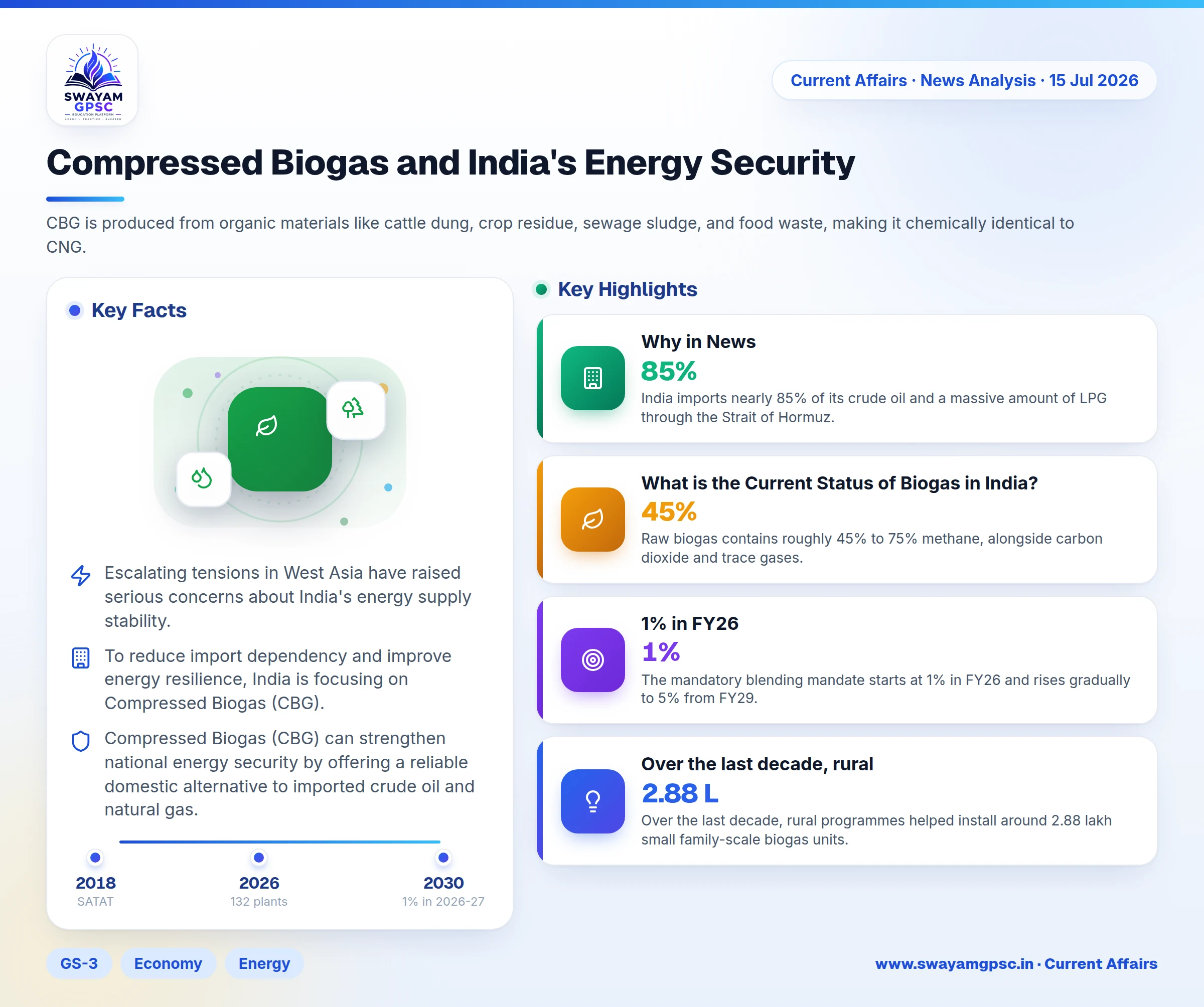
Compressed Biogas and India's Energy Security
#GS-3 #Economy #Energy #Infrastructure #Environment #Sustainable Development #Climate Change #National #Compressed Biogas
Why in News
- Escalating tensions in West Asia have raised serious concerns about India's energy supply stability.
- India imports nearly 85% of its crude oil and a massive amount of LPG through the Strait of Hormuz.
- To reduce import dependency and improve energy resilience, India is focusing on Compressed Biogas (CBG).
Summary
- Compressed Biogas (CBG) can strengthen national energy security by offering a reliable domestic alternative to imported crude oil and natural gas.
- CBG is produced from organic materials like cattle dung, crop residue, sewage sludge, and food waste, making it chemically identical to CNG.
- Key schemes like SATAT, GOBARdhan, and the National Bioenergy Programme are driving India's waste-to-energy transition.
What is the Current Status of Biogas in India?
- Biogas is a renewable fuel created when bacteria break down organic waste without oxygen.
- Raw biogas contains roughly 45% to 75% methane, alongside carbon dioxide and trace gases.
- When producers remove carbon dioxide, moisture, and impurities from raw biogas, it becomes Compressed Biogas (CBG).
- CBG serves as a direct alternative to CNG in transport vehicles, industries, households, and power plants.
- The government launched the SATAT initiative in 2018 to set up 5,000 plants across the country.
- Progress under SATAT remains slow, with only 132 plants operational by June 3, 2026.
- The government introduced mandatory blending targets for CBG in transport CNG and domestic PNG.
- The mandatory blending mandate starts at 1% in FY26 and rises gradually to 5% from FY29.
- Commercial production of CBG in India is still in its infancy despite abundant raw material availability.
- Over the last decade, rural programmes helped install around 2.88 lakh small family-scale biogas units.
- Globally, Europe, China, and the United States generate nearly 90% of all biogas.
Government Initiatives to Promote Biogas in India
- The SATAT scheme encourages private entrepreneurs to establish CBG plants and sell clean fuel to oil companies.
- The GOBARdhan scheme provides financial aid up to ₹50 lakh per district for converting organic waste into clean energy.
- Mandatory blending mandates step up CBG integration into city gas distribution systems, reaching 5% from FY29.
- The National Bioenergy Programme offers central financial support for setting up waste-to-energy and Bio-CNG projects.
- The Biomass Aggregation Machinery Scheme has an outlay of ₹564.75 crore to help producers collect and store farm waste.
- The government allocated ₹994.5 crore for gas grid connections, while SBM-Urban 2.0 supports municipal biomethanation units.
Why is Biogas Important for India's Energy Security?
- India imports around 85% of its crude oil, so replacing fossil fuels with domestic waste reduces foreign import bills.
- Because CBG works just like CNG, it provides a local fuel shield during global geopolitical crises.
- Using renewable CBG lowers greenhouse emissions and advances India toward its target of net-zero emissions by 2070.
- Converting crop residue into biogas discourages open field burning and protects local air quality.
- Biogas plants generate organic manure alongside fuel, creating extra income for farmers and improving soil health.
- Decentralized plants ensure clean cooking fuel and power reach remote rural areas, advancing Atmanirbhar Bharat.
Challenges
- Setting up CBG plants requires high capital investment, leaving India's capacity at under 1% of its 87 bcm annual potential according to the International Energy Agency (IEA).
- Banks view CBG units as high-risk investments due to uncertain gas prices and weak markets for organic fertilizer.
- Organic waste is widely scattered across rural areas, making feedstock collection, storage, and transport very costly.
- Inadequate pipeline networks prevent CBG producers from injecting gas directly into city distribution grids.
- Overlapping guidelines across multiple schemes create administrative delays and hinder smooth project monitoring.
- Relying heavily on dedicated crops like maize for bioenergy could squeeze agricultural land and threaten food security.
Way Forward
- The Indian Biogas Association (IBA) recommends establishing a ₹10,000 crore capital subsidy fund to lower initial project costs.
- Regulators should enforce priority sector lending and mandate organic fertilizer blending starting at 1% in 2026-27 up to 10% by 2030.
- Developing district biomass inventories and farmer co-operatives will ensure steady feedstock delivery throughout the year.
- Speeding up infrastructure funding will connect isolated CBG plants directly to urban gas distribution pipelines.
- Setting up a Unified National Biogas Mission will streamline single-window clearances across ministries.
- India should follow Denmark's model by focusing strictly on animal manure and organic waste rather than food crops.
Conclusion
- Compressed Biogas can transform India's energy security if the gap between targets and plant commissioning is closed quickly.
- Sustained policy support and strong pipeline infrastructure will help CBG create a clean, circular energy economy.