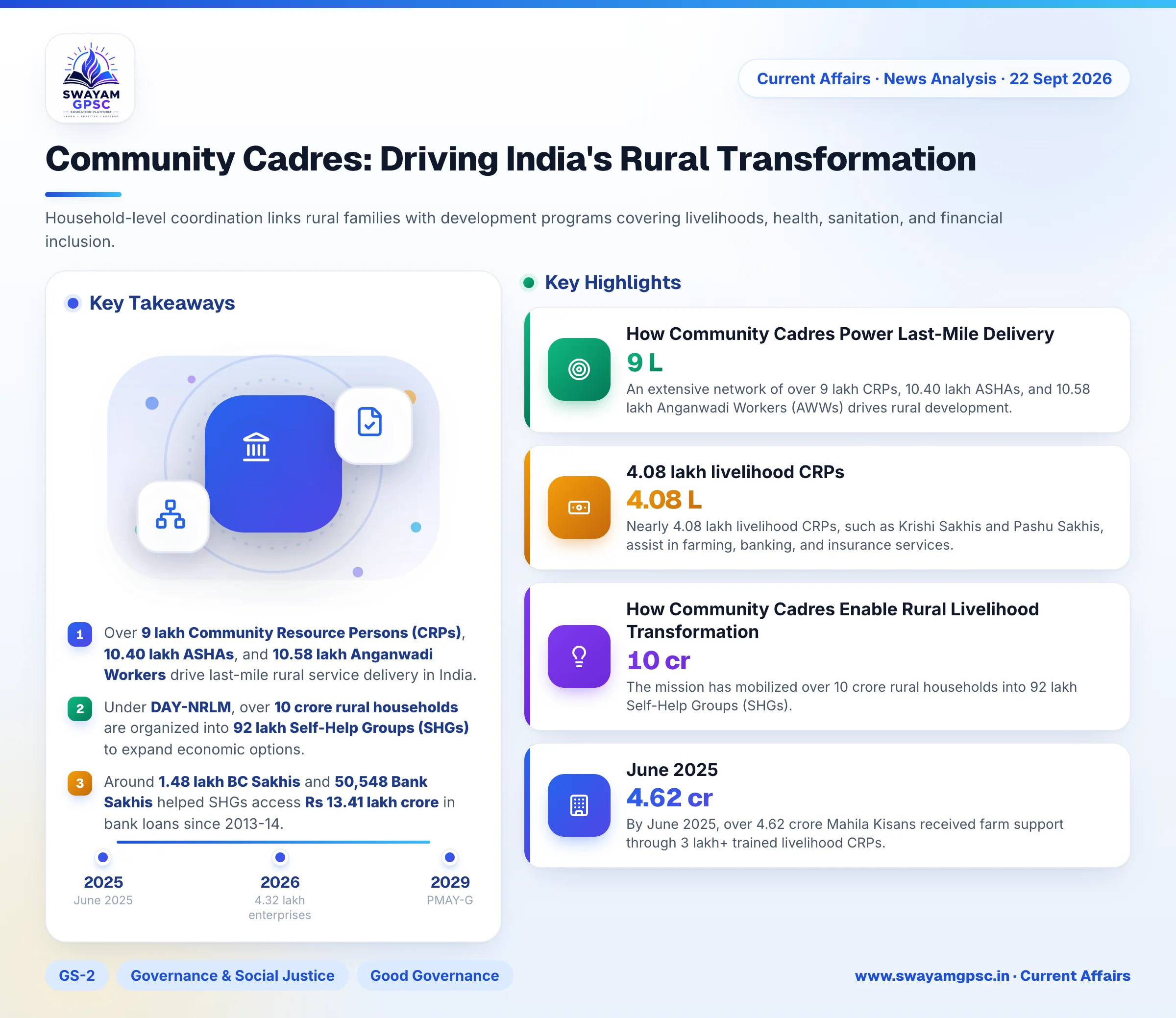
Community Cadres: Driving India's Rural Transformation
#GS-2 #Governance & Social Justice #Good Governance #Social Justice #Civil Services #GS-3 #Economy #Agriculture #Employment #Welfare Schemes
Key takeaways
- Over 9 lakh Community Resource Persons (CRPs), 10.40 lakh ASHAs, and 10.58 lakh Anganwadi Workers drive last-mile rural service delivery in India.
- Under DAY-NRLM, over 10 crore rural households are organized into 92 lakh Self-Help Groups (SHGs) to expand economic options.
- Around 1.48 lakh BC Sakhis and 50,548 Bank Sakhis helped SHGs access Rs 13.41 lakh crore in bank loans since 2013-14.
- Supported by field-level Awaas Mitras, PMAY-G targets the construction of 4.95 crore rural houses by March 2029.
Why in News
- A large network of trained grassroots workers is improving the delivery of government schemes across rural India.
- These community cadres connect local families directly to essential services in health, nutrition, sanitation, housing, water, and financial inclusion.
How Community Cadres Power Last-Mile Delivery
- Community cadres serve as trained local workers who link rural households with government bodies to raise awareness and deliver services.
- Household-level coordination links rural families with development programs covering livelihoods, health, sanitation, and financial inclusion.
- Frontline workers handle multi-sector roles. For example, ASHAs support child health, nutrition awareness, sanitation, and anti-violence drives.
- Under NRLM, Gender CRPs address critical issues including gender-based violence, social exclusion, and inequality.
- Frontline workers convert policy objectives into direct improvements in family life through integrated local actions.
- An extensive network of over 9 lakh CRPs, 10.40 lakh ASHAs, and 10.58 lakh Anganwadi Workers (AWWs) drives rural development.
- Nearly 4.08 lakh livelihood CRPs, such as Krishi Sakhis and Pashu Sakhis, assist in farming, banking, and insurance services.
Capacity Building for Community Cadres
- Training community workers is a continuous process that includes thematic modules, field mentoring, and on-site guidance.
- Under DAY-NRLM, groups like Krishi Sakhis, Pashu Sakhis, and Matsya Sakhis complete classroom and field courses.
- ASHAs undergo a phased training program over 23 days to strengthen local healthcare delivery.
- Swachhagrahis receive training to encourage proper hygiene habits and long-term sanitation gains under national cleanliness drives.
- VWSC members and Jal Sakhis learn to manage village water planning, quality tests, and system repairs.
- Awaas Mitras receive specialized training to identify beneficiaries, track housing construction, and link government schemes.
- A shared institutional model equips cadres across sectors with decentralised knowledge and continuous community presence.
How Community Cadres Enable Rural Livelihood Transformation
- DAY-NRLM supports community-driven development by creating access to credit, job skills, and social programs.
- The mission has mobilized over 10 crore rural households into 92 lakh Self-Help Groups (SHGs).
- Over 9 lakh CRPs guide rural communities in farming, livestock management, small business creation, and banking.
- These local leaders bridge knowledge and credit gaps, helping families improve farm and non-farm income.
- Local women cadres like Krishi Sakhis and Matsya Sakhis transform from simple scheme users into local change leaders.
- Community cadres come directly from local areas and receive continuous field-based guidance.
- By June 2025, over 4.62 crore Mahila Kisans received farm support through 3 lakh+ trained livelihood CRPs.
- Under the Start-up Village Entrepreneurship Programme (SVEP), government programs supported 4.32 lakh enterprises by June 2026.
- The National Campaign on Entrepreneurship aims to train 50,000 CRPs and guide 50 lakh SHG members in business growth.
How Community Cadres Drive Financial Inclusion
- Under DAY-NRLM, trained women serve as doorstep financial providers to deliver banking access in remote villages.
- More than 1.48 lakh BC Sakhis offer basic banking services like opening accounts, taking deposits, and processing money transfers.
- Over 50,548 Bank Sakhis helped SHGs access Rs 13.41 lakh crore in formal bank loans since 2013-14.
- Around 56,727 Financial Literacy CRPs teach villagers about savings, pensions, insurance, and loan choices.
- In 2025-26, over 3.81 crore women SHG members completed financial literacy programs to make informed money choices.
How Community Cadres Support Social Development
- ASHAs build healthcare awareness and deliver community-level treatments under national health schemes.
- Anganwadi Workers spot cases of Severe Acute Malnutrition (SAM) and distribute supplementary food to young children.
- The Poshan Bhi Padhai Bhi drive improves early childhood care by strengthening Anganwadi facilities and play materials.
- Swachhagrahis motivate villagers to adopt clean hygiene practices under the Swachh Bharat Mission (Grameen).
- This sanitation workforce brings together ASHA workers, ANMs, AWWs, and village volunteers.
- Under Jal Jeevan Mission (JJM), local bodies and Village Water & Sanitation Committees (VWSCs) run local water supply schemes.
- VWSCs are chosen by the Gram Sabha and must include at least 50% women alongside members from SC/ST groups.
- Over 5.33 lakh VWSCs oversee water funds, set user fees, and maintain local water quality.
- The Nal Jal Mitra Programme teaches villagers practical plumbing and electrical skills to repair water infrastructure.
- Under Pradhan Mantri Awaas Yojana-Gramin (PMAY-G), Awaas Mitras identify eligible families and track home building.
- Every approved home links with local workers like Awaas Sahayaks or Gram Rozgar Sahayaks to ensure timely construction.
- Through this local model, PMAY-G aims to build 4.95 crore houses by March 2029.
Conclusion
- Community cadres form the essential human network powering rural transformation across India.
- These dedicated workers turn top-down government policies into a bottom-up, community-led growth model.