Coal Gasification and Its Strategic Importance
#GS-3 #Economy #Infrastructure #Energy #Industry #Coal Gasification
Key takeaways
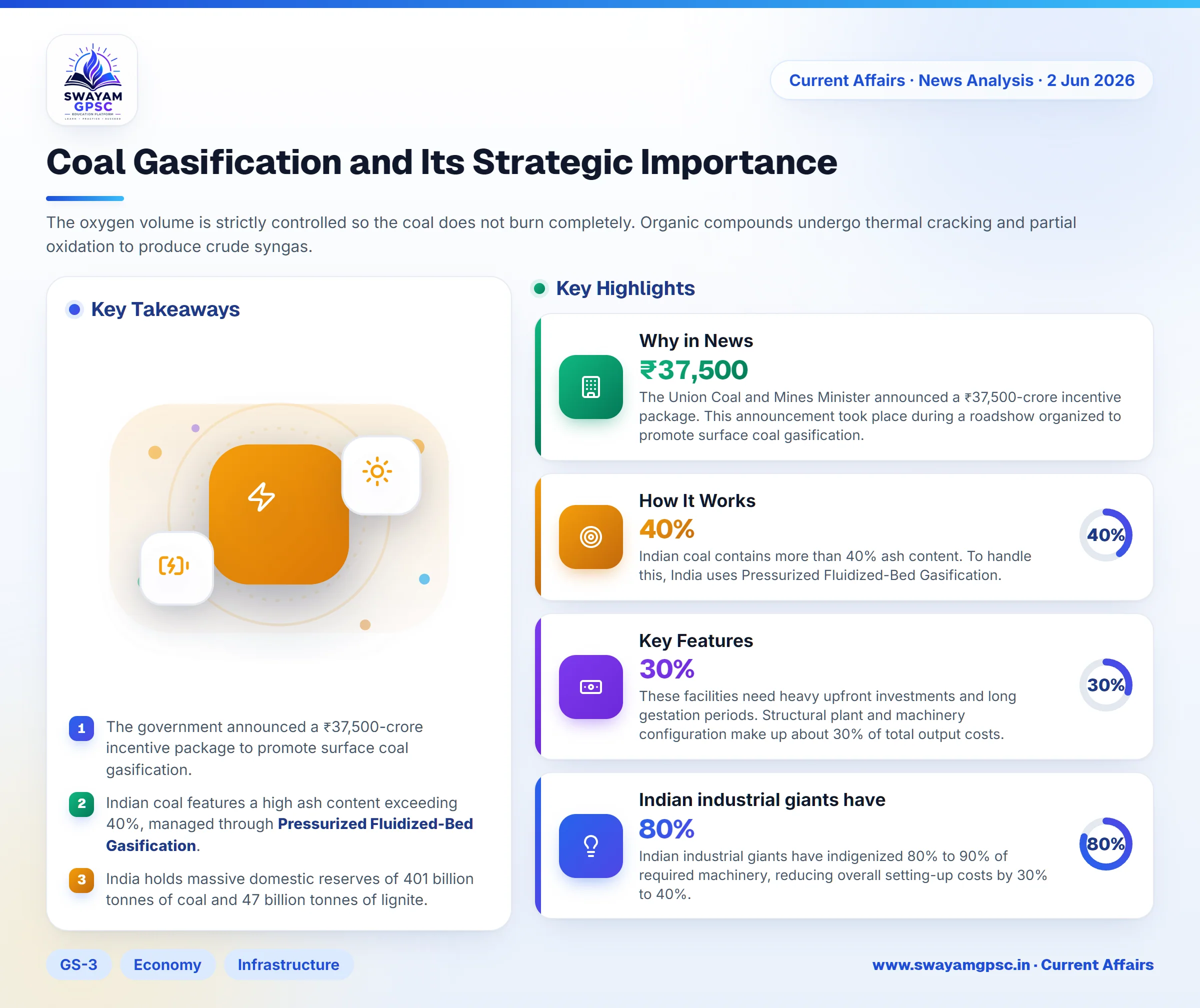
- The government announced a ₹37,500-crore incentive package to promote surface coal gasification.
- Indian coal features a high ash content exceeding 40%, managed through Pressurized Fluidized-Bed Gasification.
- India holds massive domestic reserves of 401 billion tonnes of coal and 47 billion tonnes of lignite.
- Indian companies have indigenized 80% to 90% of required machinery, reducing setup costs by 30% to 40%.
Why in News
- The Union Coal and Mines Minister announced a ₹37,500-crore incentive package. This announcement took place during a roadshow organized to promote surface coal gasification.
About Coal Gasification
- Coal gasification is a chemical process. It converts coal or lignite into synthetic gas, which is commonly known as syngas.
- Instead of burning solid coal directly, which creates heavy smoke and ash, gasification breaks its elemental bonds. High temperature and pressure transform the fuel into a clean gaseous mixture of carbon monoxide, hydrogen, and carbon dioxide.
How It Works
- Raw coal is pulverized and fed into a specialized gasification reactor. It mixes with controlled streams of oxygen and steam under extreme heat ranging from 800OC to over 1400OC.
- The oxygen volume is strictly controlled so the coal does not burn completely. Organic compounds undergo thermal cracking and partial oxidation to produce crude syngas.
- Indian coal contains more than 40% ash content. To handle this, India uses Pressurized Fluidized-Bed Gasification.
- Upward-blowing gas streams suspend the heavy coal particles in a boiling fluid-like state. This allows uniform gasification of carbon while extracting heavy mineral ash cleanly from the bottom.
- Crude syngas goes through scrubbing to remove impurities like sulfur and tar. Refined hydrogen and carbon monoxide are then chemically recombined using catalysts to create liquid fuels, fertilizers, or clean energy.
Key Features
- Technologies developed by Bharat Heavy Electricals Ltd are tailored specifically to handle complex domestic coal reserves.
- These facilities need heavy upfront investments and long gestation periods. Structural plant and machinery configuration make up about 30% of total output costs.
- Indian industrial giants have indigenized 80% to 90% of required machinery, reducing overall setting-up costs by 30% to 40%.
- India holds 401 billion tonnes of coal and 47 billion tonnes of lignite. Gasification utilizes these massive domestic resources without traditional chimney stack soot.
Significance
- Coal gasification helps produce urea, ammonia, and methanol domestically. This reduces imports and saves valuable foreign exchange.
- Gasification is cleaner than direct coal burning. It works better with carbon capture technologies, which helps decarbonization efforts.