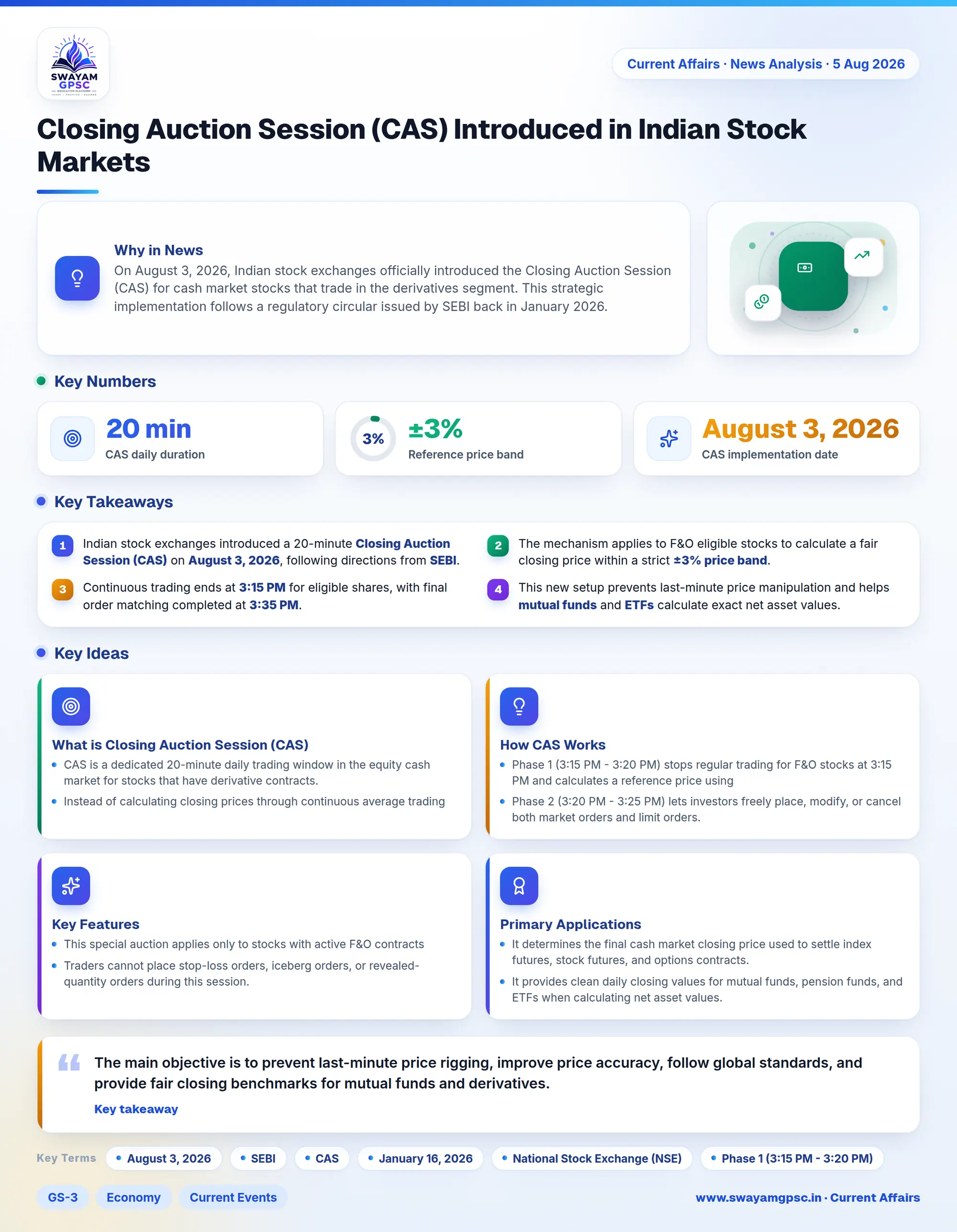
Closing Auction Session (CAS) Introduced in Indian Stock Markets
#GS-3 #Economy #Current Events #National #Closing Auction Session #SEBI #Stock Market #Derivatives
Key takeaways
- Indian stock exchanges introduced a 20-minute Closing Auction Session (CAS) on August 3, 2026, following directions from SEBI.
- The mechanism applies to F&O eligible stocks to calculate a fair closing price within a strict ±3% price band.
- Continuous trading ends at 3:15 PM for eligible shares, with final order matching completed at 3:35 PM.
- This new setup prevents last-minute price manipulation and helps mutual funds and ETFs calculate exact net asset values.
Why in News
- On August 3, 2026, Indian stock exchanges officially introduced the Closing Auction Session (CAS) for cash market stocks that trade in the derivatives segment.
- This strategic implementation follows a regulatory circular issued by SEBI back in January 2026.
What is Closing Auction Session (CAS)
- CAS is a dedicated 20-minute daily trading window in the equity cash market for stocks that have derivative contracts.
- Instead of calculating closing prices through continuous average trading, this mechanism pools buy and sell orders together to discover one equilibrium price.
- The Securities and Exchange Board of India (SEBI) mandated this change through an official policy circular published on January 16, 2026.
- Both the National Stock Exchange (NSE) and BSE rolled out this new auction framework at the same time.
- The mechanism officially became active across Indian equity markets starting August 3, 2026.
- The main objective is to prevent last-minute price rigging, improve price accuracy, follow global standards, and provide fair closing benchmarks for mutual funds and derivatives.
How CAS Works
- Phase 1 (3:15 PM - 3:20 PM) stops regular trading for F&O stocks at 3:15 PM and calculates a reference price using the 15-minute VWAP with a strict ±3% price band.
- Phase 2 (3:20 PM - 3:25 PM) lets investors freely place, modify, or cancel both market orders and limit orders.
- Phase 2 (3:25 PM - 3:30 PM) accepts only limit orders without permitting changes to market orders, closing randomly between 3:28 PM and 3:30 PM to prevent order manipulation.
- Phase 3 (3:30 PM - 3:35 PM) matches orders at a single fair equilibrium price that executes maximum trade volume, giving priority to market orders over limit orders.
Key Features
- This special auction applies only to stocks with active F&O contracts, while all other stocks keep trading until 3:30 PM under the standard 30-minute VWAP rule.
- Traders cannot place stop-loss orders, iceberg orders, or revealed-quantity orders during this session.
- Unfilled limit orders from the regular session transfer automatically into CAS if their prices stay inside the ±3% price band.
- Because NSE and BSE operate separate order books during the auction, stock prices on the two exchanges may show brief variations.
Primary Applications
- It determines the final cash market closing price used to settle index futures, stock futures, and options contracts.
- It provides clean daily closing values for mutual funds, pension funds, and ETFs when calculating net asset values.
- It helps large institutional investors complete big portfolio rebalancing orders without causing sharp price swings during regular market hours.