Climate-Resilient Coral Reefs Ecosystems
#GS-3 #Environment #Climate Change #Biodiversity #Quick Facts For Prelims
Key takeaways
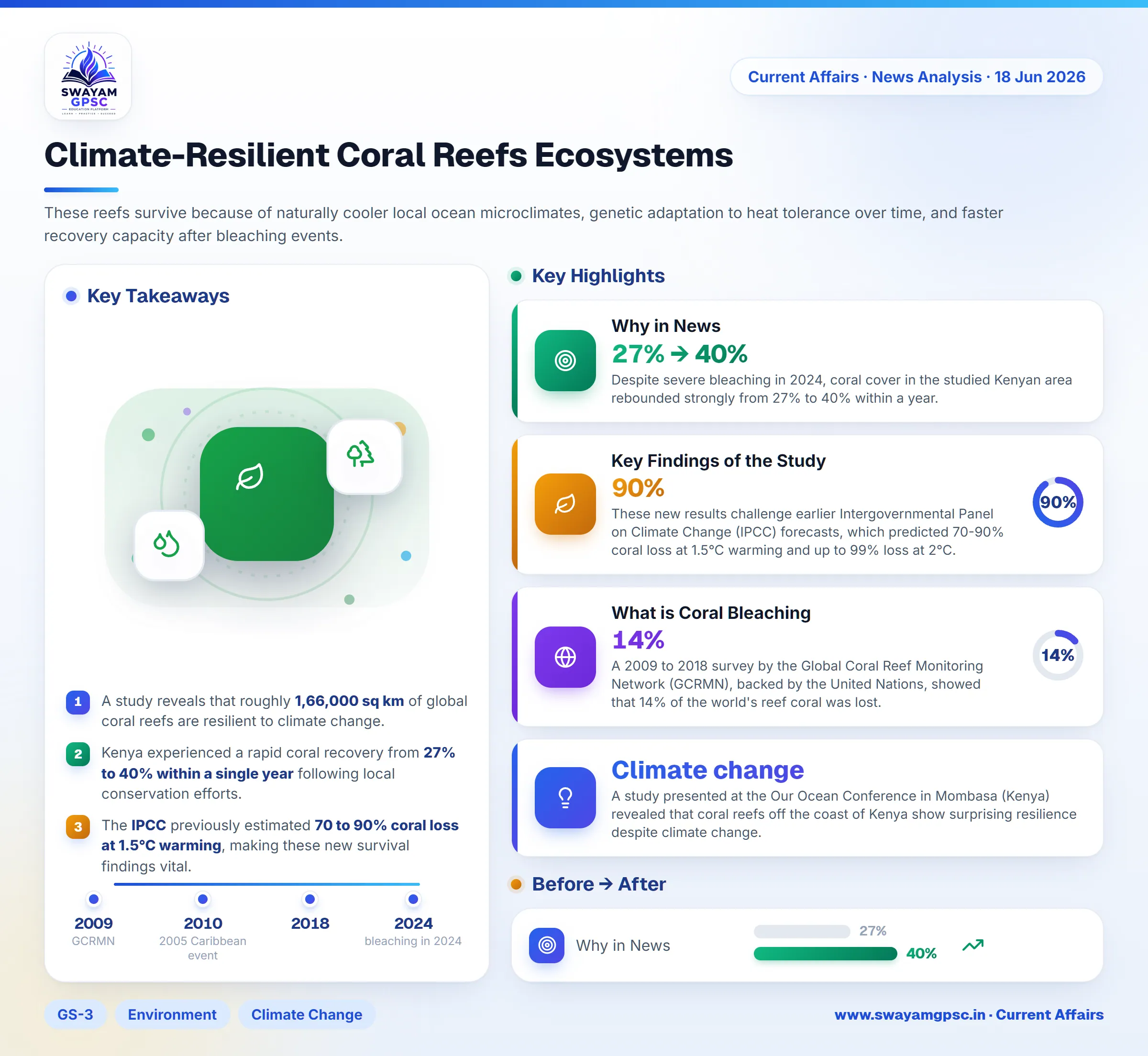
- A study reveals that roughly 1,66,000 sq km of global coral reefs are resilient to climate change.
- Kenya experienced a rapid coral recovery from 27% to 40% within a single year following local conservation efforts.
- The IPCC previously estimated 70 to 90% coral loss at 1.5°C warming, making these new survival findings vital.
- A United Nations backed report by GCRMN showed that 14% of the world's reef coral was lost between 2009 and 2018.
Why in News
- A study presented at the Our Ocean Conference in Mombasa (Kenya) revealed that coral reefs off the coast of Kenya show surprising resilience despite climate change.
- Despite severe bleaching in 2024, coral cover in the studied Kenyan area rebounded strongly from 27% to 40% within a year.
Key Findings of the Study
- Approximately 1,66,000 sq km or nearly one-third of global coral reefs are relatively climate-resilient against rising sea temperatures and thermal stress.
- These new results challenge earlier Intergovernmental Panel on Climate Change (IPCC) forecasts, which predicted 70-90% coral loss at 1.5°C warming and up to 99% loss at 2°C.
- The updated outlook suggests a more hopeful survival rate for reefs if proper protection measures are implemented.
- Local conservation actions in Kenya, including regulated fishing, patrolling, mangrove planting, and waste management, successfully protected reef ecosystems.
- These reefs survive because of naturally cooler local ocean microclimates, genetic adaptation to heat tolerance over time, and faster recovery capacity after bleaching events.
- Advanced high-resolution mapping techniques identified over three times more climate-resilient reefs than previous studies, with large numbers found in Australia, Indonesia, the Philippines, Cuba, and the Bahamas.
What is Coral Bleaching
- Coral bleaching happens when corals lose their symbiotic algae known as zooxanthellae due to stress from temperature, light, nutrients, or pollution, causing them to turn completely white.
- The primary trigger is increased ocean temperature caused by climate change, which disrupts the relationship between coral and algae.
- Bleaching can also result from cold-water stress, pollution, runoff, excessive sunlight, and extreme low tides rather than just warming oceans.
- Once algae leave, corals lose their main food source and color, making them weak, vulnerable to disease, and prone to dying if stress continues.
- Corals can survive bleaching if the stress is temporary and environmental conditions improve to allow algae to return.
- Major events like the 2005 Caribbean event and the 2010 Florida Keys cold-stress episode show how large-scale environmental shifts damage coral systems.
- A 2009 to 2018 survey by the Global Coral Reef Monitoring Network (GCRMN), backed by the United Nations, showed that 14% of the world's reef coral was lost.
- Global protection initiatives include the International Coral Reef Initiative, Global Coral Reef Monitoring Network (GCRMN), Global Coral Reef Alliance (GCRA), and The Global Coral Reef R&D Accelerator Platform.
- Indian initiatives include the Coral Bleaching Alert System (INCOIS), Artificial Reef Installation Programme, Coral Translocation Project by the Zoological Survey of India, and the Pradhan Mantri Matsya Sampada Yojana (PMMSY).