Climate Change and the Rising Cost of Living in India
#GS-3 #Economy #Environment #Climate Change #Environmental Pollution & Degradation #Food Security #Inflation #Infrastructure #Agriculture #Sustainable Development
Key takeaways
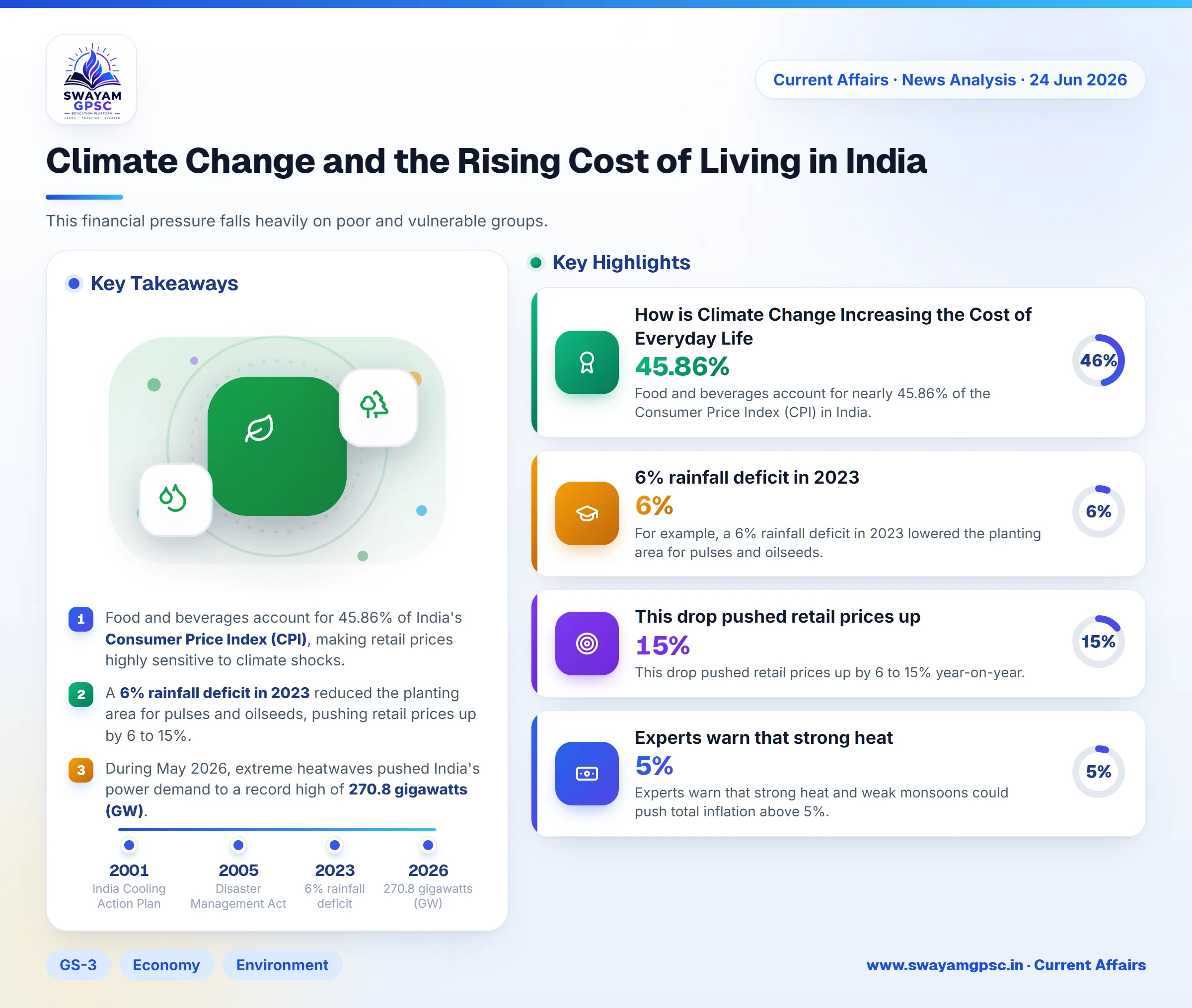
- Food and beverages account for 45.86% of India's Consumer Price Index (CPI), making retail prices highly sensitive to climate shocks.
- A 6% rainfall deficit in 2023 reduced the planting area for pulses and oilseeds, pushing retail prices up by 6 to 15%.
- During May 2026, extreme heatwaves pushed India's power demand to a record high of 270.8 gigawatts (GW).
- The World Bank warns that rising temperatures could reduce India's GDP by up to 2.8% by 2050.
Why in News
- People often view climate change as a distant threat meant for reaching net-zero emissions by 2070.
- However, in India, climate change has turned into an urgent monthly problem.
- Rising electricity bills and high vegetable prices are making daily life much costlier.
- This financial pressure falls heavily on poor and vulnerable groups.
Summary
- Climate change makes living costlier in India through food inflation, high electricity bills, water shortages, and medical costs.
- The poorest citizens suffer the most from these rising financial burdens.
- Solving this crisis needs better laws, climate-proof infrastructure, Green Budgeting, and stronger social support.
- These steps will promote climate justice and sustainable growth across the country.
How is Climate Change Increasing the Cost of Everyday Life in India
- Food and beverages account for nearly 45.86% of the Consumer Price Index (CPI) in India.
- Any weather shock to farming immediately pushes up retail market prices.
- Extreme heat harms crop output even when rains arrive on time, while weak monsoons disrupt planting schedules.
- For example, a 6% rainfall deficit in 2023 lowered the planting area for pulses and oilseeds.
- This drop pushed retail prices up by 6 to 15% year-on-year.
- Repeated climate shocks create a cycle of poor harvests, supply shortages, and hoarding.
- This chain reaction leads to persistent food inflation for everyday consumers.
- Experts warn that strong heat and weak monsoons could push total inflation above 5%.
- Intense heatwaves create a massive demand for cooling across the power grid.
- During May 2026, India's power demand reached a record high of 270.8 gigawatts (GW).
- Power companies buy expensive coal and imported fuels to meet this peak demand.
- They pass these extra costs directly to consumers through higher tariffs and surcharges.
- While higher bills annoy the middle class, they force informal workers to cut spending on food and education.
- Erratic rainfall and long dry spells cause rural wells to run dry.
- Families must spend extra time and money just to get clean drinking water.
- In cities, poor municipal water supplies have led to an unregulated private tanker economy.
- City residents must pay high prices to private vendors for basic water needs.
- This lack of public infrastructure hits slums and marginalized groups like Dalits and Adivasis the hardest.
- Heat stress, bad air quality, and climate-linked vector-borne diseases increase medical bills.
- India's public health system is already under heavy strain from these issues.
- Every day lost to climate sickness means a loss of daily wages for informal workers.
- This wage loss traps vulnerable families in a deep cycle of debt.
- The World Bank warns that rising temperatures could reduce India's GDP by up to 2.8% by 2050.
- This drop will lower living standards for nearly half of the country's population.
- States like Chhattisgarh, Madhya Pradesh, Rajasthan, Uttar Pradesh, and Maharashtra will face the steepest drops.
- These regions overlap with existing areas of farm distress, high debt, and farmer suicides.
- Rich households can afford advanced irrigation and cooling tech to protect themselves.
- Poor castes and tribes lack access to these protective tools.
- Because of this, climate change acts like an unfair tax on people who caused the least pollution.
Limitations in Addressing India's Climate-Induced Cost of Living
- Heatwaves and cold waves are not listed as official national disasters under the Disaster Management Act, 2005.
- This rule blocks access to National Disaster Response Funds (NDRF) for affected workers.
- While recent finance commissions allow states to use 10% of their state disaster funds for local disasters, central hurdles remain.
- Laws like the Essential Commodities Act, 1955 only address short price jumps instead of fixing climate supply issues.
- The India Cooling Action Plan under the Energy Conservation Act, 2001 remains only advice.
- Real estate builders face no legal rule to include passive cooling in low-income housing.
- As a result, the urban poor live in hot concrete boxes that drive up their power bills.
- The Pradhan Mantri Fasal Bima Yojana (PMFBY) uses village-level checks that miss local crop damage.
- This gap leads to very low insurance payouts for farmers.
- The fixed annual help of Rs 6,000 under PM-KISAN is not linked to inflation or weather losses.
- This fixed amount loses value during extreme weather events.
- The lack of a legal heat allowance forces workers to choose between losing wages and risking heat sickness.
- There is no price control rule for emergency water supply, allowing private vendors to profit during shortages.
- Long political fights over water sharing, like the Mekedatu reservoir or the Sutlej-Yamuna Link Canal, delay water projects.
- These delays trigger severe water crises in Delhi, Punjab, Haryana, Karnataka, and Tamil Nadu.
- Schemes like Ayushman Bharat (PM-JAY) only pay for hospital stays.
- Most climate illnesses need long-term outpatient care and medicines, which are not covered.
- Private outpatient costs are unregulated, forcing families to pay medical bills from their own pockets.
- Over 250 cities across 23 states have Heat Action Plans (HAPs).
- However, these plans lack dedicated budgets and legal power.
- They rely on weak local bodies, making them weak tools that fail to protect outdoor workers.
Key State-level Innovations
- Tamil Nadu named heatwaves a state disaster to unlock state disaster funds.
- Tamil Nadu also launched a Green Schools project that lowered classroom heat by 3 to 4 degrees Celsius using cool roofs.
- Maharashtra focuses on early warnings in vulnerable zones like Vidarbha and Marathwada.
- Telangana uses a Cool Roof Policy (2023-2028) for poor areas.
- Telangana links heat reduction with green programs like Haritha Haram and Mission Kakatiya.
- Rajasthan expanded district heat plans with shaded work areas and adjusted work hours.
- Jodhpur set up a net-zero cooling station that drops local heat by 8 to 12 degrees Celsius.
- Kerala set up village-level heat plans in Kozhikode and added heat rules to its climate action plan.
- Delhi uses an alert system for outdoor workers, while Uttar Pradesh builds Miyawaki forests and sponge parks.
Measures Needed to Strengthen Climate Resilience and Adaptation
- India must pass a new Climate Resilience and Adaptation Act to move past the old Disaster Management Act, 2005.
- This law should create a National Climate Adaptation Authority (NCAA) to enforce rules across ministries.
- The Supreme Court must expand Article 21 to include the Right to Thermal Comfort and Climate Safety.
- The government should give legal power to the India Cooling Action Plan (ICAP).
- Affordable housing projects must follow cool design rules for real estate approvals.
- India should start Green Budgeting to make all ministries check climate risks and fund safety projects.
- The RBI must include climate risks in inflation forecasts since weather shocks drive up food prices.
- India should copy Europe's model of municipal heat mapping and local green rules.
- Cities should use property tax rewards to promote cool roofs and urban forests.
Conclusion
- In a warming world, Article 21 guarantees both the right to life and a safe climate.
- India must follow the rule that polluters pay while vulnerable people receive protection.
- These steps will help India achieve SDG 13 on climate action and SDG 10 on reducing inequalities.