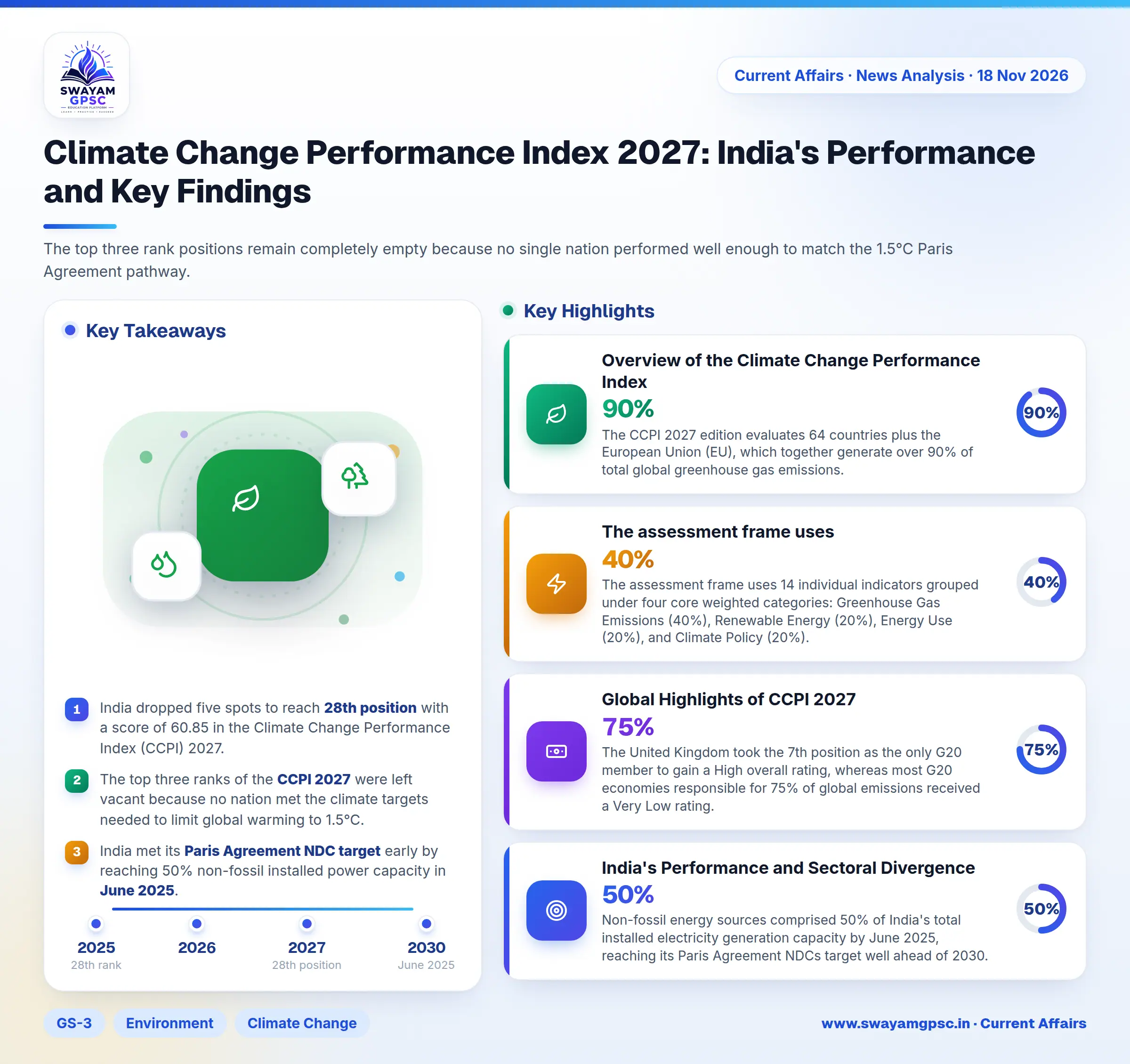
Climate Change Performance Index 2027: India's Performance and Key Findings
#GS-3 #Environment #Climate Change #Environmental Pollution & Degradation #Current Events #International #Quick Facts For Prelims
Key takeaways
- India dropped five spots to reach 28th position with a score of 60.85 in the Climate Change Performance Index (CCPI) 2027.
- The top three ranks of the CCPI 2027 were left vacant because no nation met the climate targets needed to limit global warming to 1.5°C.
- India met its Paris Agreement NDC target early by reaching 50% non-fossil installed power capacity in June 2025.
- The United Kingdom in 7th place was the only G20 nation to receive a High climate rating in this evaluation cycle.
- Major operational challenges for India's clean energy growth include grid storage bottlenecks and frequent solar power curtailment.
Why in News
- India fell five positions to secure the 28th position with a Medium overall performance rating in the Climate Change Performance Index (CCPI) 2027.
- The latest index report was officially published during the 31st Conference of the Parties (COP31) to the UNFCCC held in Antalya, Turkey.
Overview of the Climate Change Performance Index
- The Germanwatch, NewClimate Institute, and Climate Action Network (CAN) International have published this independent climate evaluation tool annually since 2005.
- The CCPI 2027 edition evaluates 64 countries plus the European Union (EU), which together generate over 90% of total global greenhouse gas emissions.
- The assessment frame uses 14 individual indicators grouped under four core weighted categories: Greenhouse Gas Emissions (40%), Renewable Energy (20%), Energy Use (20%), and Climate Policy (20%).
Global Highlights of CCPI 2027
- The top three rank positions remain completely empty because no single nation performed well enough to match the 1.5°C Paris Agreement pathway.
- Denmark secured the 4th position, maintaining its status as the leading country for the sixth year in a row, followed by Lithuania in 5th and Luxembourg in 6th.
- The United Kingdom took the 7th position as the only G20 member to gain a High overall rating, whereas most G20 economies responsible for 75% of global emissions received a Very Low rating.
- At the bottom of the rankings, Iran finished last in 68th position, with the United States in 67th and Russia in 66th.
India's Performance and Sectoral Divergence
- India logged an overall score of 60.85 to reach 28th rank, showing a continuous drop from 23rd in 2026 and 10th in 2025.
- The report assigned Medium ratings to India for Greenhouse Gas Emissions, Energy Use, and Climate Policy, while giving its total Renewable Energy category a Low rating.
- Despite the overall sector grade, India earned a High rating for its Renewable Energy trend indicator due to rapid growth in solar and wind power adoption.
- Non-fossil energy sources comprised 50% of India's total installed electricity generation capacity by June 2025, reaching its Paris Agreement NDCs target well ahead of 2030.
- The index praised several key national initiatives, including the adoption of Electric Vehicles, expansion of rooftop solar panels, industrial energy conservation programs, and the Carbon Credit Trading Scheme covering 490 industrial entities.
- However, structural bottlenecks like grid storage shortages and solar power curtailment created a gap between installed green capacity and actual power generation.