Civil Registration System Report 2024 Highlights Near Universal Birth and Death Registration
#GS-1 #GS-2 #Population #Government Policies & Interventions #Civil Registration System #National
Why in News
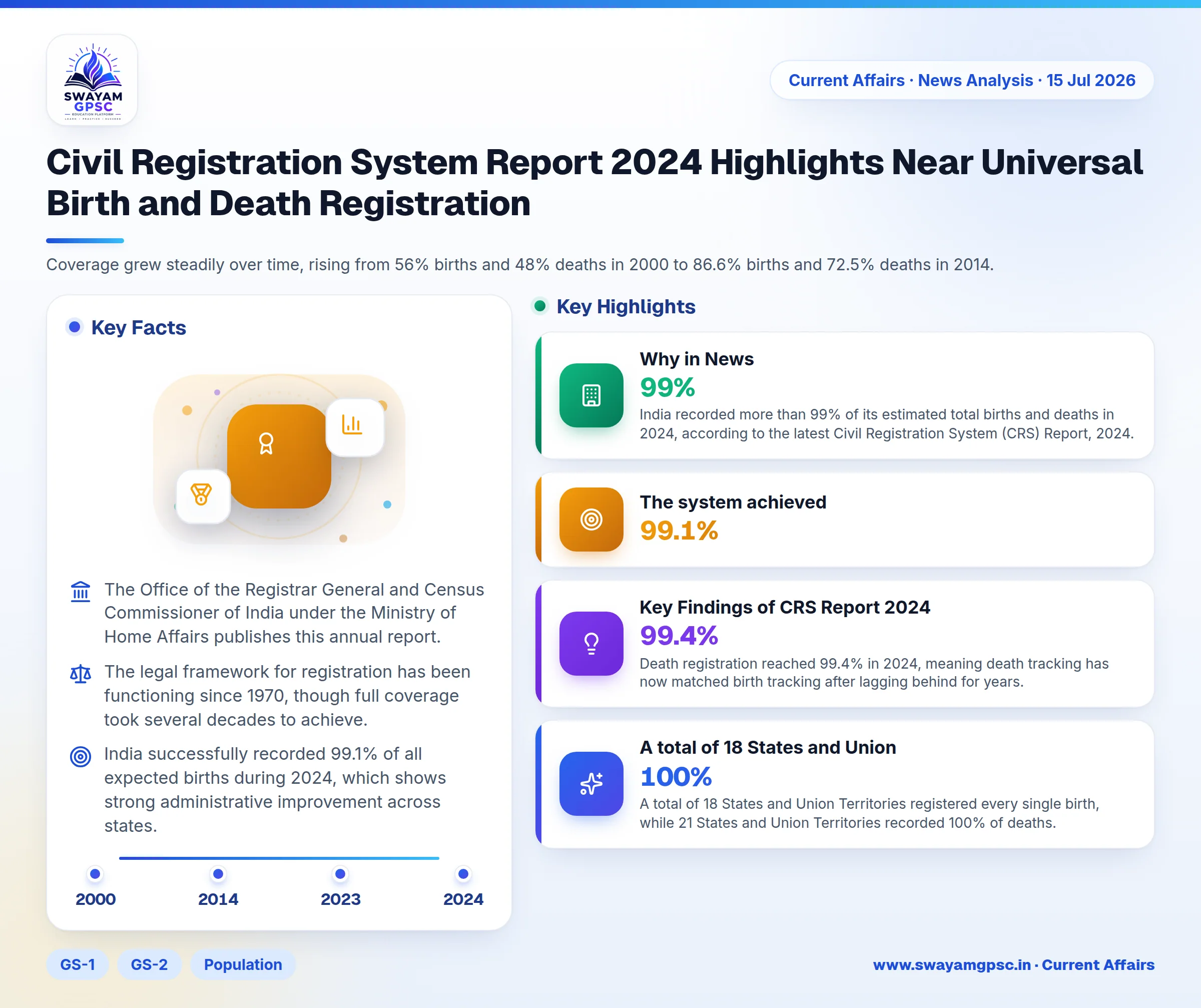
- India recorded more than 99% of its estimated total births and deaths in 2024, according to the latest Civil Registration System (CRS) Report, 2024.
- The system achieved 99.1% birth registration and 99.4% death registration in 2024, showing huge progress compared to 2000 when coverage was only 56% for births and 48% for deaths.
About the Report
- The Office of the Registrar General and Census Commissioner of India under the Ministry of Home Affairs publishes this annual report.
- This official system continuously records vital life events like births, deaths, and stillbirths under the Registration of Births and Deaths Act, 1969, which was updated in 2023.
- The legal framework for registration has been functioning since 1970, though full coverage took several decades to achieve.
Key Findings of CRS Report 2024
- India successfully recorded 99.1% of all expected births during 2024, which shows strong administrative improvement across states.
- Death registration reached 99.4% in 2024, meaning death tracking has now matched birth tracking after lagging behind for years.
- A total of 18 States and Union Territories registered every single birth, while 21 States and Union Territories recorded 100% of deaths.
- Coverage grew steadily over time, rising from 56% births and 48% deaths in 2000 to 86.6% births and 72.5% deaths in 2014.
- Many families still delay their paperwork beyond the mandatory 21-day reporting window despite overall high participation.
- Infant death recording shows a major gap, as cities accounted for 84.2% of registered infant deaths while villages reported only 15.8%.
- Registering a death does not automatically provide a verified doctor certificate, which limits how useful the data is for studying disease trends.
- Total coverage figures rely on estimates from the Sample Registration System, so actual registration percentages might be slightly lower if base estimates are incomplete.
Significance of Civil Registration
- It builds a solid national baseline for counting population numbers, fertility trends, mortality rates, and the gender ratio at birth.
- Clear registration statistics help government leaders design better public health initiatives and target social support policies accurately.
- Local administrative bodies use this granular data to plan regional facilities and public services effectively.
- Official certificates serve as essential legal identity proof required for school admissions, insurance claims, property inheritance, and welfare schemes.
- Real-time tracking of death patterns helps health authorities spot seasonal disease outbreaks and handle public health crises like pandemics.
Provisions for Registration of Births and Deaths
- The Registration of Births and Deaths Act, 1969 makes registering every birth and death compulsory at the exact place where the event occurs.
- The central registrar guides overall implementation, while regional officers and local registrars manage field operations and issue legal certificates.
- An amendment requires all administrative registration work across the nation to move online through the central digital portal starting October 2023.
- Families must report births, deaths, or stillbirths occurring after 28 weeks of pregnancy within 21 days to avoid paying late penalty fees.
- Indian citizens living abroad must register child births at local diplomatic missions under the Citizenship Act 1955.
- If parents return to live in India permanently, Section 20 of the RBD Act, 1969 grants them 60 days from arrival to complete local birth registration.
- Deaths of citizens overseas are recorded by Indian consulates and automatically held valid under domestic registration laws.
- Officials who neglect their statutory duties during the registration process face mandatory financial penalties up to Rs 1,000.
Registrar General of India
- Set up in 1949 under the Ministry of Home Affairs, this apex office directs demographic data gathering including the official Census of India and the Linguistic Survey of India.
- It leads the operational rollout of national registration laws and manages the digital system for civil data updates.
- The agency updates the National Population Register (NPR) to keep precise demographic entries for all regular residents in the country.
- An officer of Joint Secretary rank heads this authority to provide administrative leadership for population planning.