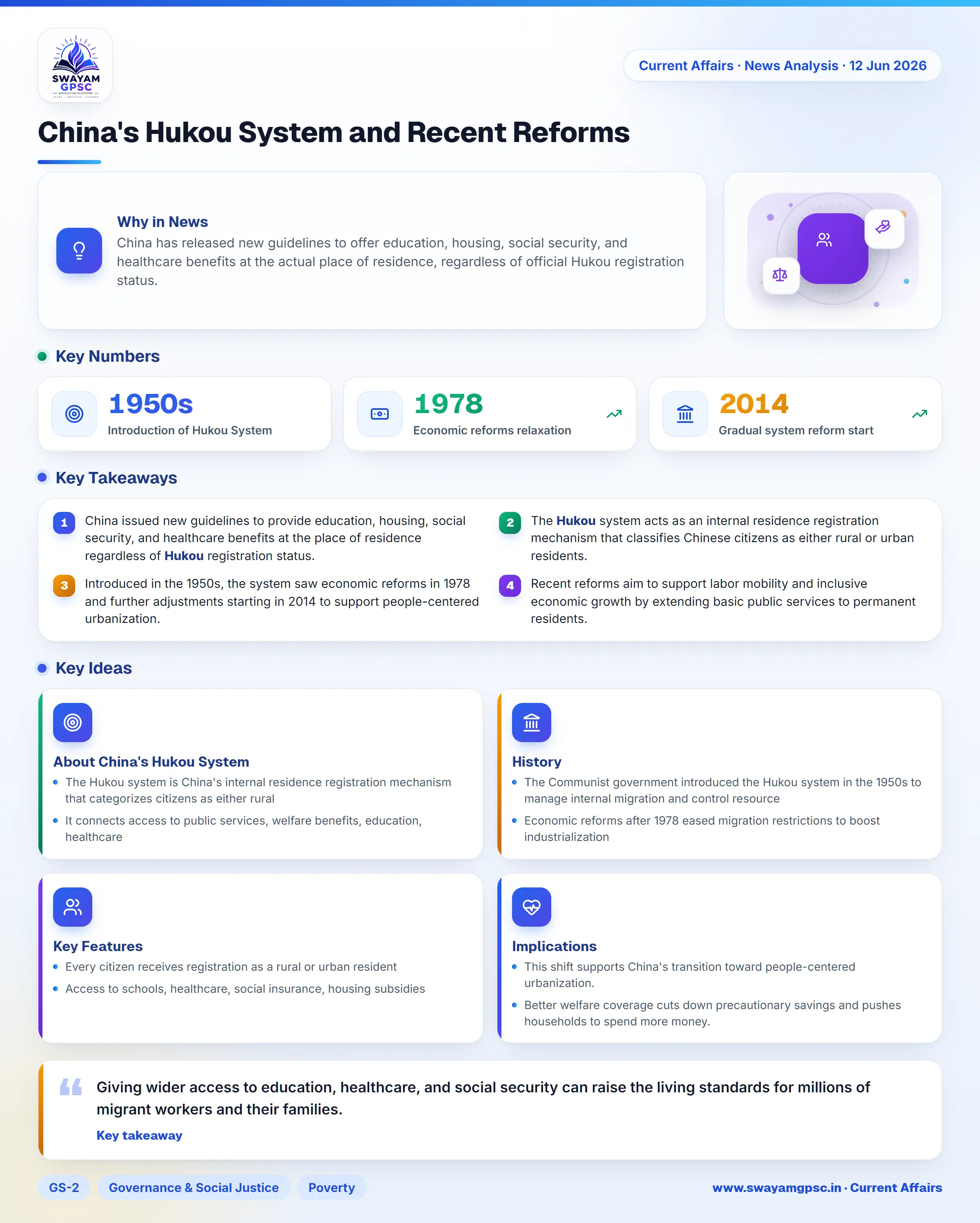
China's Hukou System and Recent Reforms
#GS-2 #Governance & Social Justice #Poverty #GS-3 #Economy #Infrastructure #Current Events #International
Key takeaways
- China issued new guidelines to provide education, housing, social security, and healthcare benefits at the place of residence regardless of Hukou registration status.
- The Hukou system acts as an internal residence registration mechanism that classifies Chinese citizens as either rural or urban residents.
- Introduced in the 1950s, the system saw economic reforms in 1978 and further adjustments starting in 2014 to support people-centered urbanization.
- Recent reforms aim to support labor mobility and inclusive economic growth by extending basic public services to permanent residents.
Why in News
- China has released new guidelines to offer education, housing, social security, and healthcare benefits at the actual place of residence, regardless of official Hukou registration status.
About China's Hukou System
- The Hukou system is China's internal residence registration mechanism that categorizes citizens as either rural or urban residents.
- It connects access to public services, welfare benefits, education, healthcare, and housing directly to a person's registered place of residence.
- People often refer to it as an internal passport system because it controls population movement and state resource distribution.
History
- The Communist government introduced the Hukou system in the 1950s to manage internal migration and control resource distribution.
- Economic reforms after 1978 eased migration restrictions to boost industrialization, but welfare benefits stayed linked to Hukou status.
- China has slowly reformed the system since 2014 to absorb migrant workers and encourage people-centered urbanization.
Key Features
- Every citizen receives registration as a rural or urban resident, which decides their eligibility for government welfare and public services.
- Access to schools, healthcare, social insurance, housing subsidies, and welfare benefits stays tied to the registered locality.
- Migrant workers often face trouble getting benefits in cities where they work because they lack official registration there.
- The system helps governments plan infrastructure, employment, and public spending based on registered populations.
- Recent reforms focus on permanent residents instead of Hukou status, bringing basic public services to migrant groups.
- The main goal is to support urbanization, labor mobility, and inclusive economic growth without completely ending the Hukou system.
Implications
- Giving wider access to education, healthcare, and social security can raise the living standards for millions of migrant workers and their families.
- This shift supports China's transition toward people-centered urbanization.
- Better welfare coverage cuts down precautionary savings and pushes households to spend more money.
- These changes fit well with China's broader strategy to move toward consumption-driven growth.