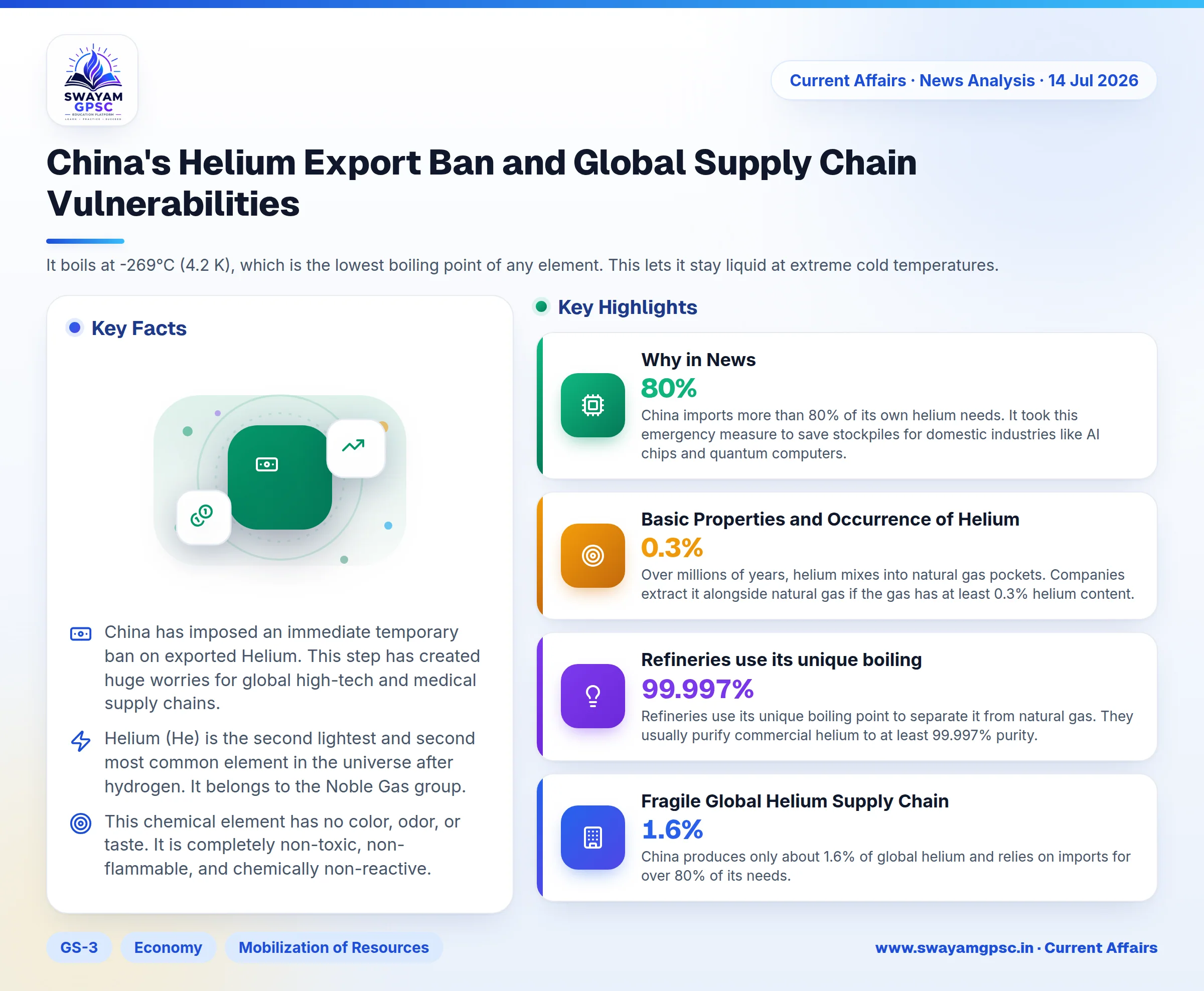
China's Helium Export Ban and Global Supply Chain Vulnerabilities
#GS-3 #Economy #Mobilization of Resources #Infrastructure #Science & Technology #Energy #Current Events #International #Helium Export Ban
Why in News
- China has imposed an immediate temporary ban on exported Helium. This step has created huge worries for global high-tech and medical supply chains.
- China imports more than 80% of its own helium needs. It took this emergency measure to save stockpiles for domestic industries like AI chips and quantum computers.
Basic Properties and Occurrence of Helium
- Helium (He) is the second lightest and second most common element in the universe after hydrogen. It belongs to the Noble Gas group.
- This chemical element has no color, odor, or taste. It is completely non-toxic, non-flammable, and chemically non-reactive.
- It boils at -269°C (4.2 K), which is the lowest boiling point of any element. This lets it stay liquid at extreme cold temperatures.
- Earth holds a non-renewable supply of helium. Heavy radioactive elements like uranium decay deep underground to produce this gas.
- Over millions of years, helium mixes into natural gas pockets. Companies extract it alongside natural gas if the gas has at least 0.3% helium content.
- Refineries use its unique boiling point to separate it from natural gas. They usually purify commercial helium to at least 99.997% purity.
- Factories can also collect tiny amounts from LNG plants or air. However, these minor sources cannot satisfy global demand.
Fragile Global Helium Supply Chain
- China produces only about 1.6% of global helium and relies on imports for over 80% of its needs. Most production happens in the United States, Qatar, and Russia, while Canada and Algeria also supply key amounts.
- Trade limits on Russian exports and global transport problems have made the helium market very tight.
- Qatar supplies most of Asia's helium. Because ships must pass through the Strait of Hormuz, conflict in West Asia threatens global supplies.
- Companies must store and ship helium as a super-cold liquid in special double-walled steel containers. China manufactures most of these containers.
- If shipments face delays, the liquid warms up and boils off into air. This loss makes quick transportation essential.
- India imports 100% of its helium needs, and gets over 50% from Qatar. This reliance leaves Indian hospitals, chip makers, and labs open to supply risks.
- A supply disruption in March 2026 at Qatar's Ras Laffan complex caused shortages in India. As a result, local helium prices jumped by 35-50%.
Key Applications and Strategic Importance of Helium
- In healthcare, helium serves as a cold liquid to keep MRI magnets super-conductive. This cooling is vital for running scanners in rural hospitals and controlling diagnostic costs.
- In chip manufacturing, helium cools silicon wafers quickly without reacting with chemicals. This makes it a crucial input for the India Semiconductor Mission (ISM).
- In space tech, helium stays gas even next to liquid hydrogen fuel. ISRO uses it to pressurize fuel tanks in LVM3 rockets and the Gaganyaan mission.
- In quantum computing, helium stays liquid near absolute zero to cool quantum processors. It supports basic security goals under the National Quantum Mission.
- In telecommunications, helium cools hot drawn glass rapidly to make clear glass fibers. It helps produce quality cables for BharatNet and 5G networks.
- In defense and nuclear plants, tiny helium atoms easily pass through invisible leaks. Technicians use it to inspect high-pressure tanks and maintain nuclear safety.
Domestic Helium Reserves in India
- The Bakreshwar hot springs in West Bengal release gas containing 1.4% helium. It remains India's most promising natural source.
- The Variable Energy Cyclotron Centre (VECC) under the Department of Atomic Energy (DAE) set up a test plant at Bakreshwar to collect and purify helium.
- The monazite beach sands in Kerala contain thorium and uranium decay products. These sands hold helium, but harvesting it costs a lot of money.
- The government asked ONGC to check natural gas blocks in the Godavari basin for helium. However, Indian gas fields hold far less helium than US or Qatari reserves.
Key Questions on Global Helium Supply
- The United States, Qatar, and Russia lead global helium output. India imports 100% of its demand, getting over 50% from Qatar.
- Helium boils at -269°C and does not burn or react with other chemicals. These properties make it ideal for MRI scanners and chip making.
- The supply drop at Qatar's Ras Laffan complex in March 2026 created shortages in India and raised prices by 35-50%.
- Helium cools silicon chips and keeps quantum bits stable. This makes it vital for the India Semiconductor Mission and the National Quantum Mission.