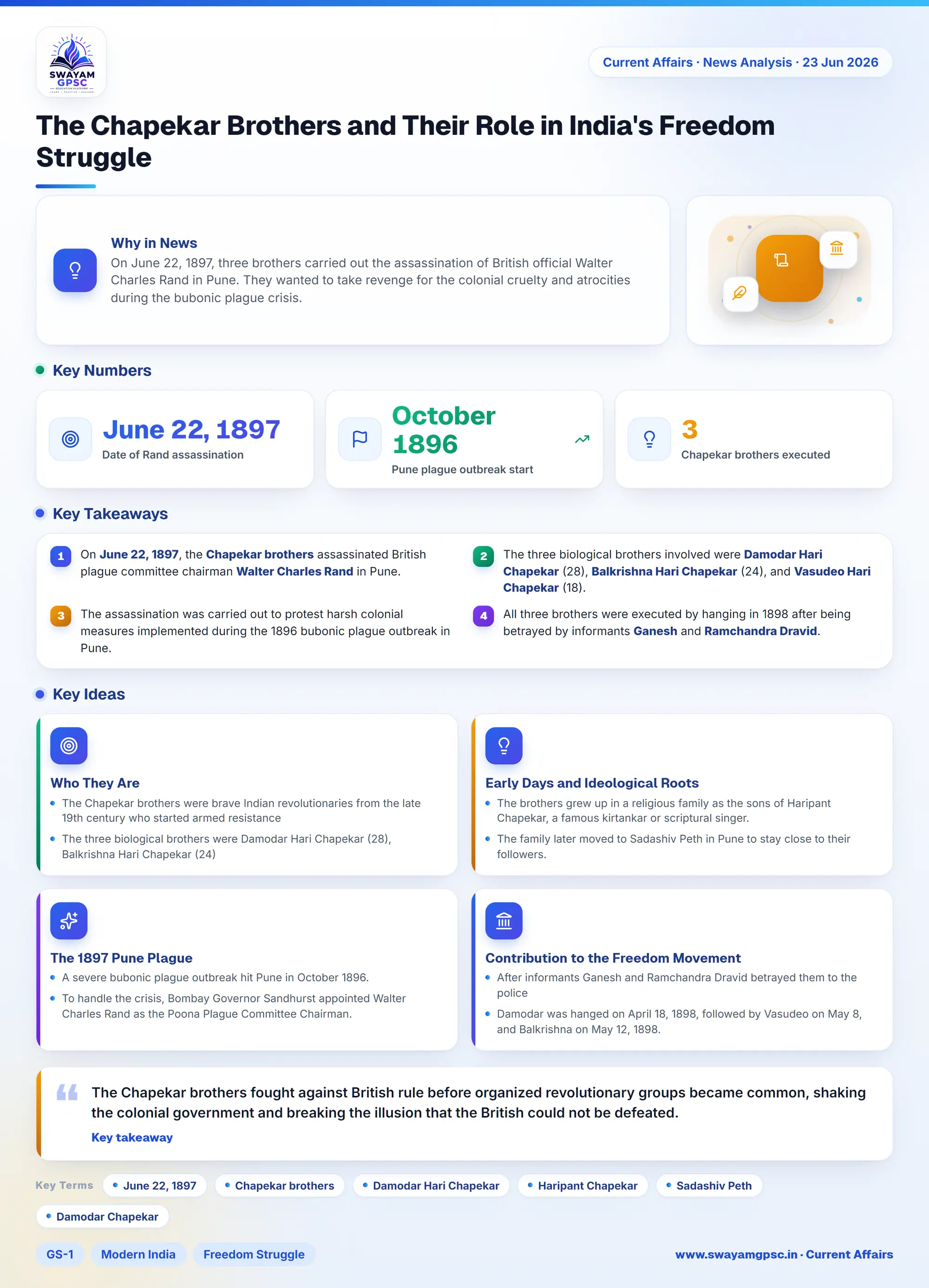
The Chapekar Brothers and Their Role in India's Freedom Struggle
#GS-1 #Modern India #Freedom Struggle #History #Culture #Mahagujarat Movement
Key takeaways
- On June 22, 1897, the Chapekar brothers assassinated British plague committee chairman Walter Charles Rand in Pune.
- The three biological brothers involved were Damodar Hari Chapekar (28), Balkrishna Hari Chapekar (24), and Vasudeo Hari Chapekar (18).
- The assassination was carried out to protest harsh colonial measures implemented during the 1896 bubonic plague outbreak in Pune.
- All three brothers were executed by hanging in 1898 after being betrayed by informants Ganesh and Ramchandra Dravid.
Why in News
- On June 22, 1897, three brothers carried out the assassination of British official Walter Charles Rand in Pune.
- They wanted to take revenge for the colonial cruelty and atrocities during the bubonic plague crisis.
Who They Are
- The Chapekar brothers were brave Indian revolutionaries from the late 19th century who started armed resistance against British rule.
- The three biological brothers were Damodar Hari Chapekar (28), Balkrishna Hari Chapekar (24), and Vasudeo Hari Chapekar (18).
- They originally came from the Konkan region and hold a unique place in history as the only set of three biological brothers hanged for India's freedom.
Early Days and Ideological Roots
- The brothers grew up in a religious family as the sons of Haripant Chapekar, a famous kirtankar or scriptural singer.
- The family later moved to Sadashiv Peth in Pune to stay close to their followers.
- Listening to religious stories from childhood, Damodar Chapekar often wondered why his generation could not fight the British oppressors the same way people fought demons in mythology.
- The brothers drew deep inspiration from the armed struggle of Vasudev Balwant Phadke.
- They were also strong followers of nationalist leader Lokmanya Tilak and read his bold newspaper Kesari regularly.
The 1897 Pune Plague and the Assassination
- A severe bubonic plague outbreak hit Pune in October 1896.
- To handle the crisis, Bombay Governor Sandhurst appointed Walter Charles Rand as the Poona Plague Committee Chairman.
- British soldiers forced harsh and insulting rules on local people, entering private homes with leather boots and violating sacred home spaces.
- Angry at these actions, the brothers planned to kill Rand during Queen Victoria’s Diamond Jubilee celebration on June 22, 1897, even sending him a warning letter beforehand.
- They waited near the Mutha river bridge and used their secret code Gondya ala re, which they originally used at home to warn each other when their government-employed uncle walked in.
- Due to poor visibility in the dark, the youngest brother Vasudeo signaled for the wrong carriage, leading Balkrishna to shoot and kill Lieutenant Charles Ayerst by mistake.
- Realizing the mistake quickly, Damodar jumped onto the second carriage and shot Rand, who later died from his wounds on July 3.
Contribution to the Freedom Movement and Significance
- The Chapekar brothers fought against British rule before organized revolutionary groups became common, shaking the colonial government and breaking the illusion that the British could not be defeated.
- After informants Ganesh and Ramchandra Dravid betrayed them to the police, the three brothers received death sentences.
- Damodar was hanged on April 18, 1898, followed by Vasudeo on May 8, and Balkrishna on May 12, 1898.
- Damodar wrote about his deep love for the country in his memoir titled Musings from the Gallows.
- The supreme sacrifice of the Chapekar brothers inspired many others, moving a young Vinayak Damodar Savarkar in Nashik to take an oath before goddess Durga to finish their work.