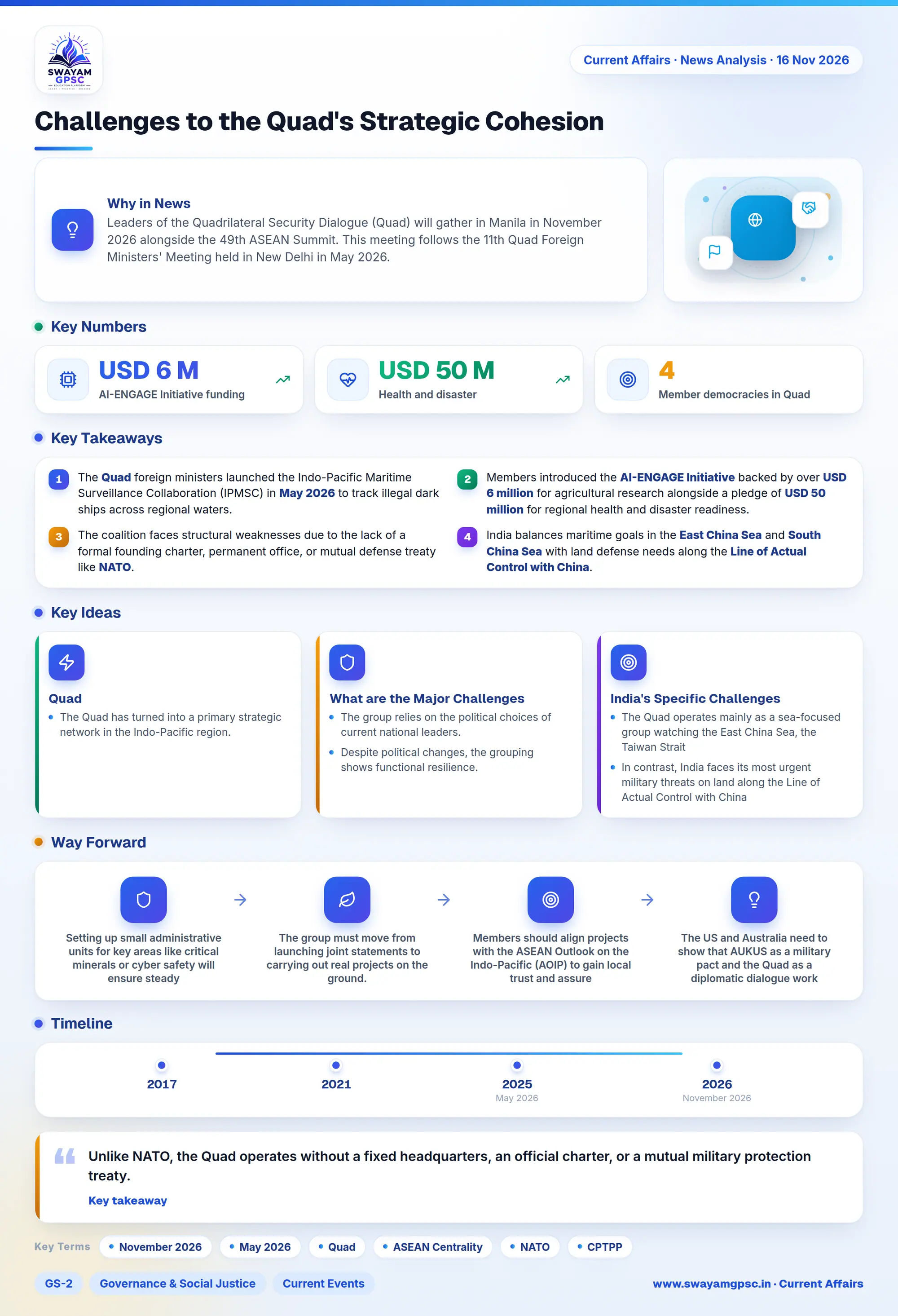
Challenges to the Quad's Strategic Cohesion
#GS-2 #Governance & Social Justice #Current Events #International #Quadrilateral Security Dialogue #Bilateral Groupings & Agreements #Indo-Pacific
Key takeaways
- The Quad foreign ministers launched the Indo-Pacific Maritime Surveillance Collaboration (IPMSC) in May 2026 to track illegal dark ships across regional waters.
- Members introduced the AI-ENGAGE Initiative backed by over USD 6 million for agricultural research alongside a pledge of USD 50 million for regional health and disaster readiness.
- The coalition faces structural weaknesses due to the lack of a formal founding charter, permanent office, or mutual defense treaty like NATO.
- India balances maritime goals in the East China Sea and South China Sea with land defense needs along the Line of Actual Control with China.
Why in News
- Leaders of the Quadrilateral Security Dialogue (Quad) will gather in Manila in November 2026 alongside the 49th ASEAN Summit.
- This meeting follows the 11th Quad Foreign Ministers' Meeting held in New Delhi in May 2026.
- The gathering occurs as experts raise questions about the long-term unity and organizational drive of the group.
Summary
- The Quad has turned into a primary strategic network in the Indo-Pacific region. It helps India boost sea security, balance China's growing power, and maintain independent policy choices without entering an official military compact.
- Even so, differing national goals, weak formal structures, deep trade ties with China, and shifting US plans create testy obstacles to group unity.
- The future strength of the Quad depends on supplying helpful public assets to the region while preserving ASEAN Centrality and keeping the Indo-Pacific area open to all.
What are the Major Challenges to the Quad's Strategic Cohesion?
- Unlike NATO, the Quad operates without a fixed headquarters, an official charter, or a mutual military protection treaty.
- The group relies on the political choices of current national leaders. Because all four countries are democracies, changing local elections, coalition politics, and shifting government plans can disrupt progress.
- Despite political changes, the grouping shows functional resilience. Even though leaders skipped a formal summit in 2025, foreign ministers met regularly and started the Indo-Pacific Maritime Surveillance Collaboration (IPMSC) in May 2026.
- This ongoing work indicates that regular cooperation relies less on top-level leader summits.
- The Quad lacks a clear economic strategy to offer Southeast Asia a strong choice against China's Belt and Road Initiative (BRI) or market control.
- The four nations have no shared free trade agreement. Since the US and India stay out of large regional trade blocks like the CPTPP and RCEP, the group offers limited economic deterrence.
- Unilateral trade taxes, protective commerce rules, and supply network interruptions created tension among members in 2025, threatening to weaken overall geopolitical unity.
- To avoid being called an Asian military bloc, the Quad expanded its goals into non-traditional areas like climate issues, vaccines, STEM fellowships, and space projects.
- Some analysts worry this wide range of projects might weaken strategic priorities, but work on critical tech, supply chains, ocean tracking, and disaster relief builds regional trust.
- The main task is balancing core security goals with direct benefits for neighboring nations.
- The long-term impact of the group depends on the ongoing US Pivot to Asia.
- However, global distractions like the Russia-Ukraine War, conflicts in West Asia, and calls for members to spend more on their own defense make partners doubt long-term US attention in the Indo-Pacific.
- Uncertainty in Washington leads Indo-Pacific partners to build security links outside the main group.
- Through its One Cooperative Effort Among Nations (OCEAN) initiative, Japan is modernizing its defense stance and building direct security ties with regional partners.
- The Japan-Australia-India (JAI) defense meeting in Cebu in the Philippines highlights how regional powers are ready to collaborate on hard security without direct US guidance.
- European countries like France are expanding ties with regional partners to maintain balance across the area.
- India actively builds varied defense ties with friendly nations across the Indian Ocean Region and Southeast Asia.
India's Specific Challenges and Dilemmas Within the Quad
- The Quad operates mainly as a sea-focused group watching the East China Sea, the Taiwan Strait, and the South China Sea.
- In contrast, India faces its most urgent military threats on land along the Line of Actual Control with China and its border with Pakistan.
- The group offers no direct military support for India's mountain borders, creating an imbalance in shared defense responsibilities.
- Russia sees the Quad as an exclusive coalition led by Washington.
- India must maintain diplomatic balance so its work with the group does not damage ties with Moscow, which remains a key supplier of weapons like S-400 systems and affordable energy.
- This approach contrasts sharply with the heavy economic sanctions supported by the other three members.
- While the US promotes a Free and Open Indo-Pacific (FOIP) model, India stresses an open, multipolar structure through its MAHASAGAR vision.
- Different strategic targets and views on handling China create difficulties in maintaining a single policy line.
- India works carefully to remain a leading voice for the Global South.
- Building close military links with three wealthy Western-aligned nations risks harming India's non-aligned reputation among developing countries that view the group as a tool for Western power.
- India often disagrees with Japan and the US on global data rules inside tech working groups.
- While the US and Japan promote the Data Free Flow with Trust (DFFT) model, India insists on data localization rules, national digital rights, and trade protections.
Quad
- The Quad is an informal strategic and diplomatic partnership among four democracies: India, the United States, Japan, and Australia.
- Its main target is to keep the Indo-Pacific free, open, inclusive, and prosperous while supporting democratic principles, legal rules, sea navigation freedoms, and protection from pressure.
- The partnership began as a joint emergency relief team following the 2004 Indian Ocean tsunami.
- Former Japanese Prime Minister Shinzo Abe proposed it as a strategic dialogue in 2007, members revived it in 2017 as Quad 2.0 to handle China's growing military power, and leaders raised it to top-level summits in 2021.
- Unlike NATO, the group is not a military alliance and has no mutual defense treaty, fixed office, or charter. It functions as a flexible group built around specific issues.
- Members combine resources to support the region in specific areas.
- They work on ocean safety by improving domain awareness against illegal fishing and dark ships while hosting joint naval exercises like Malabar.
- They build economic stability by securing critical mineral paths, setting up safe communications like Open RAN, and funding new tools like Artificial Intelligence.
- They coordinate disaster relief, climate plans, and public health projects across Southeast Asia and the broader region.
- India uses the group to balance China's power without joining a formal military bloc, preserving its independent foreign policy strategy.
- The initiative boosts India's capability in ocean awareness through the Indo-Pacific Partnership for Maritime Domain Awareness (IPMDA) and solidifies its position as a primary security provider in the Indian Ocean Region.
- Group projects support the wider China+1 strategy, helping India become an attractive base for manufacturing and international supply lines.
Recent Strategic Milestones of the Quad (2025-2026)
- Members established the Indo-Pacific Maritime Surveillance Collaboration (IPMSC) in May 2026 to improve ocean tracking of illegal dark ships through space, air, and sea tools.
- The group reaffirmed support for the ASEAN Outlook on the Indo-Pacific (AOIP) in July 2026 to strengthen regional cooperation and address concerns about local organizations being ignored.
- Partners launched the Quad Critical Minerals Initiative to diversify rare earth supply networks, encourage processing investments, and reduce economic reliance on China.
- To protect regional communications against cyber threats, the group funds undersea internet cables for Pacific Island nations and supports secure Open RAN phone standards.
- The group introduced the AI-ENGAGE Initiative with over USD 6 million to support farming research using artificial intelligence and robotics.
- Members pledged over USD 50 million to improve regional public health capabilities and emergency response systems across the Indo-Pacific.
Way Forward
- Setting up small administrative units for key areas like critical minerals or cyber safety will ensure steady progress through leadership changes, even without a formal military treaty.
- The group must move from launching joint statements to carrying out real projects on the ground. Offering high-quality construction, Open RAN tech standards, and climate funding provides local partners with a reliable alternative to China's Belt and Road Initiative (BRI).
- Members should align projects with the ASEAN Outlook on the Indo-Pacific (AOIP) to gain local trust and assure Southeast Asian nations they remain central to regional plans.
- The US and Australia need to show that AUKUS as a military pact and the Quad as a diplomatic dialogue work together smoothly rather than competing.
- To keep India fully engaged, the group must direct more attention to the Indian Ocean Region to counter China's influence by building facilities in East Africa and island states.
- Working with partners like South Korea, Vietnam, and France on target areas like supply lines will expand the group's reach without complicating main decision-making.
Conclusion
- The group's future success depends on balancing shared security targets with independent foreign policies.
- By improving sea security, securing supply lines, and delivering real public benefits while respecting local leadership, the group can help build a free, open, and rules-based Indo-Pacific.