Challenges of Journalism in India
#GS-2 #GS-3 #Indian Polity & Constitution #Governance & Social Justice #Current Events #Economy #Infrastructure #Misinformation #Article 19 #Telecom Regulatory Authority of India #Press Council of India #World Press Freedom Index
Key takeaways
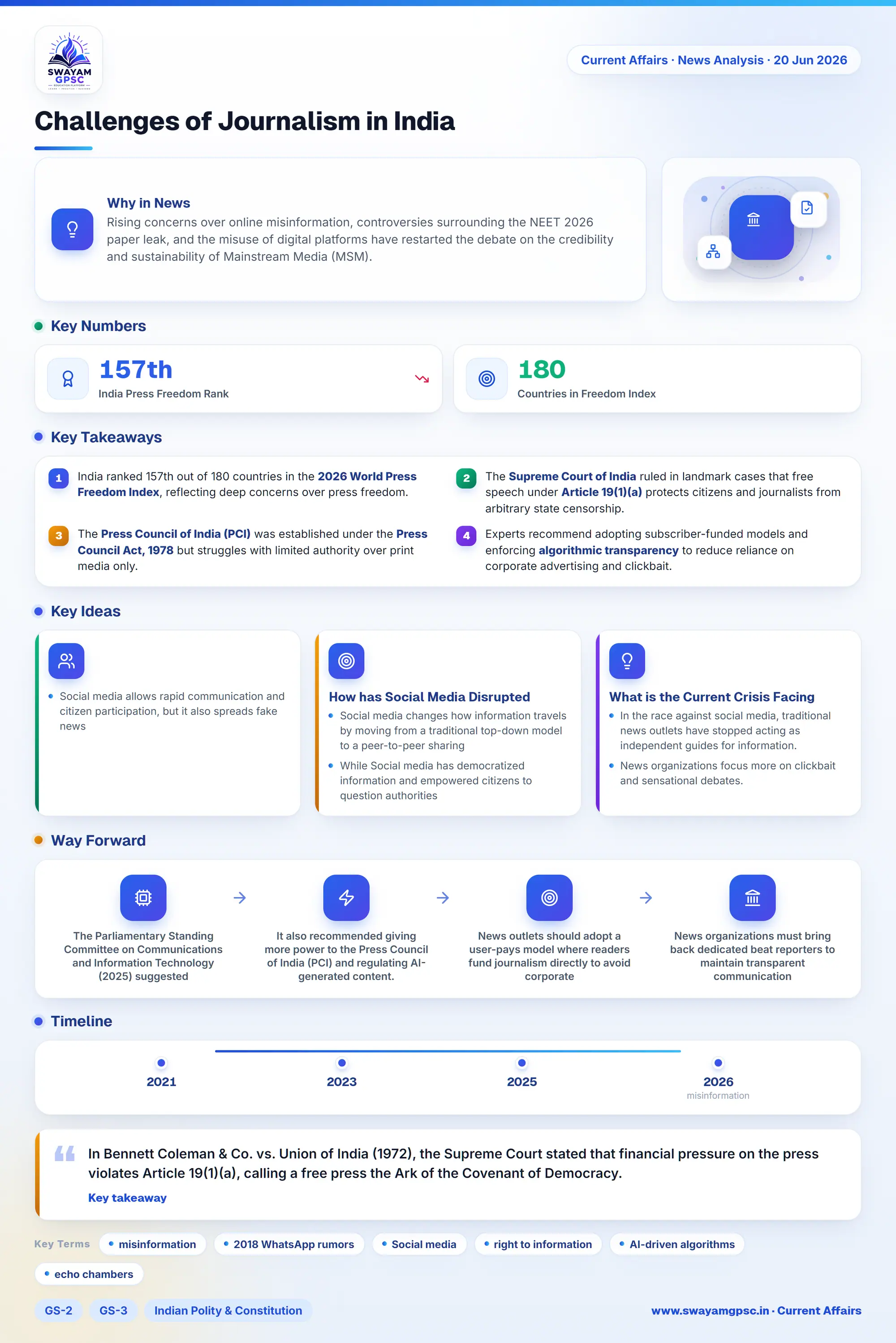
- India ranked 157th out of 180 countries in the 2026 World Press Freedom Index, reflecting deep concerns over press freedom.
- The Supreme Court of India ruled in landmark cases that free speech under Article 19(1)(a) protects citizens and journalists from arbitrary state censorship.
- The Press Council of India (PCI) was established under the Press Council Act, 1978 but struggles with limited authority over print media only.
- Experts recommend adopting subscriber-funded models and enforcing algorithmic transparency to reduce reliance on corporate advertising and clickbait.
Why in News
- Rising concerns over online misinformation, controversies surrounding the NEET 2026 paper leak, and the misuse of digital platforms have restarted the debate on the credibility and sustainability of Mainstream Media (MSM).
- Experts point out that a robust, independent, and subscriber-supported media setup is vital for protecting public conversations and democratic governance.
Summary
- Social media allows rapid communication and citizen participation, but it also spreads fake news, creates echo chambers, and causes societal division through algorithm-driven content.
- Mainstream media struggles with corporate influence, weak rules, and political pressures, making reforms like algorithmic transparency, anti-SLAPP laws, and reader-funded journalism necessary.
How has Social Media Disrupted the Flow of Information
- Social media changes how information travels by moving from a traditional top-down model to a peer-to-peer sharing model.
- While Social media has democratized information and empowered citizens to question authorities, it has also created a state of information disorder.
- False rumors can trigger real-world violence and disorder. For instance, 2018 WhatsApp rumors about child kidnappers led to fatal mob lynchings across multiple states.
- Huge amounts of unverified rumors spread quickly on Social media, creating public panic and social instability.
- Fabricated news can alter voter opinions during elections, which harms the democratic system.
- Fake news damages the right to information guaranteed under Article 19 and affirmed by the *Supreme Court of India in Raj Narayan vs. Uttar Pradesh Government (1975)*.
- Platforms use AI-driven algorithms to personalize user feeds based on watch time and scrolling habits.
- These systems prioritize engagement by showing content that matches existing beliefs.
- This practice builds echo chambers and filter bubbles, which deepen societal divides.
What is the Current Crisis Facing Mainstream Media
- In the race against social media, traditional news outlets have stopped acting as independent guides for information.
- News organizations focus more on clickbait and sensational debates. The growing trend of corporate-controlled media and profit-driven reporting pushes genuine public issues aside.
- The media serves as the fourth pillar of democracy and should act as an unbiased guide, but many outlets abandon this duty.
- By focusing on sensationalism or Yellow Journalism, news channels ignore their ethical duty to educate the public.
- Although the Directive Principles of State Policy (DPSP) promote scientific thinking, some prime-time television programs air unverified claims that weaken critical thinking.
Corporate Monopolization and Lawfare
- When large corporate groups buy news channels, it leads to self-censorship and hides news that hurts the parent company's business interests.
- Companies often file Strategic Lawsuits Against Public Participation (SLAPP) to drain the financial resources of investigative journalists.
- Despite warnings from the Telecom Regulatory Authority of India (TRAI) about market dominance, India lacks statutory firewalls to regulate cross-media holdings.
- In *Secretary, Ministry of I&B vs. CAB (1995)*, the Supreme Court ruled that airwaves belong to the public and directed the state to prevent corporate monopolies.
State Coercion and Executive Overreach
- In *Madhyamam Broadcasting Ltd. vs. Union of India (2023)*, the Supreme Court rejected the misuse of national security arguments to cancel broadcast licenses.
- However, authorities still use tough laws like the Unlawful Activities (Prevention) Act 1967, the Prevention of Money Laundering Act, 2002 (PMLA), and defamation charges against critical reporters.
- Governments sometimes use the grant or cancellation of Directorate of Advertising and Visual Publicity (DAVP) funds to force favorable news coverage.
- In *Bennett Coleman & Co. vs. Union of India (1972)*, the Supreme Court stated that financial pressure on the press violates Article 19(1)(a), calling a free press the *Ark of the Covenant of Democracy*.
Institutional and Regulatory Deficits
- Created under the Press Council Act, 1978, the Press Council of India (PCI) is a quasi-judicial body meant to protect press standards.
- Its power is weak because it cannot punish violators and only oversees print media.
- The PCI cannot regulate television, digital news sites, or paid news practices.
- The Information Technology (Intermediary Guidelines and Digital Media Ethics Code) Rules, 2021 set up a self-monitoring system supervised by a government committee.
- This arrangement creates worries about government interference in digital publishing under Article 19(1)(a).
- In *Shreya Singhal vs. Union of India (2015)*, the Supreme Court struck down Section 66A of the IT Act because vague laws create a chilling effect on free speech.
- Physical threats and attacks on reporters continue to hurt press freedom.
- Because of these issues, India ranked 157th out of 180 countries in the 2026 World Press Freedom Index by Reporters Without Borders.
The Societal and Democratic Cost
- People complain about poor media standards while continuing to consume dangerous and unverified free content from anonymous social media accounts.
- As traditional reporting fades and leaders avoid media questions, the lack of trusted communication harms social stability.
Way Forward
- The Parliamentary Standing Committee on Communications and Information Technology (2025) suggested fact-checking rules, internal ombudsmen, clearer definitions of fake news, and stricter penalties.
- It also recommended giving more power to the Press Council of India (PCI) and regulating AI-generated content.
- News outlets should adopt a user-pays model where readers fund journalism directly to avoid corporate and political bias.
- News organizations must bring back dedicated beat reporters to maintain transparent communication between the public and the government.
- The government must pass anti-SLAPP laws to shield investigative reporters from malicious lawsuits.
- Authorities must respect the right to free speech under Article 19(1)(a) and stop misusing anti-terror laws against journalists.
- Social media companies must adjust their algorithms to favor verified facts over emotional clickbait.
- Schools should teach media literacy so students can spot misinformation and identify credible sources.
- Australia’s News Media Bargaining Code requires tech giants to pay news publishers for their content, helping independent journalism survive.
- The European Union’s Digital Services Act (DSA) forces large tech platforms to address fake news and election interference through transparent algorithms.