The Challenge of India's Digital Sovereignty
#GS-3 #Economy #Infrastructure #Science & Technology #ICT #Cyber Security #GS-2 #Government Policies & Interventions #Governance & Social Justice #Current Events #National
Key takeaways
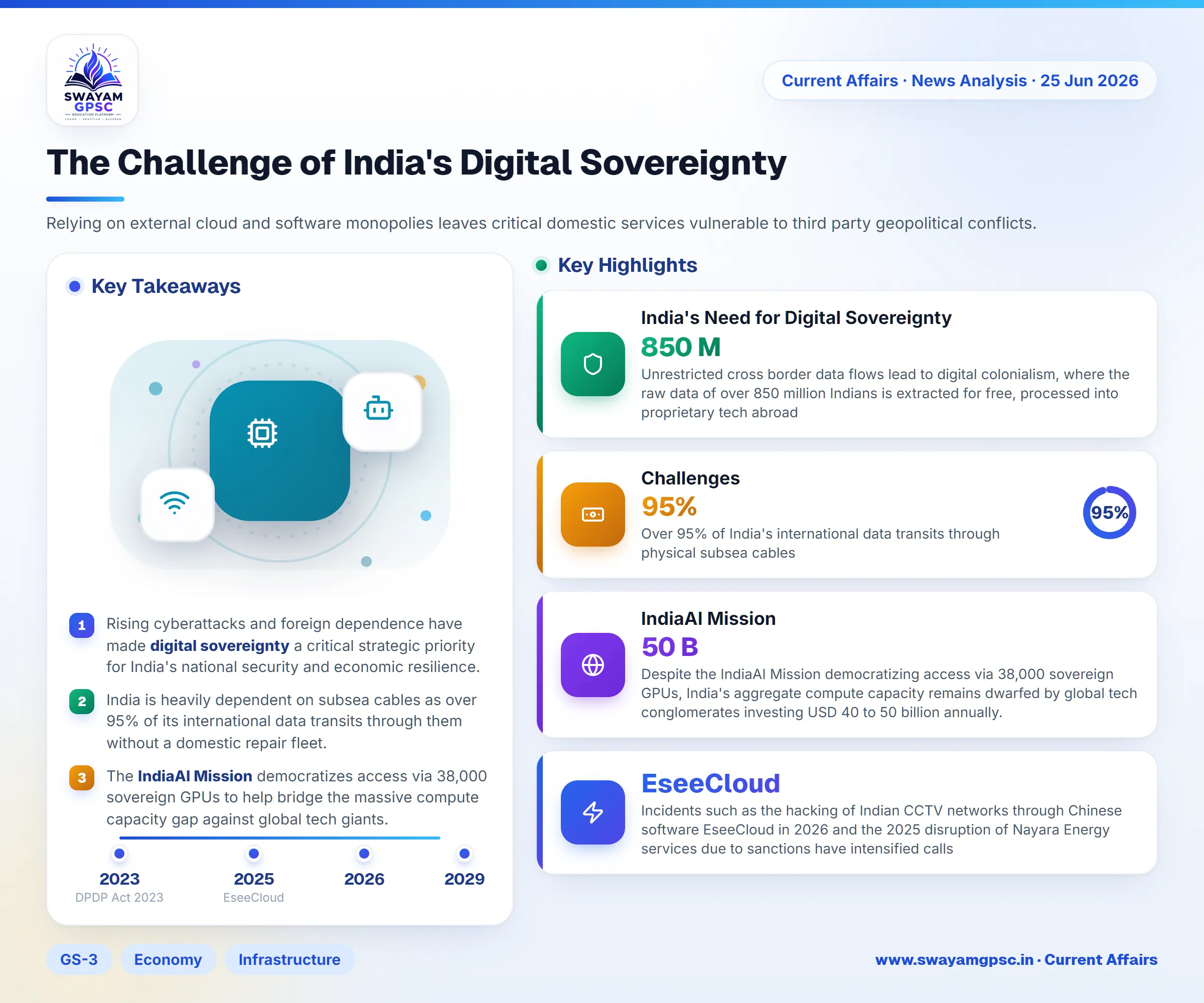
- Rising cyberattacks and foreign dependence have made digital sovereignty a critical strategic priority for India's national security and economic resilience.
- India is heavily dependent on subsea cables as over 95% of its international data transits through them without a domestic repair fleet.
- The IndiaAI Mission democratizes access via 38,000 sovereign GPUs to help bridge the massive compute capacity gap against global tech giants.
- The Digital Personal Data Protection Act, 2023 establishes a robust legal framework to restrict unauthorized cross-border data transfers and protect citizen data.
Why in News
- Rising cyberattacks and global geopolitical tensions have exposed India's dependence on foreign digital infrastructure.
- Incidents such as the hacking of Indian CCTV networks through Chinese software EseeCloud in 2026 and the 2025 disruption of Nayara Energy services due to sanctions have intensified calls for strengthening digital sovereignty.
Summary
- Rising cyberattacks and geopolitical tensions have exposed India's dependence on foreign digital infrastructure, making digital sovereignty a strategic necessity for national security, economic resilience, and technological autonomy.
- India is pursuing digital sovereignty through initiatives such as the India Semiconductor Mission, IndiaAI Mission, Digital Public Infrastructure (UPI, ONDC, MeghRaj), and stronger legal, cybersecurity, and quantum technology frameworks to reduce dependence on foreign technology.
Digital Sovereignty
- This refers to a nation's ability to exercise effective and independent control over its digital infrastructure, data, critical technologies, and communication networks, free from undue influence by foreign corporations or governments.
- It encompasses Data Sovereignty regarding data localisation and privacy, Computational Sovereignty over computing and AI infrastructure, and Technological Autonomy for indigenous hardware and software supply chains.
India's Need for Digital Sovereignty
- Modern defence systems from fighter aircraft to early warning radars rely heavily on embedded code controlled by foreign manufacturers.
- This dependence creates massive national security vulnerabilities, as foreign vendors could theoretically activate remote kill switches to disrupt operations, mirroring strategic risks exposed by the denial of GPS support during the 1999 Kargil War.
- Data localization as a physical storage practice is a flawed defense.
- Under laws like the US CLOUD Act, American headquartered tech companies can be legally forced to surrender Indian data to the US government, even if the servers are physically located in Mumbai or Delhi.
- Relying on external cloud and software monopolies leaves critical domestic services vulnerable to third party geopolitical conflicts.
- The 2025 Nayara Energy disruption where Microsoft suspended the Indian refinery cloud services to enforce unilateral EU sanctions demonstrated how foreign providers can instantly paralyze critical Indian economic assets.
- Relying on foreign Artificial Intelligence models effectively outsources cognitive autonomy.
- These models encode external cultural biases and legal doctrines, which can distort domestic policy, judicial interpretations, and strategic decision making at the expense of India's national interests.
- The weaponization of the SWIFT global financial messaging system against geopolitical rivals proves that reliance on Western dominated financial routing is a severe strategic liability, and India must insulate its macroeconomic ecosystem from unilateral financial sanctions.
- Unrestricted cross border data flows lead to digital colonialism, where the raw data of over 850 million Indians is extracted for free, processed into proprietary tech abroad, and sold back to Indian markets.
- Additionally, foreign trade agreements that demand broad access to government data or restrict source code disclosure severely weaken India's regulatory oversight and AI competitiveness.
- Digital sovereignty is impossible without hardware autonomy, and total dependence on imported semiconductors exposes India's critical infrastructure to hardware trojans, supply chain blockades, and sudden export controls.
- Initiatives like the India Semiconductor Mission are vital to building a secure, trusted domestic chip manufacturing ecosystem.
- According to the Power Transition Theory, as a rising power approaches economic and strategic parity with an established global hegemon, the hegemon will systematically deploy structural barriers to contain it, as evident in the US-China Tech Cold War.
- Building indigenous digital capabilities ensures India is not subjected to external technological coercion and retains completely independent decision making on the global stage.
Challenges
- While the India Semiconductor Mission (ISM) is successfully scaling domestic chip packaging, achieving front end fabrication relies on foreign Extreme Ultraviolet lithography and precision chemicals, leaving India exposed to export controls and hardware trojans.
- Over 95% of India's international data transits through physical subsea cables, and lacking a domestically flagged cable repair fleet leaves India's digital economy highly vulnerable to bandwidth blackouts during maritime sabotage or conflict.
- Despite the IndiaAI Mission democratizing access via 38,000 sovereign GPUs, India's aggregate compute capacity remains dwarfed by global tech conglomerates investing USD 40 to 50 billion annually.
- This deficit risks forcing India to rely on foreign foundation models that encode external biases.
- The DPDP Act 2023 enforces data privacy but cannot mandate platform sovereignty because India cannot audit the proprietary source code of foreign software used in critical sectors like aviation, banking, and power, allowing hidden software backdoors to remain undetected.
- The impending arrival of quantum computing threatens to instantly break the encryption securing India's digital infrastructure via Harvest Now and Decrypt Later attacks.
- The Department of Science and Technology roadmap mandates migrating Critical Information Infrastructure (CII) to Post Quantum Cryptography by 2029, which remains a massive financial and logistical hurdle.
- During negotiations for Free Trade Agreements and the Indo-Pacific Economic Framework (IPEF), developed nations continuously push for unrestricted cross border data flows and bans on source code audits, directly conflicting with India's sovereign policy goals.
- India lacks aggressive foundational representation in bodies like the International Telecommunication Union (ITU).
- Relying on foreign Standard Essential Patents forces India to pay massive royalties and adapt to foreign designed telecom architectures.
- India suffers a talent drain in hyperspecialized fields like quantum mechanics and device physics, and heavy reliance on foreign venture capital for deep tech startups means critical intellectual property and patents often end up legally domiciled abroad.
- Relying on foreign Low Earth Orbit constellations risks surrendering gatekeeping control over domestic connectivity.
- Western dominance in cyber insurance leaves Indian firms vulnerable if insurers unilaterally invoke state sponsored cyberattack exclusions to deny payouts.
- Deep tech requires venture capital that can tolerate long gestation periods and high failure rates, but in India, most venture capital funding goes to consumer tech rather than hard technology.
Initiatives
- The ISM promotes domestic chip manufacturing to reduce hardware dependence.
- The IndiaAI Mission builds sovereign AI infrastructure and indigenous models like BharatGen and Bhashini.
- The National Critical Mineral Mission (NCMM) secures supplies of lithium, cobalt, and rare earth elements for strategic technologies.
- The India Stack acts as India's alternative to Big Tech monopolies.
- By building open source and interoperable public goods, India prevents foreign platforms from establishing chokepoints in critical financial and identity routing.
- The Open Network for Digital Commerce (ONDC) is an initiative to democratize e commerce, breaking the algorithmic and data hoarding monopolies of foreign giants and ensuring digital trade value remains with domestic sellers.
- MeghRaj is the national sovereign cloud initiative designed to host critical state and citizen data strictly within domestic data centers.
- The National Quantum Mission (NQM) and Post Quantum Cryptography Roadmap aim to rapidly migrate India's Critical Information Infrastructure to quantum resistant encryption before adversaries achieve Q-Day capabilities.
- The National Critical Information Infrastructure Protection Centre (NCIIPC) continuously audits software and mandates rapid incident reporting to counter software defined sabotage and advanced persistent threats from adversarial states.
- The Digital Personal Data Protection Act, 2023 establishes a sovereign legal framework for data processing, restricts unauthorized cross border data transfers, penalizes breaches, and mandates the processing of citizen data strictly under Indian judicial oversight.
- India is strengthening trusted technology partnerships, including joining Pax Silica, to secure AI supply chains, reduce dependence on Chinese technologies, and build resilient and trusted digital ecosystems.
Way Forward
- Move critical government and strategic workloads from foreign cloud platforms to sovereign domestic cloud infrastructure such as MeghRaj to ensure full jurisdictional control.
- India must establish designated Cable Protection Zones within its Exclusive Economic Zone and immediately fund a domestically flagged subsea cable repair fleet.
- Leveraging the new Draft Telecommunications Rules, India must aggressively expand decentralized Cable Landing Station Points of Presence to prevent data chokepoints and physical sabotage at major coastal hubs.
- Expand India's open and interoperable Digital Public Infrastructure, including UPI and ONDC, to reduce dependence on both US and Chinese technology ecosystems.
- Securing India's cognitive autonomy demands the rapid expansion of a sovereign AI ecosystem.
- By subsidizing high performance GPU infrastructure for indigenous startups like Sarvam AI and government initiatives like Bhashini and BharatGen, India is ensuring its critical intelligence systems are not mediated by foreign algorithms.
- Expand the Digital Rupee and cross border settlement initiatives to reduce reliance on foreign financial networks and enhance resilience against external sanctions.
- Supply chains, software developer communities, and target markets must be integrated into missions at inception rather than as an afterthought.
- India must assert its digital sovereignty in international standard setting forums to prevent a splinternet duopoly, ensuring future networking protocols do not inherently disadvantage Indian tech exports or embed foreign surveillance mechanisms.