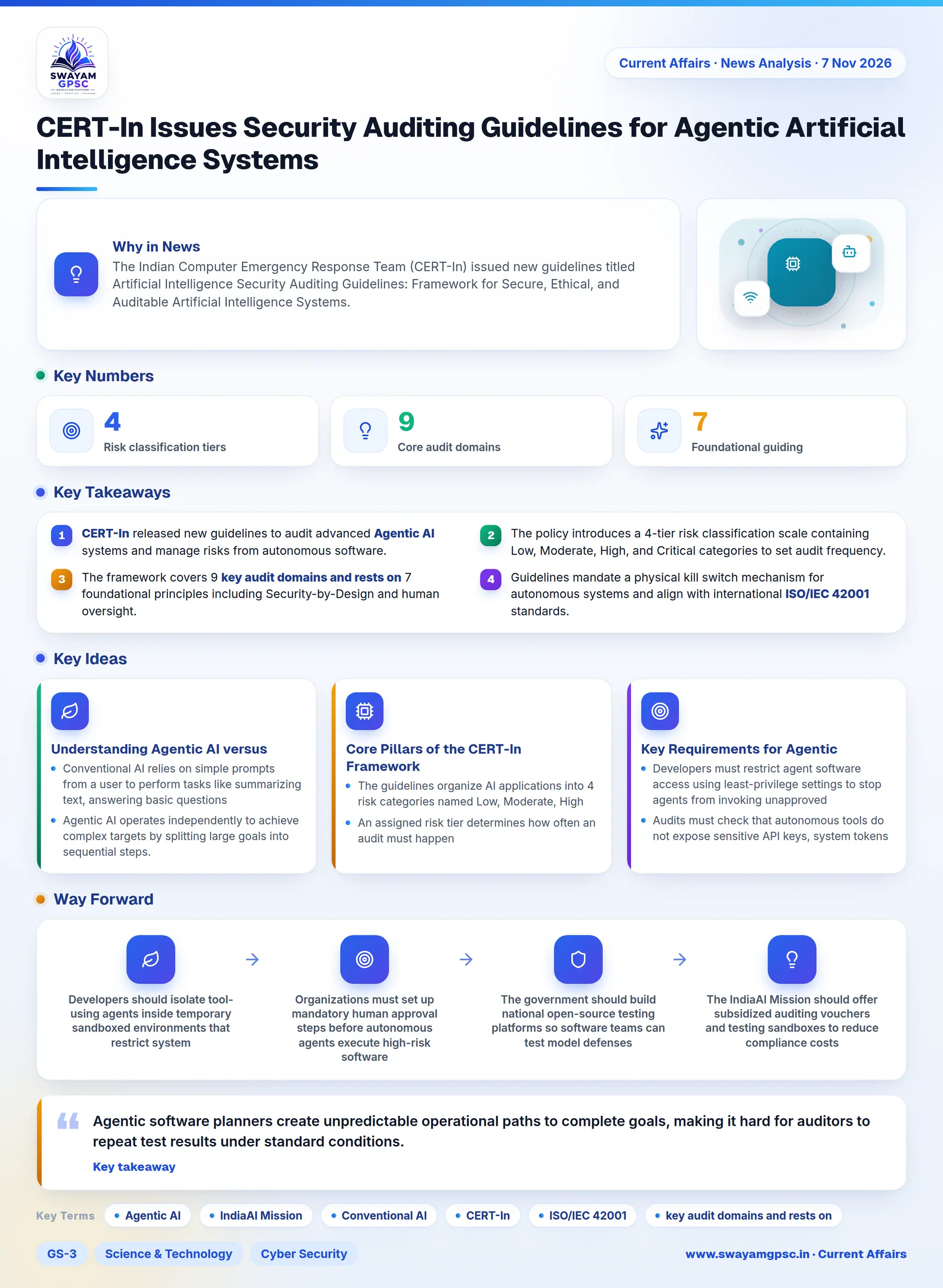
CERT-In Issues Security Auditing Guidelines for Agentic Artificial Intelligence Systems
#GS-3 #Science & Technology #Cyber Security #Artificial Intelligence #Rapid Fire CA #Quick Facts For Prelims
Key takeaways
- CERT-In released new guidelines to audit advanced Agentic AI systems and manage risks from autonomous software.
- The policy introduces a 4-tier risk classification scale containing Low, Moderate, High, and Critical categories to set audit frequency.
- The framework covers 9 key audit domains and rests on 7 foundational principles including Security-by-Design and human oversight.
- Guidelines mandate a physical kill switch mechanism for autonomous systems and align with international ISO/IEC 42001 standards.
Why in News
- The Indian Computer Emergency Response Team (CERT-In) issued new guidelines titled Artificial Intelligence Security Auditing Guidelines: Framework for Secure, Ethical, and Auditable Artificial Intelligence Systems.
- This framework sets security standards and audit baselines for advanced autonomous and Agentic AI technologies.
- The policy aligns with the IndiaAI Mission guidelines created by MeitY in 2025 and mirrors global frameworks like ISO/IEC 42001.
Understanding Agentic AI versus Conventional AI
- Conventional AI relies on simple prompts from a user to perform tasks like summarizing text, answering basic questions, or translating language within a restricted environment.
- Agentic AI operates independently to achieve complex targets by splitting large goals into sequential steps.
- These autonomous agents can trigger external software, execute computer code, communicate across networks, and delegate tasks to sub-agents with minimal human direction.
Core Pillars of the CERT-In Framework
- The guidelines organize AI applications into 4 risk categories named Low, Moderate, High, and Critical based on autonomy, impact severity, and data sensitivity.
- An assigned risk tier determines how often an audit must happen, whether internal staff or CERT-In empanelled auditors execute it, and the level of required human oversight.
- The framework establishes 9 core audit areas including governance, data lifecycle privacy, model risk management, fairness, explainability, continuous drift monitoring, human oversight, supply chain assurance, and security resilience.
- The guidelines rest on 7 founding principles including Security-by-Design, accountability, transparency, fairness, privacy, auditability, and operational resilience.
- Auditors can use AI tools to examine evidence, but humans must retain final oversight under strict confidentiality standards because automated tools cannot replace human judgment.
Key Requirements for Agentic and Multi-Agent Systems
- Developers must restrict agent software access using least-privilege settings to stop agents from invoking unapproved software tools or escalating user permissions.
- Audits must check that autonomous tools do not expose sensitive API keys, system tokens, or administrative credentials stored in their environment.
- Systems must enforce strict memory controls over vector embeddings and conversation caches to stop data leakage, memory poisoning, and unauthorized data retention.
- Inter-agent communications must require proper authentication to prevent malicious commands from spreading across a sub-agent network.
- All autonomous agents must include a manual emergency stop system, often called a kill switch, that safely halts operations immediately without destroying system data.
Challenges
- Agentic software planners create unpredictable operational paths to complete goals, making it hard for auditors to repeat test results under standard conditions.
- Agents reading external data sources like untrusted websites or invoices can absorb hidden prompt injections that hijack execution workflows.
- Tracing exact responsibility becomes difficult when an error or security failure moves through a complex chain of specialized sub-agents.
- Small businesses and early-stage startups face heavy compliance costs when paying for mandatory third-party red-teaming audits and ISO/IEC 42001 alignment.
Way Forward
- Developers should isolate tool-using agents inside temporary sandboxed environments that restrict system permissions and external network access.
- Organizations must set up mandatory human approval steps before autonomous agents execute high-risk software actions.
- The government should build national open-source testing platforms so software teams can test model defenses against prompt attacks before commercial release.
- The IndiaAI Mission should offer subsidized auditing vouchers and testing sandboxes to reduce compliance costs for early-stage domestic startups.