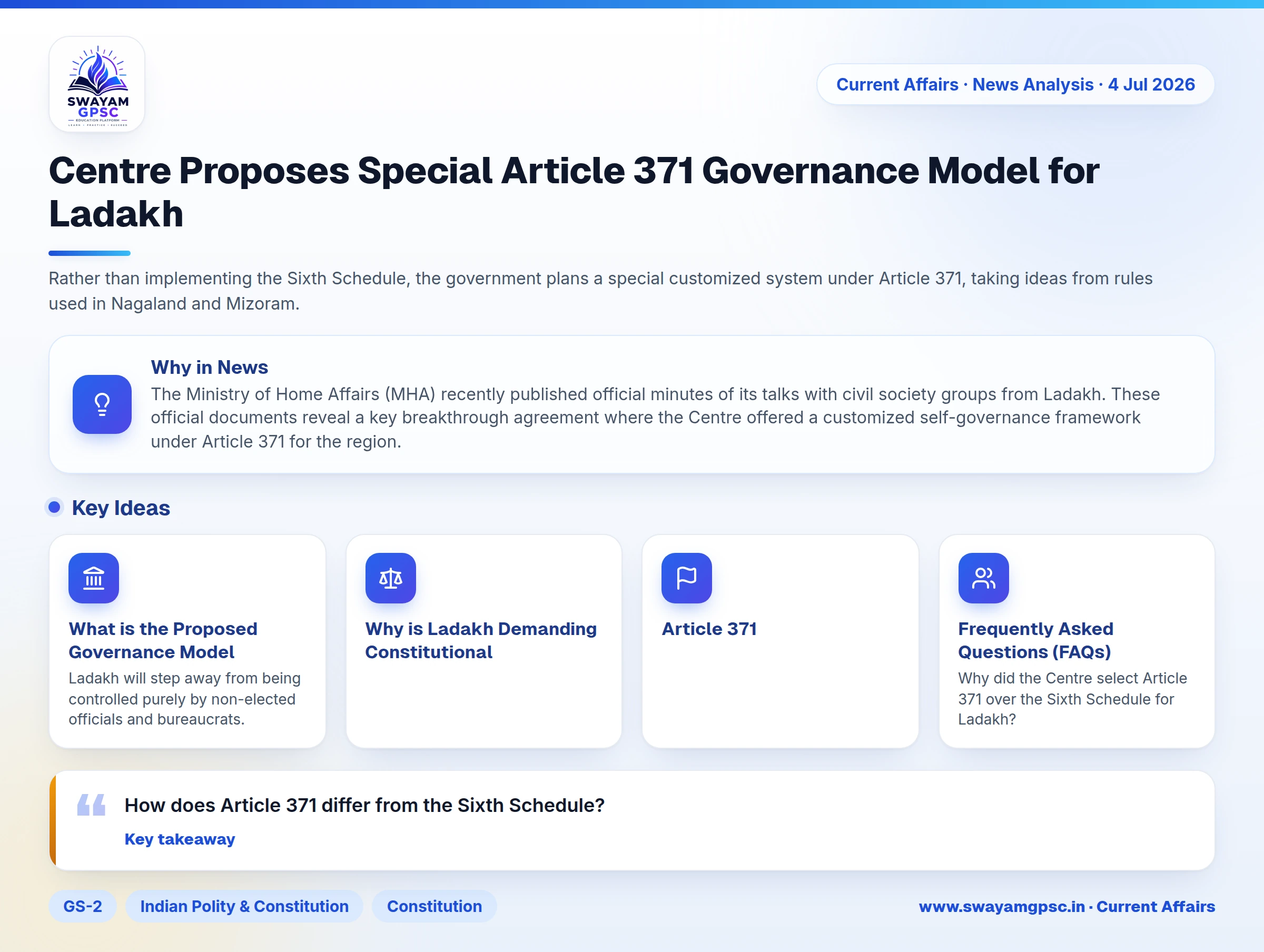
Centre Proposes Special Article 371 Governance Model for Ladakh
#GS-2 #Indian Polity & Constitution #Constitution #Federalism #Co-operative Federalism #Constitutional Amendments #Governance & Social Justice #Indian Society #Vulnerable Sections #Issues Related to SCs & STs #Ladakh #Article 371 #Sixth Schedule
Why in News
- The Ministry of Home Affairs (MHA) recently published official minutes of its talks with civil society groups from Ladakh.
- These official documents reveal a key breakthrough agreement where the Centre offered a customized self-governance framework under Article 371 for the region.
- This proposed draft agreement represents a major move toward ending long-standing political standoffs, public protests, and lack of local representation in Ladakh.
What is the Proposed Governance Model for Ladakh?
- Rather than implementing the Sixth Schedule, the government plans a special customized system under Article 371, taking ideas from rules used in Nagaland and Mizoram.
- This unique arrangement aims to provide strong legal protection for Ladakh's local land rights, tribal culture, and job opportunities for locals.
- Ladakh will step away from being controlled purely by non-elected officials and bureaucrats.
- The government will establish a democratically elected body for the entire Union Territory to give local residents a direct political voice.
- This new elected council will hold real power, exercising distinct legislative, executive, and financial powers over local matters.
- In a major governance shift, the elected representatives will directly supervise civil servants who handle subjects assigned to the body.
- Elected leaders will also get the right to write performance reviews for these officers, making administrators directly accountable to local representatives.
- The new region-wide legislature will coordinate smoothly with existing village-level Panchayati Raj Institutions (PRIs).
- Due to current financial burdens like government salary expenses, immediate statehood is not possible, but the Centre formally accepted Statehood as Ladakh's ultimate long-term goal.
Why is Ladakh Demanding Constitutional Safeguards?
- In August 2019, Parliament repealed Article 370 and passed the Jammu and Kashmir Reorganisation Act, 2019, splitting the former state into two territories.
- While Ladakh fulfilled its old goal of becoming a separate Union Territory, it was created without an elected assembly.
- Before 2019, Ladakh sent 4 members to the state assembly, but as a Union Territory, decision-making fell strictly under the Lieutenant Governor, leaving local hill councils with limited power.
- Between 2021 and 2026, local groups led by activists like Sonam Wangchuk launched major protests over worries about losing their land and culture to outsiders.
- Protesters demanded full statehood, protection under the Sixth Schedule, a separate Ladakh Public Service Commission (LPSC), and 2 parliamentary seats covering Leh and Kargil.
Article 371
- Article 371 in Part XXI of the Constitution of India grants special provisions to specific states to meet their historical, cultural, and regional requirements.
- While the core Article 371 has existed since 26th January 1950, lawmakers added Articles 371A through 371J later using constitutional amendments under Article 368.
- Unlike the Sixth Schedule which relies on autonomous district councils, Article 371 enables state assemblies or Governors to restrict outsider land buying and shield local customs, such as in Nagaland under Article 371A.
- For instance, Article 371 allows the creation of dedicated regional development boards in states like Maharashtra and Gujarat.
- These special sections cover multiple states including Article 371A for Nagaland, 371B for Assam, 371C for Manipur, 371D & 371E for Andhra Pradesh and Telangana, 371F for Sikkim, 371G for Mizoram, 371H for Arunachal Pradesh, 371I for Goa, and 371J for the Kalyana Karnataka Region of Karnataka.
- The government contends that a tailor-made Article 371 framework gives Ladakh strong safeguards for land and employment while avoiding the administrative headaches of the Sixth Schedule.
Frequently Asked Questions (FAQs)
- Why did the Centre select Article 371 over the Sixth Schedule for Ladakh? The government believes a customized Article 371 framework protects local land, tribal culture, and jobs while offering greater administrative flexibility.
- What are the main features of the proposed administrative model for Ladakh? It creates an elected territory-level body with legislative, financial, and executive powers that manages local bureaucrats and coordinates with Panchayati Raj Institutions.
- What key demands did Ladakh's civil society groups present? They asked for full statehood, Sixth Schedule status, a dedicated Ladakh Public Service Commission, and 2 parliamentary seats.
- How does Article 371 differ from the Sixth Schedule? Article 371 grants state-specific protections through constitutional clauses, whereas the Sixth Schedule sets up Autonomous District Councils with judicial, legislative, and administrative authority in tribal areas.