Centre Plans Panel to Review UGC Equity Regulations 2026
#GS-2 #Governance & Social Justice #Education #Social Justice #Vulnerable Sections #Government Policies & Interventions #Rapid Fire CA #Quick Facts For Prelims
Key takeaways
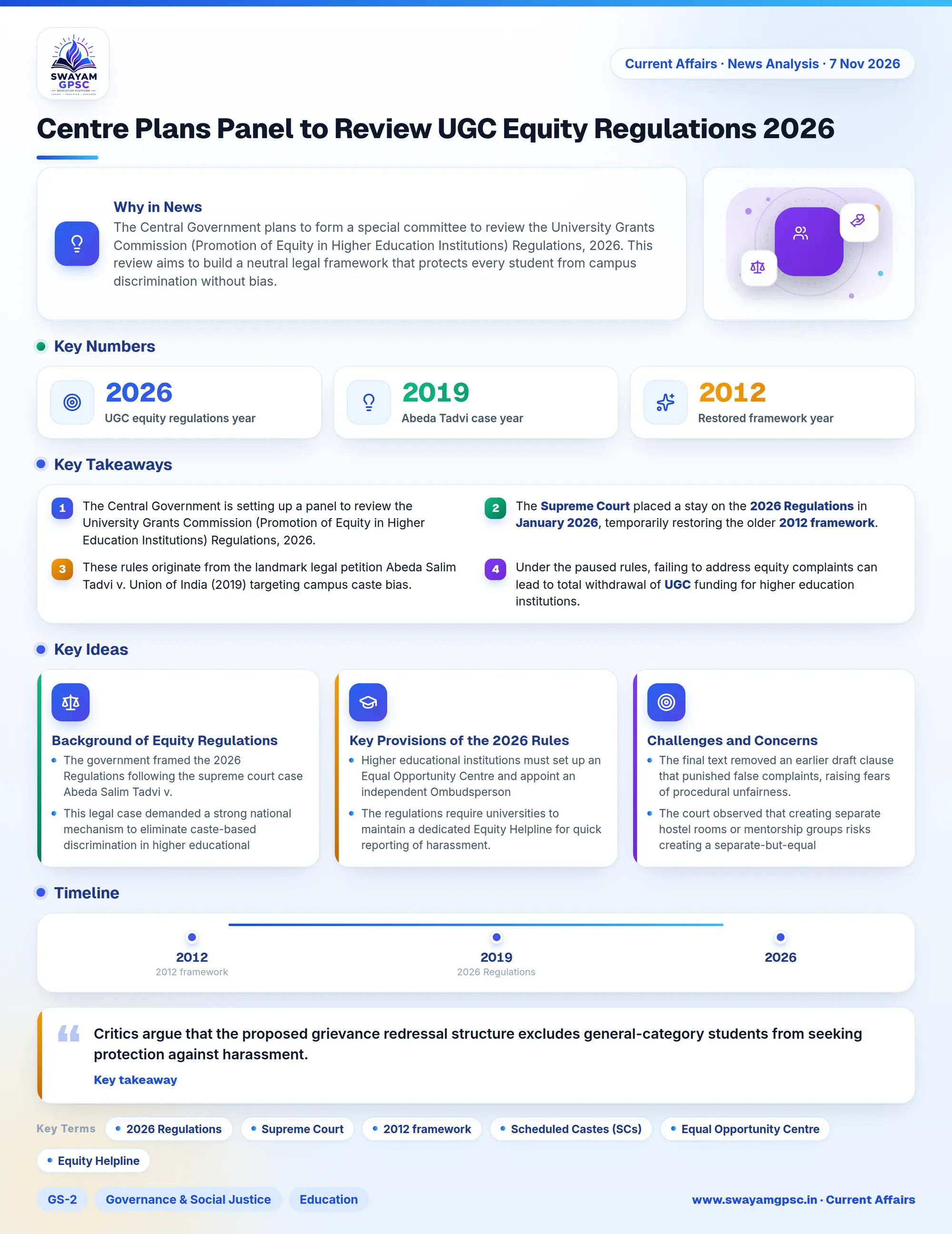
- The Central Government is setting up a panel to review the University Grants Commission (Promotion of Equity in Higher Education Institutions) Regulations, 2026.
- The Supreme Court placed a stay on the 2026 Regulations in January 2026, temporarily restoring the older 2012 framework.
- These rules originate from the landmark legal petition Abeda Salim Tadvi v. Union of India (2019) targeting campus caste bias.
- Under the paused rules, failing to address equity complaints can lead to total withdrawal of UGC funding for higher education institutions.
- Judicial concerns center on procedural gaps, potential exclusion of general-category students, and fundamental rights under Article 14, Article 15, and Article 21.
Why in News
- The Central Government plans to form a special committee to review the University Grants Commission (Promotion of Equity in Higher Education Institutions) Regulations, 2026.
- This review aims to build a neutral legal framework that protects every student from campus discrimination without bias.
Background of Equity Regulations
- The government framed the 2026 Regulations following the supreme court case Abeda Salim Tadvi v. Union of India (2019).
- This legal case demanded a strong national mechanism to eliminate caste-based discrimination in higher educational institutions.
- The Supreme Court stayed the 2026 regulations in January 2026 after nationwide protests and legal challenges over vague wording and potential misuse.
- Because of this judicial stay, higher education institutions temporarily reverted to the older 2012 framework.
- The overall goal of the 2026 guidelines was to stop discrimination based on religion, race, caste, sex, or birth location.
- They focused heavily on ensuring equity for Scheduled Castes (SCs), Scheduled Tribes (STs), Socially and Educationally Backward Classes (SEBCs), and Economically Weaker Sections (EWS).
Key Provisions of the 2026 Rules
- Higher educational institutions must set up an Equal Opportunity Centre and appoint an independent Ombudsperson for serious student grievances.
- The regulations require universities to maintain a dedicated Equity Helpline for quick reporting of harassment.
- Campus administrators must form mobile Equity Squads to patrol vulnerable areas and designate Equity Ambassadors among students and staff.
- Institutions face heavy financial fines and the complete withdrawal of UGC grants if they ignore equity standards or discrimination complaints.
Challenges and Concerns
- Critics argue that the proposed grievance redressal structure excludes general-category students from seeking protection against harassment.
- The final text removed an earlier draft clause that punished false complaints, raising fears of procedural unfairness.
- The court observed that creating separate hostel rooms or mentorship groups risks creating a separate-but-equal environment that breaks Article 14 and Article 15.
- Judges questioned whether the framework offers enough protection to Extremely Backward Castes within existing SC, ST, and OBC sub-classifications.
- The judiciary highlighted that leaving out ragging as a distinct form of discrimination weakens protections under Article 14 and Article 21.