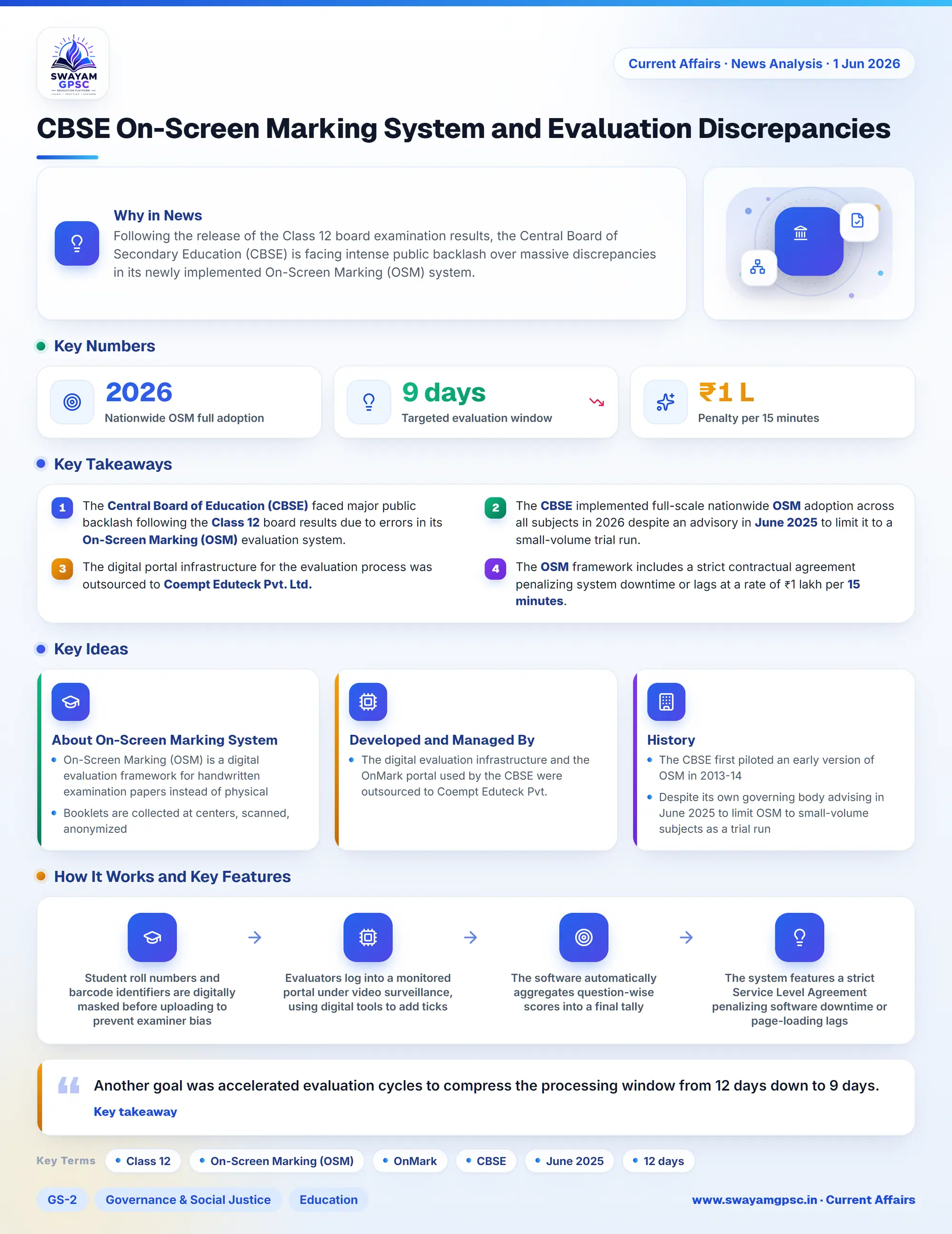
CBSE On-Screen Marking System and Evaluation Discrepancies
#GS-2 #Governance & Social Justice #Education #Good Governance #Economy #Infrastructure
Key takeaways
- The Central Board of Education (CBSE) faced major public backlash following the Class 12 board results due to errors in its On-Screen Marking (OSM) evaluation system.
- The CBSE implemented full-scale nationwide OSM adoption across all subjects in 2026 despite an advisory in June 2025 to limit it to a small-volume trial run.
- The digital portal infrastructure for the evaluation process was outsourced to Coempt Eduteck Pvt. Ltd.
- The OSM framework includes a strict contractual agreement penalizing system downtime or lags at a rate of ₹1 lakh per 15 minutes.
Why in News
- Following the release of the Class 12 board examination results, the Central Board of Secondary Education (CBSE) is facing intense public backlash over massive discrepancies in its newly implemented On-Screen Marking (OSM) system.
About On-Screen Marking System
- On-Screen Marking (OSM) is a digital evaluation framework for handwritten examination papers instead of physical answer scripts being graded manually with a red pen.
- Booklets are collected at centers, scanned, anonymized, and uploaded onto a secure cloud platform where evaluators grade them digitally on computer screens.
Developed and Managed By
- The digital evaluation infrastructure and the OnMark portal used by the CBSE were outsourced to Coempt Eduteck Pvt. Ltd.
History
- The CBSE first piloted an early version of OSM in 2013-14, which failed due to a lack of digital literacy and infrastructure.
- Despite its own governing body advising in June 2025 to limit OSM to small-volume subjects as a trial run, the CBSE bypassed the pilot phase and enforced full-scale nationwide adoption across all subjects in 2026.
Aim
- The CBSE introduced full-scale OSM to modernize its evaluation pipeline.
- The stated objectives included complete elimination of manual totaling and tabulation errors.
- Another goal was accelerated evaluation cycles to compress the processing window from 12 days down to 9 days.
- It also aimed for enhanced transparency and reduction of post-result verification applications.
How It Works and Key Features
- Student roll numbers and barcode identifiers are digitally masked before uploading to prevent examiner bias under anonymization.
- Evaluators log into a monitored portal under video surveillance, using digital tools to add ticks, cross out answers, and assign step-wise marks on screen.
- The software automatically aggregates question-wise scores into a final tally, preventing manual arithmetic errors.
- The system features a strict Service Level Agreement penalizing software downtime or page-loading lags at a rate of ₹1 lakh per 15 minutes.