CAPEX Support Scheme for Critical Mineral Processing
#GS-1 #Distribution of Key Natural Resources #GS-3 #Economy #Infrastructure #Science & Technology #Current Events #National
Key takeaways
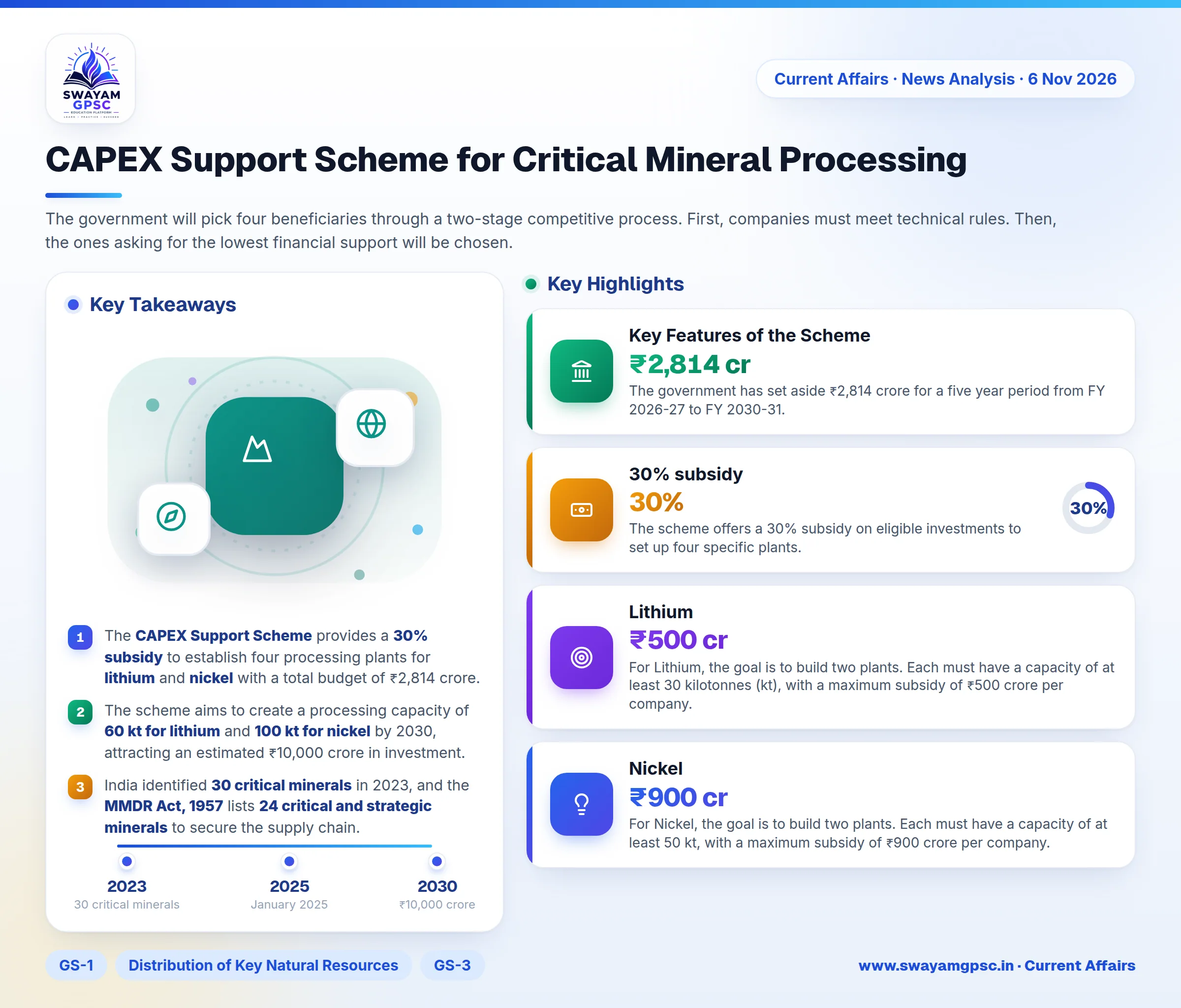
- The CAPEX Support Scheme provides a 30% subsidy to establish four processing plants for lithium and nickel with a total budget of ₹2,814 crore.
- The scheme aims to create a processing capacity of 60 kt for lithium and 100 kt for nickel by 2030, attracting an estimated ₹10,000 crore in investment.
- India identified 30 critical minerals in 2023, and the MMDR Act, 1957 lists 24 critical and strategic minerals to secure the supply chain.
- To support the circular economy, the government launched a ₹1,500 crore recycling scheme in September 2025 for e-waste and batteries.
Why in News
- The Union Cabinet has given its approval for the CAPEX Support Scheme to Promote Critical Mineral Processing. This move aims to boost India's own ability to process minerals, cut down on imports, and make the supply chain for critical minerals more secure.
Key Features of the Scheme
- The Ministry of Mines is managing this scheme. It provides financial help for capital expenditure to build plants that can process lithium and nickel into high-purity forms, filling a major gap in India's mineral industry.
- The government has set aside ₹2,814 crore for a five year period from FY 2026-27 to FY 2030-31. The Central Government will fully fund this, with ₹2,800 crore for subsidies and ₹14 crore for administrative costs.
- The scheme offers a 30% subsidy on eligible investments to set up four specific plants.
- For Lithium, the goal is to build two plants. Each must have a capacity of at least 30 kilotonnes (kt), with a maximum subsidy of ₹500 crore per company.
- For Nickel, the goal is to build two plants. Each must have a capacity of at least 50 kt, with a maximum subsidy of ₹900 crore per company.
- Lithium plants will turn ores and concentrates into battery-grade products. Nickel plants will produce battery-grade nickel sulphate or Class-1 nickel, and they can also recover cobalt.
- The government will pick four beneficiaries through a two-stage competitive process. First, companies must meet technical rules. Then, the ones asking for the lowest financial support will be chosen.
- Subsidies will be paid in three parts based on milestones. The first 25% is given after spending 25% of the capital and providing 15% equity. The next 50% (cumulative) comes after 50% expenditure and 50% equity. The final 100% is paid once the plant starts working and full equity is provided.
- Companies must start their plants within three years of the Letter of Award (LoA). While the absolute limit is five years, any delay beyond three years will result in a reduction of the remaining subsidy.
- A three level system will manage the scheme. The Governing Council (GC), led by the Secretary of the Ministry of Mines, gives strategic direction. The Techno-Financial Committee (TFC) checks proposals. The Project Management Agency (PMA) handles daily administration.
Importance of Processing Capacity
- In 2023, a Ministry of Mines committee identified 30 critical minerals. Additionally, the MMDR Act, 1957 lists 24 critical and strategic minerals in its First Schedule. Currently, India relies too much on importing refined versions of these minerals.
- These minerals are vital for national security, economic growth, and clean energy. They are used in making electric vehicles, aerospace equipment, defence tools, and electronics.
- A few countries control most of the world's processing plants. This makes India vulnerable to price jumps, export bans, and political tensions. India needs its own resilient supply chains.
- India wants to reach net-zero by 2070. This goal, along with the rise of electric cars and battery storage, is driving up the demand for high-purity minerals.
- Processing these minerals is expensive because it requires high-tech machinery and strict environmental rules. This creates a high barrier for private companies.
- Companies often struggle to find raw materials and the right technical expertise, which makes these projects risky without government help.
- Even with local plants, India might still need to import raw ores. This means the country must build strong partnerships with other nations for sourcing minerals.
Other Government Initiatives
- The National Critical Mineral Mission (NCMM) was started in January 2025. It focuses on the whole chain, from finding minerals and mining them to processing and recycling.
- In September 2025, the government approved a ₹1,500 crore recycling scheme. This helps recover minerals from old batteries and e-waste, promoting a circular economy.
- To boost domestic supply, the government has already auctioned 64 critical and strategic mineral blocks and 11 Exploration Licence blocks.
Expected Outcomes
- The scheme aims to attract roughly ₹10,000 crore in investment. It intends to create a processing capacity of 60 kt for lithium and 100 kt for nickel by 2030.
- By processing minerals at home, India will reduce its reliance on imported refined products. This will save foreign exchange and strengthen the local value chain.
- India will be less affected by global supply shocks or export restrictions from other countries.
- Local availability of these minerals will help industries making battery cells, electric vehicles, and speciality steel.
- Building these plants will create many new jobs and drive overall industrial growth.
Conclusion
- The CAPEX Support Scheme is a key step toward Atmanirbhar Bharat. By focusing on lithium and nickel, India is securing its strategic autonomy and supporting its green energy goals.