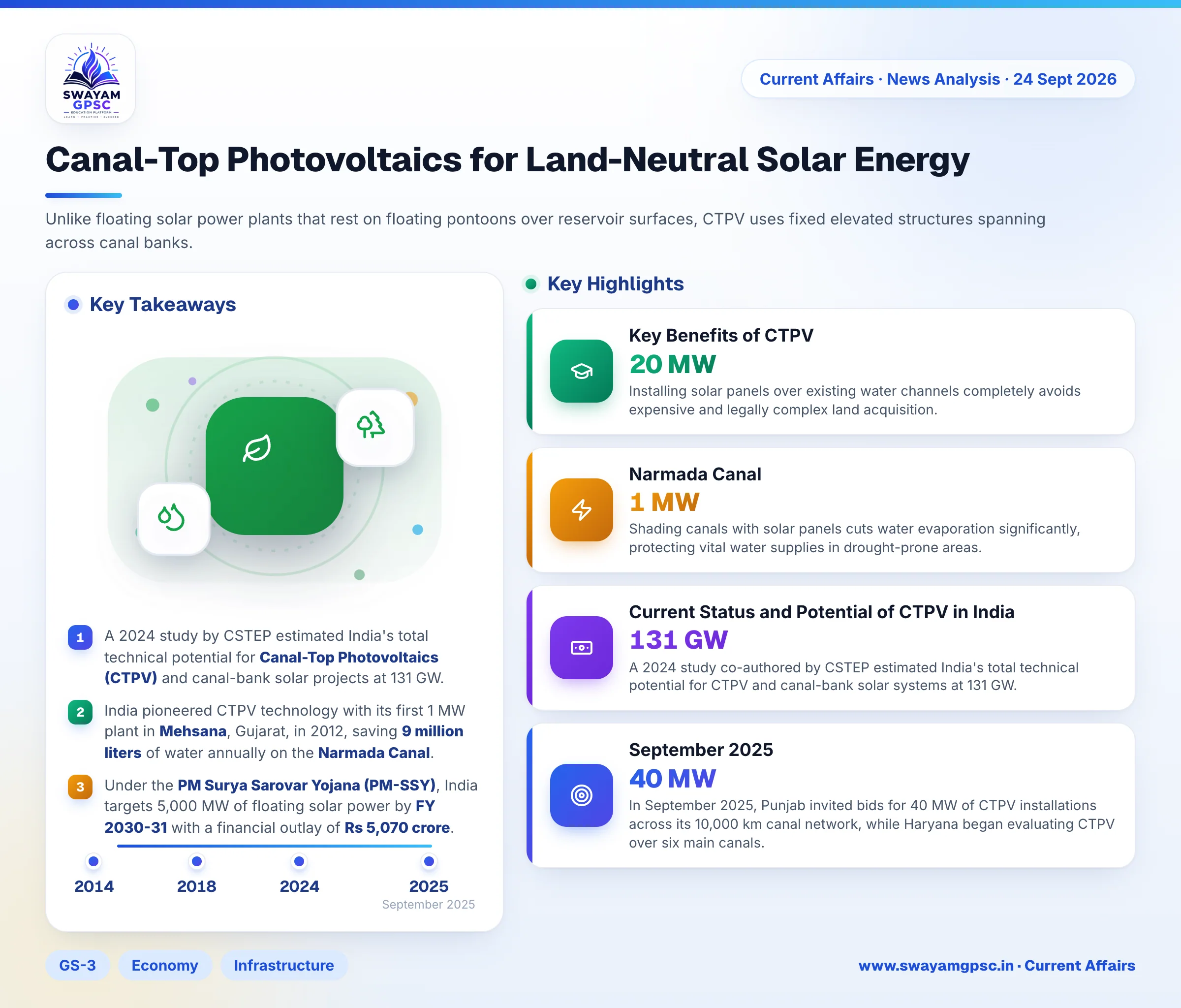
Canal-Top Photovoltaics for Land-Neutral Solar Energy
#GS-3 #Economy #Infrastructure #Environment #Renewable Energy #Climate Change #Current Events #National
Key takeaways
- A 2024 study by CSTEP estimated India's total technical potential for Canal-Top Photovoltaics (CTPV) and canal-bank solar projects at 131 GW.
- India pioneered CTPV technology with its first 1 MW plant in Mehsana, Gujarat, in 2012, saving 9 million liters of water annually on the Narmada Canal.
- Under the PM Surya Sarovar Yojana (PM-SSY), India targets 5,000 MW of floating solar power by FY 2030-31 with a financial outlay of Rs 5,070 crore.
Why in News
- High land costs and complex acquisition delays for ground solar projects have renewed interest in Canal-Top Photovoltaics (CTPV) as a land-neutral energy solution.
- This technology supports government efforts for land-saving solar power, complementing schemes like PM Surya Sarovar Yojana (PM-SSY), PM-KUSUM, and the National Solar Mission.
What is Canal-Top Photovoltaics
- Canal-Top Photovoltaics (CTPV) is a renewable energy technology where solar panels are mounted on elevated steel frames directly over irrigation or water canals.
- Unlike floating solar power plants that rest on floating pontoons over reservoir surfaces, CTPV uses fixed elevated structures spanning across canal banks.
- Engineers design these structural frameworks according to canal width and orientation to ensure that flowing water beneath remains completely clear for farming and municipal supply.
Key Benefits of CTPV
- Installing solar panels over existing water channels completely avoids expensive and legally complex land acquisition. For example, a 20 MW CTPV project in Punjab saved approximately 100 acres of land.
- Shading canals with solar panels cuts water evaporation significantly, protecting vital water supplies in drought-prone areas. A 1 MW system on the Narmada Canal in Gujarat saves nearly 9 million liters of water every year.
- Water flowing beneath the panels provides a cooling effect that maintains panel efficiency during intense summer heat while creating multi-functional energy and water infrastructure.
- Blocking direct sunlight reduces weed and algae growth inside canal channels, which lowers routine cleaning and maintenance costs for water authorities.
Current Status and Potential of CTPV in India
- India pioneered this technology by commissioning its first 1 MW CTPV installation in Mehsana, Gujarat, in 2012.
- Gujarat later added a 20 MW CTPV project in Vadodara, while Punjab set up another 20 MW installation between 2014 and 2018.
- A 2024 study co-authored by CSTEP estimated India's total technical potential for CTPV and canal-bank solar systems at 131 GW.
- The top five states with the highest potential based on sunlight, canal structures, and grid access are Uttar Pradesh, Bihar, Karnataka, Andhra Pradesh, and Punjab.
- In September 2025, Punjab invited bids for 40 MW of CTPV installations across its 10,000 km canal network, while Haryana began evaluating CTPV over six main canals.
Challenges
- Constructing tall elevated frames capable of spanning wide canals and resisting heavy wind loads makes CTPV costlier than standard ground-mounted solar power plants.
- Cleaning solar panels, carrying out repairs, and clearing silt or mud from underlying canal beds become far more complicated under covered structures.
- Because irrigation canals stretch out in long narrow lines, connecting CTPV projects to distant electrical substations increases power evacuation expenses.
Pradhan Mantri Surya Sarovar Yojana
- The Pradhan Mantri Surya Sarovar Yojana (PM-SSY) is a Central Sector Scheme designed to build Floating Solar Photovoltaic (FSPV) projects on reservoirs alongside Energy Storage Systems (ESS).
- The program aims to achieve 5,000 MW of floating solar capacity by FY 2030-31 supported by an official budget allocation of Rs 5,070 crore.
- To manage solar power fluctuations and stabilize grid supply, all projects must integrate Battery Energy Storage Systems (BESS) with at least two hours of backup capacity, providing 10,000 MWh in total.
- Developers receive Central Financial Assistance (CFA) of Rs 1 crore per MW upon project setup, plus up to Rs 50 lakh per project to cover feasibility, bathymetry, and environmental studies.
- This scheme saves scarce agricultural land, cuts reservoir water evaporation, lowers annual carbon emissions by 10 million tonnes, and creates about 16,000 to 17,000 green jobs.