Canada-India Trade and Investment Forum
#GS-2 #Economy #International Relations #Groupings & Agreements Involving India and/or Affecting India's Interests #Quick Facts For Prelims
Key takeaways
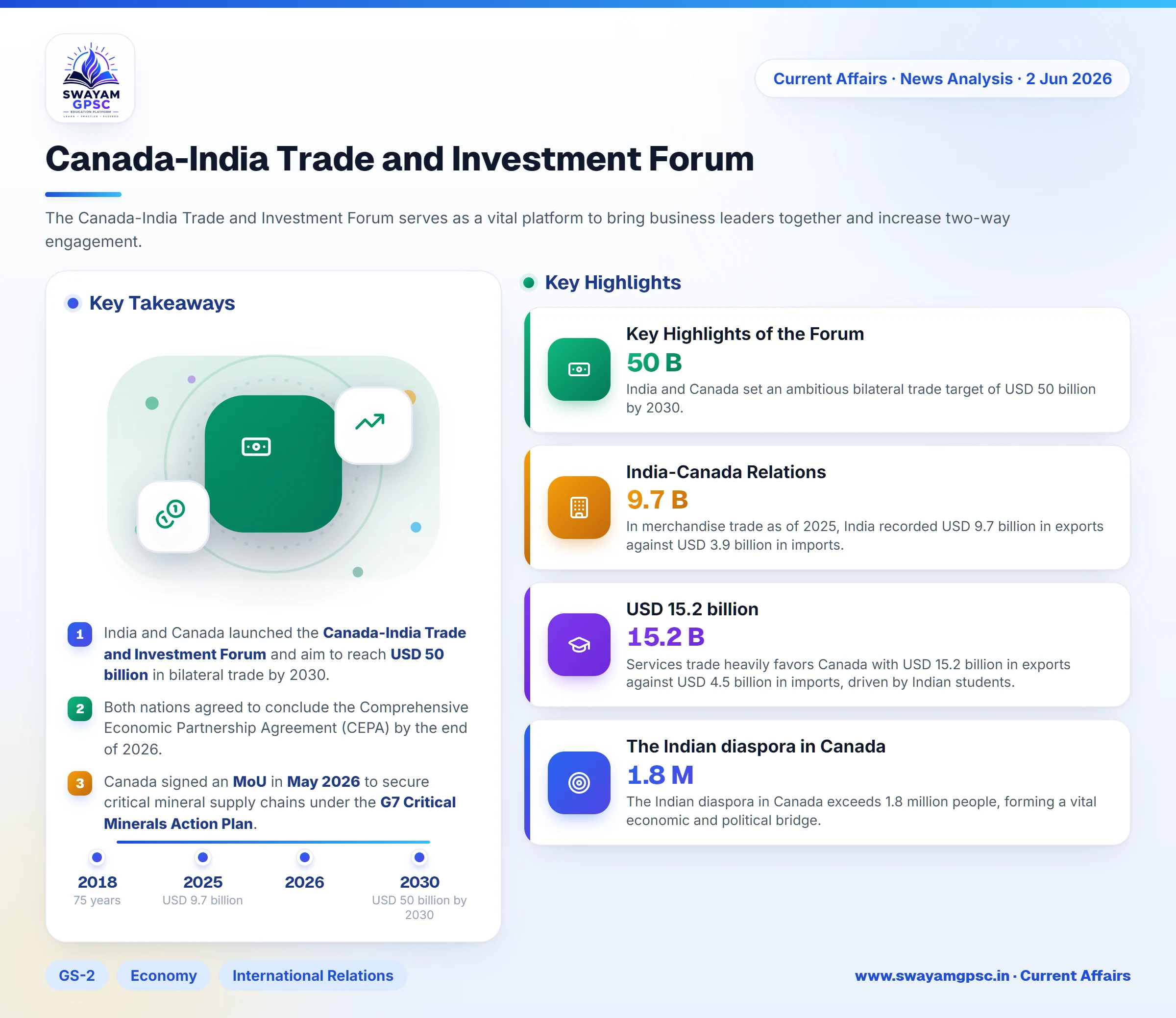
- India and Canada launched the Canada-India Trade and Investment Forum and aim to reach USD 50 billion in bilateral trade by 2030.
- Both nations agreed to conclude the Comprehensive Economic Partnership Agreement (CEPA) by the end of 2026.
- Canada signed an MoU in May 2026 to secure critical mineral supply chains under the G7 Critical Minerals Action Plan.
- The Indian diaspora in Canada numbers over 1.8 million, serving as a major pillar of bilateral soft power.
Why in News
- The Union Commerce and Industry Minister led the largest Indian business delegation to Canada recently.
- Both governments launched the Canada-India Trade and Investment Forum to boost business ties.
- The two nations committed to finalizing the Comprehensive Economic Partnership Agreement (CEPA) by the end of 2026.
Key Highlights of the Forum
- The Canada-India Trade and Investment Forum serves as a vital platform to bring business leaders together and increase two-way engagement.
- Both nations adopted a pragmatic approach to expedite CEPA negotiations by targeting low-hanging fruit and protecting sensitive domestic sectors like agriculture.
- Canada described the proposed CEPA as a game changer for reviving bilateral economic ties.
- India and Canada set an ambitious bilateral trade target of USD 50 billion by 2030.
- The updated roadmap prioritizes Small and Medium Enterprises (SMEs) to drive untapped trade volumes alongside large conglomerates.
- Canada announced a Team Canada Trade Mission to India later in 2026 to showcase strong market interest.
- Discussions focused on deepening cooperation in clean energy, critical minerals, agri-food, advanced manufacturing, digital technologies, and skills development.
- An MoU was signed in May 2026 to build secure critical mineral supply chains aligned with the G7 Critical Minerals Action Plan.
Comprehensive Economic Partnership Agreement
- A CEPA is a broad free trade agreement covering goods, services, investment, competition, and intellectual property rights.
- Unlike standard free trade pacts focusing only on tariffs, a CEPA aims to reduce non-tariff barriers and standardize regulatory frameworks.
- India currently has five active CEPAs with South Korea, Japan, Malaysia, the UAE, and Oman.
Significance of India-Canada Relations
- Canada is a top-tier supplier of critical minerals like potash, uranium, and nickel.
- Direct resource access supports India's renewable energy goals and electric vehicle manufacturing ambitions.
- Canada's Indo-Pacific Strategy views India as a core partner for a rules-based regional order.
- This partnership supports India’s MAHASAGAR vision as a counterweight to unilateralism in the region.
- India offers a large consumer base and digital expertise, which complements Canada's capital abundance and advanced manufacturing.
- The 2010 Nuclear Cooperation Agreement ensures a steady supply of Canadian uranium for India's civilian nuclear program.
- Canadian clean-tech expertise supports India's transition to low-carbon energy and the National Green Hydrogen Mission.
- The Australia-Canada-India Technology and Innovation Partnership promotes joint work in quantum communications and biotechnology.
India-Canada Relations
- India and Canada share over 75 years of diplomatic ties, upgraded to a Strategic Partnership in 2018.
- In merchandise trade as of 2025, India recorded USD 9.7 billion in exports against USD 3.9 billion in imports.
- Services trade heavily favors Canada with USD 15.2 billion in exports against USD 4.5 billion in imports, driven by Indian students.
- Canadian exports to India include vegetables, mineral fuels, and wood pulp, while Indian exports feature pharmaceuticals and electronics.
- The Indian diaspora in Canada exceeds 1.8 million people, forming a vital economic and political bridge.
- India remains the largest source of international students in Canada, boosting educational and research ties.
- Security cooperation relies on the Joint Working Group on Counter Terrorism from 1997, supported by the Extradition Treaty of 1987.
Conclusion
- The bilateral relationship is shifting from simple trade to a comprehensive strategic partnership.
- Despite occasional political friction over security issues, the fundamental economic drivers remain robust and vital for India's global rise.