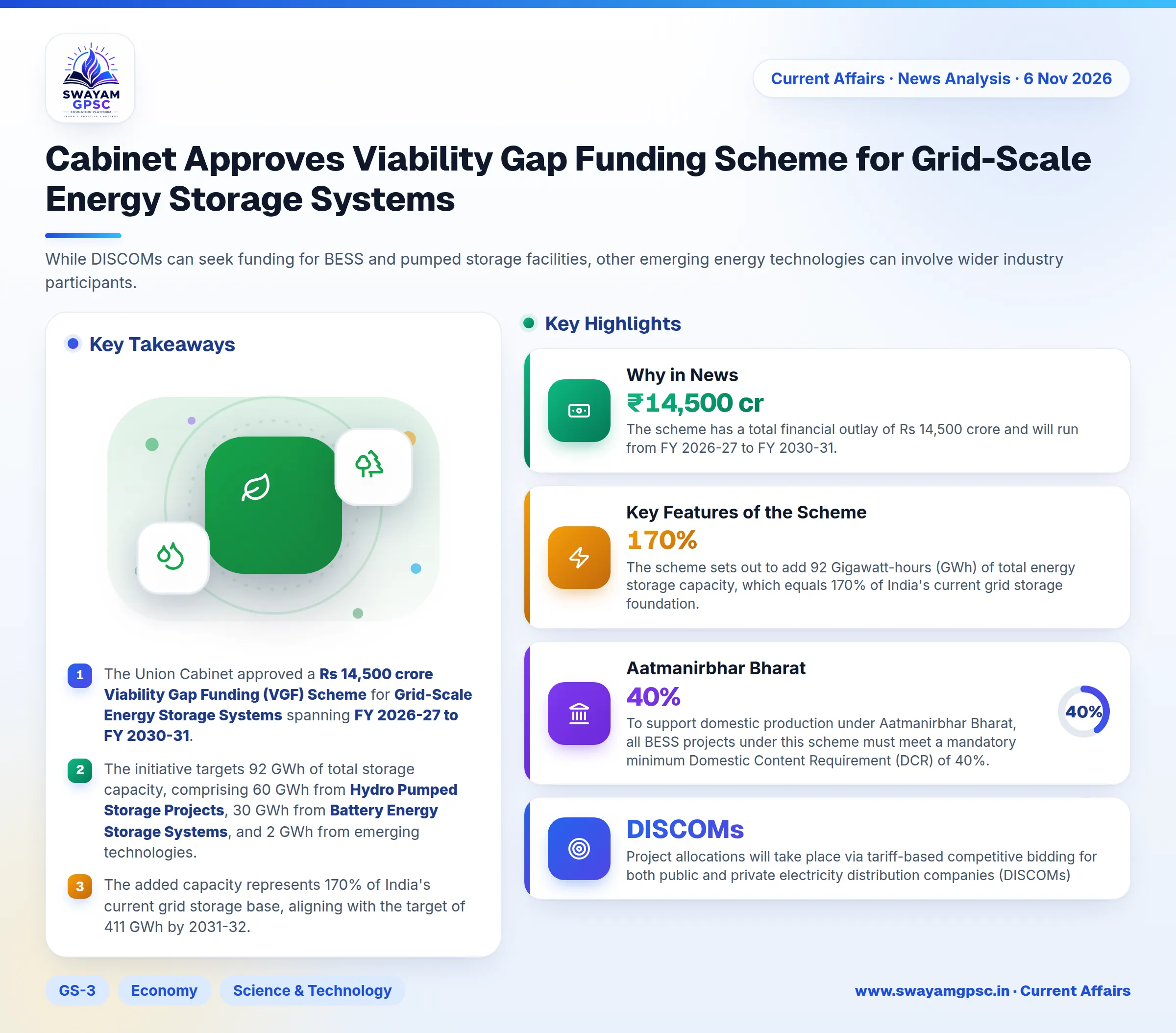
Cabinet Approves Viability Gap Funding Scheme for Grid-Scale Energy Storage Systems
#GS-3 #Economy #Science & Technology #Environment #Infrastructure #Energy #Sustainable Development #Rapid Fire CA #Quick Facts For Prelims #Growth & Development
Key takeaways
- The Union Cabinet approved a Rs 14,500 crore Viability Gap Funding (VGF) Scheme for Grid-Scale Energy Storage Systems spanning FY 2026-27 to FY 2030-31.
- The initiative targets 92 GWh of total storage capacity, comprising 60 GWh from Hydro Pumped Storage Projects, 30 GWh from Battery Energy Storage Systems, and 2 GWh from emerging technologies.
- The added capacity represents 170% of India's current grid storage base, aligning with the target of 411 GWh by 2031-32.
- All BESS installations under the scheme must include a mandatory minimum Domestic Content Requirement of 40% to strengthen local manufacturing.
- The scheme is expected to attract total public and private sector investments of Rs 97,600 crore in clean energy infrastructure.
Why in News
- The Union Cabinet recently approved the Viability Gap Funding (VGF) Scheme for developing Grid-Scale Energy Storage Systems.
- The scheme has a total financial outlay of Rs 14,500 crore and will run from FY 2026-27 to FY 2030-31.
- This government initiative will strengthen grid stability, assist in integrating renewable power, and boost India's long-term energy security.
Key Features of the Scheme
- The scheme sets out to add 92 Gigawatt-hours (GWh) of total energy storage capacity, which equals 170% of India's current grid storage foundation.
- This capacity expansion will help the country reach its broader national goal of achieving 411 GWh of total energy storage by 2031-32.
- The total 92 GWh capacity includes 60 GWh from Hydro Pumped Storage Projects (PSPs), 30 GWh from Battery Energy Storage Systems (BESS), and 2 GWh from alternative or emerging storage technologies.
- Project allocations will take place via tariff-based competitive bidding for both public and private electricity distribution companies (DISCOMs), rewarding developers who offer low tariffs with minimal financial aid.
- To support domestic production under Aatmanirbhar Bharat, all BESS projects under this scheme must meet a mandatory minimum Domestic Content Requirement (DCR) of 40%.
- While DISCOMs can seek funding for BESS and pumped storage facilities, other emerging energy technologies can involve wider industry participants.
- The central government's grant of Rs 14,500 crore is expected to leverage a total infrastructure investment of nearly Rs 97,600 crore across public and private sectors.
- The scheme spans a five-year operational timeline from FY 2026-27 to FY 2030-31, providing enough time to complete complex battery and hydro-pumped storage facilities.
Significance and Impact
- By offering financial aid directly on the demand side, this scheme complements existing supply-side incentives like production-linked schemes for battery makers.
- Energy storage systems balance overall electricity supply by absorbing surplus solar or wind generation during off-peak times and releasing it during peak hours.
- Storing clean power reduces renewable energy curtailment, stabilizes frequency across the transmission grid, and minimizes dependence on fossil-fuel thermal plants.
- The mandatory 40% local sourcing requirement builds a resilient domestic supply chain, cuts costly battery imports, and advances green technology manufacturing inside India.
- This planned capital boost will attract substantial private investment, delivering round-the-clock clean electricity to consumers at affordable rates.
Understanding Viability Gap Funding
- Viability Gap Funding (VGF) is a one-time grant provided by the central government to support major infrastructure initiatives.
- It targets projects that hold significant economic value for the country but lack immediate commercial profitability due to high initial startup costs.
- By covering the gap between initial setup expenditures and lower immediate market returns, VGF encourages private investors to participate while keeping final utility tariffs affordable.