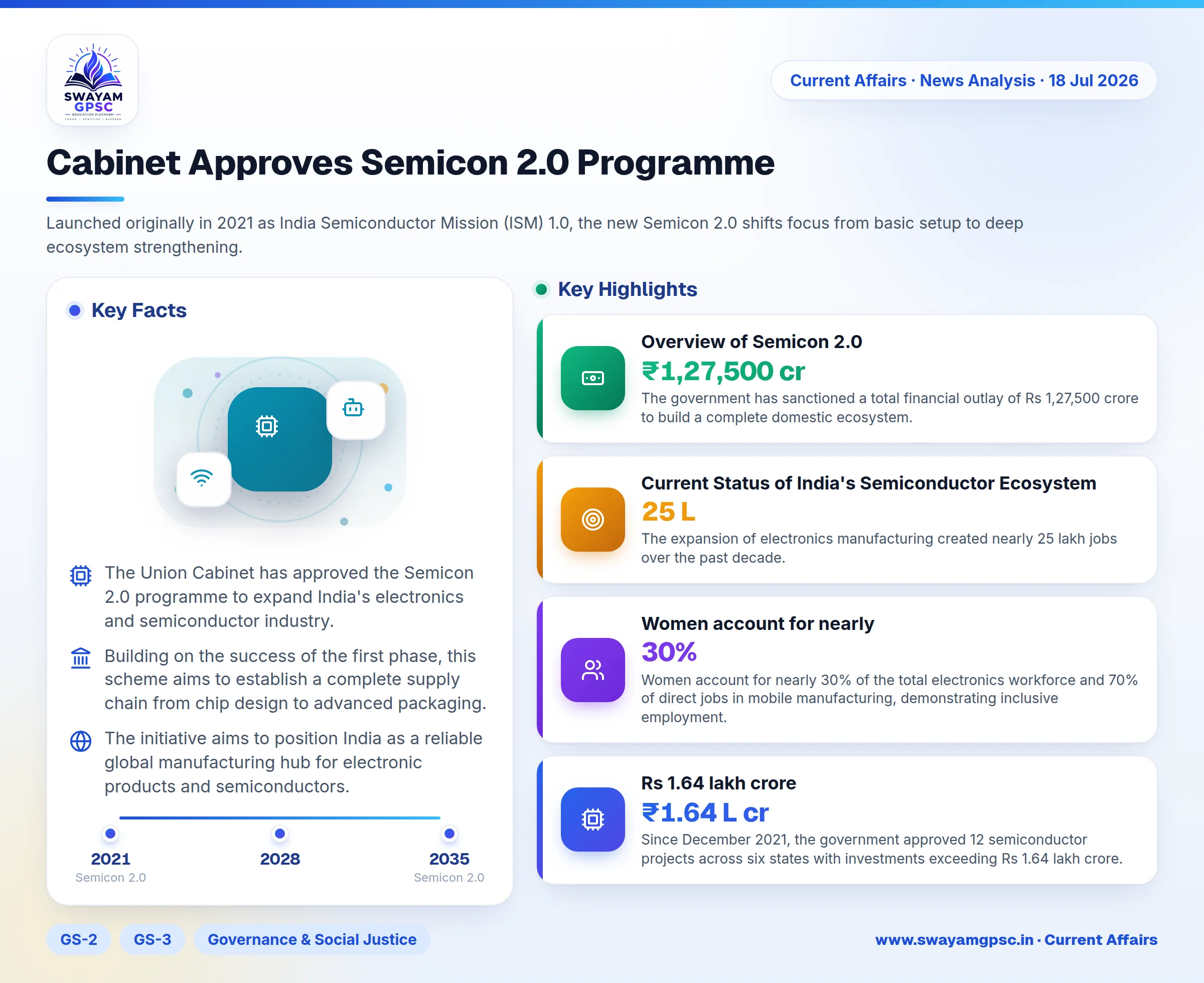
Cabinet Approves Semicon 2.0 Programme
#GS-2 #GS-3 #Governance & Social Justice #Economy #Infrastructure #Science & Technology #Indigenization of Technology #Technology Missions #Current Events #National
Why in News
- The Union Cabinet has approved the Semicon 2.0 programme to expand India's electronics and semiconductor industry.
- Building on the success of the first phase, this scheme aims to establish a complete supply chain from chip design to advanced packaging.
- The initiative aims to position India as a reliable global manufacturing hub for electronic products and semiconductors.
Overview of Semicon 2.0
- Launched originally in 2021 as India Semiconductor Mission (ISM) 1.0, the new Semicon 2.0 shifts focus from basic setup to deep ecosystem strengthening.
- The government has sanctioned a total financial outlay of Rs 1,27,500 crore to build a complete domestic ecosystem.
- Under the chip design pillar, the government supports semiconductor Intellectual Property and startups to make India a leader in fabless chip design.
- Under the machines and materials pillar, incentives are provided for local production and research in semiconductor equipment, specialty chemicals, industrial gases, and critical materials.
- Under the fab expansion pillar, capital investments are encouraged for silicon, compound semiconductor, discrete component, and display fabs, with India's first semiconductor fab expected by 2028.
- Under the ATMP and OSAT pillar, advanced packaging technologies will strengthen the Assembly, Testing, Marking, and Packaging sector.
- Under the research and development pillar, partnerships with top global research centers will focus on advanced areas like AI-native chip design.
- Under the talent development pillar, around 68,000 students across 315 universities are currently getting trained using advanced Electronic Design Automation tools.
Current Status of India's Semiconductor Ecosystem
- Over the last eleven years, electronics manufacturing in India grew 7-fold and exports increased 11-fold, making India the world's second-largest mobile phone manufacturer.
- The expansion of electronics manufacturing created nearly 25 lakh jobs over the past decade.
- Women account for nearly 30% of the total electronics workforce and 70% of direct jobs in mobile manufacturing, demonstrating inclusive employment.
- Since December 2021, the government approved 12 semiconductor projects across six states with investments exceeding Rs 1.64 lakh crore.
- The original Semicon 1.0 scheme was launched in 2021 with an outlay of Rs 76,000 crore to build initial fabrication and design capabilities through Design Linked Incentives.
- Financial assistance was provided to 24 semiconductor design projects from startups and MSMEs to design System-on-Chips for satellites, drones, and AI.
- Under Semicon 2.0, India aims to master 3-nanometre and 2-nanometre technologies and build a domestic semiconductor market worth USD 200 billion by 2035.
Strategic Importance of a Complete Semiconductor Ecosystem
- Recent geopolitical tensions like the US-China chip rivalry show that semiconductors are critical strategic assets required for national autonomy.
- Producing chips locally protects critical infrastructure like defense systems, ISRO space missions, power grids, and telecom networks from hardware manipulation.
- Electronics represent India's second-largest import bill after crude oil, so local manufacturing helps reduce the Current Account Deficit.
- Semiconductors are essential components for electric vehicles, 5G and 6G networks, medical devices, and artificial intelligence hardware.
- Although India has nearly 20% of the global chip design talent, full manufacturing capability is needed to lead in Quantum Computing and IoT.
- Localizing supply chains for raw materials and gases reduces vulnerability to global trade disruptions, especially dependencies on China.
- Becoming a trusted semiconductor provider strengthens foreign partnerships through agreements like the India-US iCET, Quad, and bilateral ties with Japan, Germany, and the EU.
Conclusion
- Semicon 2.0 marks India's transformation from an electronics assembler into a comprehensive semiconductor superpower.
- By promoting self-reliance across design, manufacturing, and R&D, this scheme builds a solid foundation for achieving Viksit Bharat.