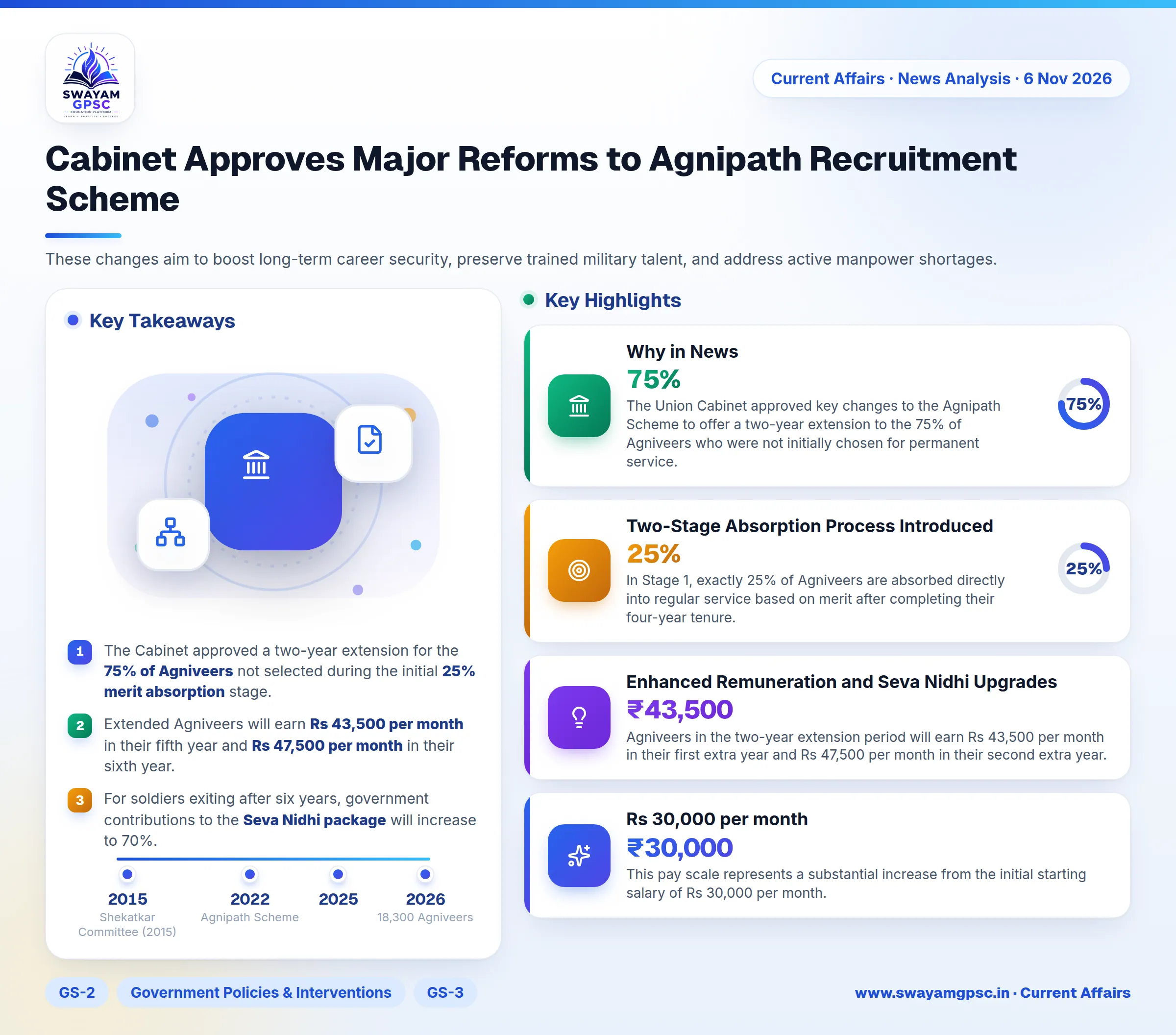
Cabinet Approves Major Reforms to Agnipath Recruitment Scheme
#GS-2 #Government Policies & Interventions #GS-3 #Various Security Forces & Agencies & Their Mandate #Agnipath Scheme #Defence Reforms #Armed Forces
Key takeaways
- The Cabinet approved a two-year extension for the 75% of Agniveers not selected during the initial 25% merit absorption stage.
- Extended Agniveers will earn Rs 43,500 per month in their fifth year and Rs 47,500 per month in their sixth year.
- For soldiers exiting after six years, government contributions to the Seva Nidhi package will increase to 70%.
- The reforms help address major military shortages, including an Army shortfall of 1.8 lakh personnel in November 2025.
- Higher long-term retention risks raising military pension liabilities, threatening the goal of the Kargil Review Committee (1999) to keep average force age at 26 years.
Why in News
- The Union Cabinet approved key changes to the Agnipath Scheme to offer a two-year extension to the 75% of Agniveers who were not initially chosen for permanent service.
- This extension gives remaining candidates a second pathway to join the regular cadre of the Armed Forces based on merit and willingness.
- This decision arrives ahead of December 2026, when the first batch of roughly 18,300 Agniveers will finish their initial four-year tenure.
Summary of Key Changes and Goals
- The Agnipath Reforms grant a two-year service extension to the 75% non-retained Agniveers, alongside higher pay and opportunities for regular absorption.
- These changes aim to boost long-term career security, preserve trained military talent, and address active manpower shortages.
- Achieving success requires balancing personnel retention with military modernization, building high-tech combat skills, and supporting exiting personnel.
Two-Stage Absorption Process Introduced
- In Stage 1, exactly 25% of Agniveers are absorbed directly into regular service based on merit after completing their four-year tenure.
- In Stage 2, the remaining 75% of Agniveers receive an optional two-year extension as a second tour of duty.
- Candidates in the extended phase can apply for permanent regular enrolment if they express willingness and meet strict military standards.
Enhanced Remuneration and Seva Nidhi Upgrades
- Agniveers in the two-year extension period will earn Rs 43,500 per month in their first extra year and Rs 47,500 per month in their second extra year.
- This pay scale represents a substantial increase from the initial starting salary of Rs 30,000 per month.
- For those exiting after six years, the government will now contribute 70% of the Seva Nidhi corpus, replacing the former equal 50-50 split between the soldier and the state.
Seniority and Performance Tracking Reforms
- Agniveers regularized after six years will rank below peers who entered regular service at the four-year mark to maintain proper seniority structures.
- A single centralized database across all three military branches now tracks candidates using objective performance metrics.
- Regular absorption decisions will evaluate adaptability, discipline, technological skills, and a clean zero-vigilance record.
Significance of the Agnipath Reforms
- Extending service lengths helps the military retain experienced, combat-trained Agniveers and maximizes returns on initial training investments.
- The longer timeline directly addresses youth concerns regarding short employment terms and post-service job uncertainty.
- Retention helps resolve recruitment deficits caused by the two-year pandemic freeze, especially given the reported shortfall of 1.8 lakh personnel in November 2025.
- As noted by the Chief of Defence Staff (CDS), internal absorption options lower the reliance of exiting Agniveers on job quotas in Central Armed Police Forces (CAPF).
Operational and Service-Specific Challenges
- Military branches have different staffing needs: the Navy requested 75% retention, while the Army and Air Force favored 50% retention.
- Retaining a much higher share of pensionable soldiers increases long-term fiscal liabilities and dilutes original defence pension reduction targets.
- Higher revenue spending on salaries and pensions threatens to reduce the capital budget needed for modern weapons and equipment procurement.
Institutional and Socio-Economic Challenges
- Higher internal retention rates could limit annual intake slots for fresh recruits, requiring periodic checks on total force strength.
- Intense internal competition for limited regular slots at the 4-year and 6-year marks risks harming unity and the traditional regimentation system.
- Continuous cycles of short-term recruitment and evaluation strain military academies and hurt the force's teeth-to-tail ratio.
- Exiting personnel still face hard transitions into civilian employment, as the Seva Nidhi package alone cannot provide lifelong security.
- Higher retention rates threaten to reverse the key goal of the Kargil Review Committee (1999) to lower the military's average age to 26 years.
Way Forward and Actionable Measures
- The Ministry of Defence should set up dedicated, non-lapsable capital funds so revenue spending does not hamper Aatmanirbhar Bharat procurement programs.
- Training academies must train 5th and 6th-year Agniveers in modern skills like artificial intelligence, drone operations, cyber security, robotics, and electronic warfare.
- India needs a civilian transition setup similar to the US G.I. Bill to connect exiting personnel with defense industrial corridors in Uttar Pradesh and Tamil Nadu.
- Exiting candidates should receive direct pathways into private defense manufacturing, R&D startups, and aviation maintenance with formal skill certificates.
- The government should conduct structural performance audits similar to the recommendations of the Shekatkar Committee (2015).
- Clear guidelines are needed regarding seniority, promotions, pensions, and quota policies across CAPF, PSUs, and state government jobs.
Conclusion
- The 2026 Agnipath reforms shift military hiring toward a flexible system that resolves job uncertainty while retaining experienced soldiers.
- Long-term success depends on fair, merit-based selections alongside balanced military spending that supports modern national security needs.
Frequently Asked Questions
- The Agnipath Scheme was launched in June 2022 as a merit-based entry system for non-officer ranks across the Army, Navy, and Air Force.
- Major 2026 reforms offer a two-year extension to the remaining 75% of Agniveers, creating a second path to regular military service.
- The Seva Nidhi package is a tax-free financial payout given upon service exit, built through joint contributions from the soldier and the government.
- Core goals of the scheme are to lower the average age of the armed forces, improve combat readiness, and cut pension overheads.
- These reforms assist the military by holding onto skilled personnel, fixing staff shortages, and offering clearer long-term career growth.