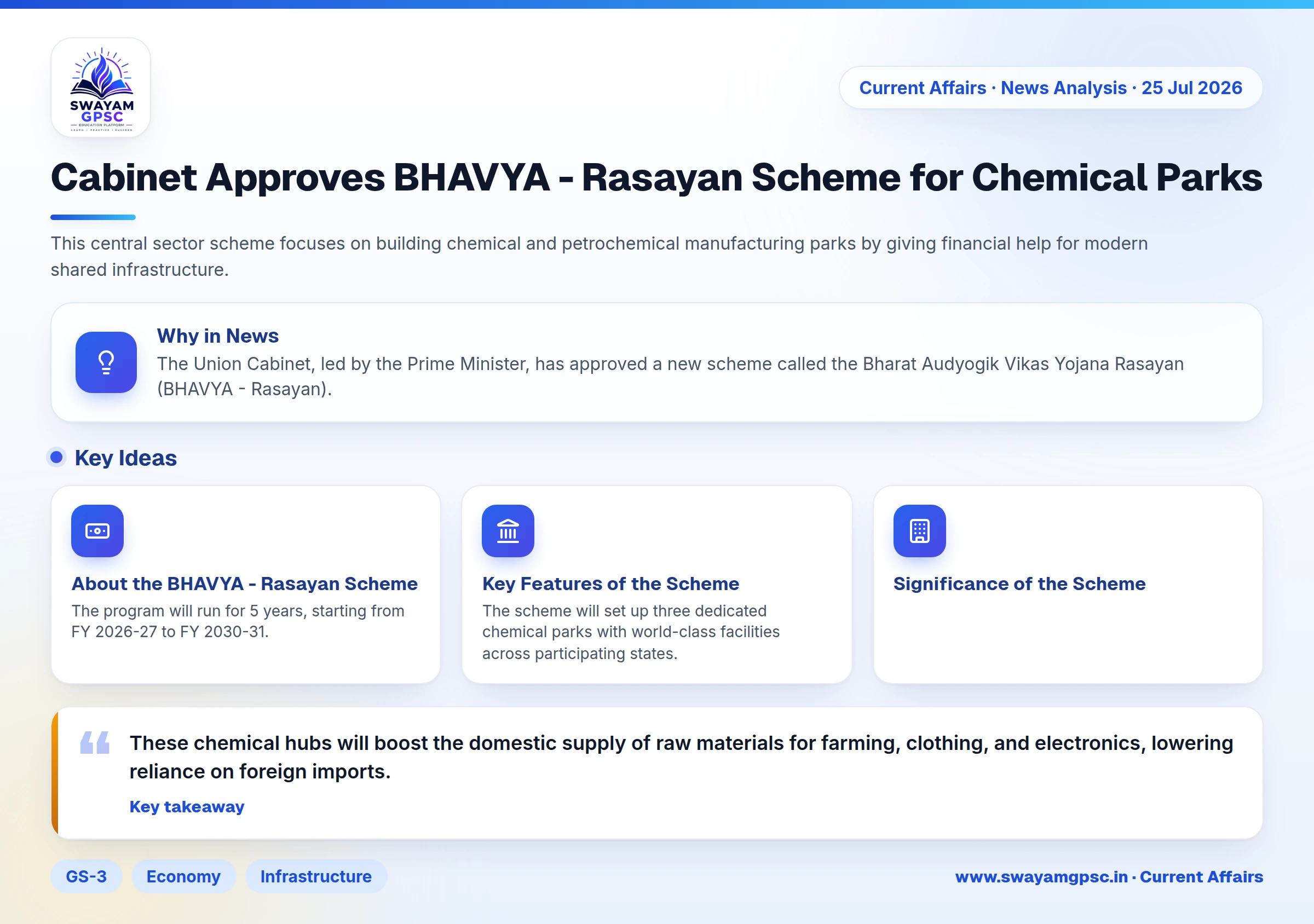
Cabinet Approves BHAVYA - Rasayan Scheme for Chemical Parks
#GS-3 #Economy #Infrastructure #Current Events #National #Chemical Industry
Why in News
- The Union Cabinet, led by the Prime Minister, has approved a new scheme called the Bharat Audyogik Vikas Yojana Rasayan (BHAVYA - Rasayan).
About the BHAVYA - Rasayan Scheme
- This central sector scheme focuses on building chemical and petrochemical manufacturing parks by giving financial help for modern shared infrastructure.
- The Department of Chemicals and Petrochemicals under the Ministry of Chemicals and Fertilizers will run this scheme.
- The program will run for 5 years, starting from FY 2026-27 to FY 2030-31.
- It aims to build an eco-friendly and low-cost chemical ecosystem that reduces shipping costs, attracts domestic investment and FDI, cuts imports, and boosts India's role in Global Value Chains (GVCs).
Key Features of the Scheme
- The government has set aside a total budget of ₹3,030 crore, which includes ₹3,000 crore for shared facilities and ₹30 crore for administrative costs.
- The scheme will set up three dedicated chemical parks with world-class facilities across participating states.
- The Central Government will give up to ₹1,000 crore per park, while the state government must contribute at least ₹500 crore.
- Sites submitted by state governments will be evaluated and selected through a competitive Challenge Route framework.
- States must provide at least 8 sq. km. (2,000 acres) of continuous and dispute-free land for every park.
- The parks will feature Common Effluent Treatment Plants (CETP) to safely clean industrial wastewater.
- They will include Treatment, Storage, and Disposal Facilities (TSDF) to handle hazardous industrial waste safely.
- The infrastructure will provide dedicated solvent recovery and distillation units for factories inside the park.
- The facilities will supply steam through centralized generation and distribution systems for manufacturing needs.
- The locations will offer interconnected pipeline networks along with modern logistics and warehousing spaces.
Significance of the Scheme
- These chemical hubs will boost the domestic supply of raw materials for farming, clothing, and electronics, lowering reliance on foreign imports.
- Shared CETPs and waste management sites will lower factory costs, reduce environmental pollution, and support the goals of Viksit Bharat 2047.