Cabinet Approves Additional Investment in NIIF
#GS-3 #Economy #Infrastructure #Growth #Investment #Rapid Fire CA
Key takeaways
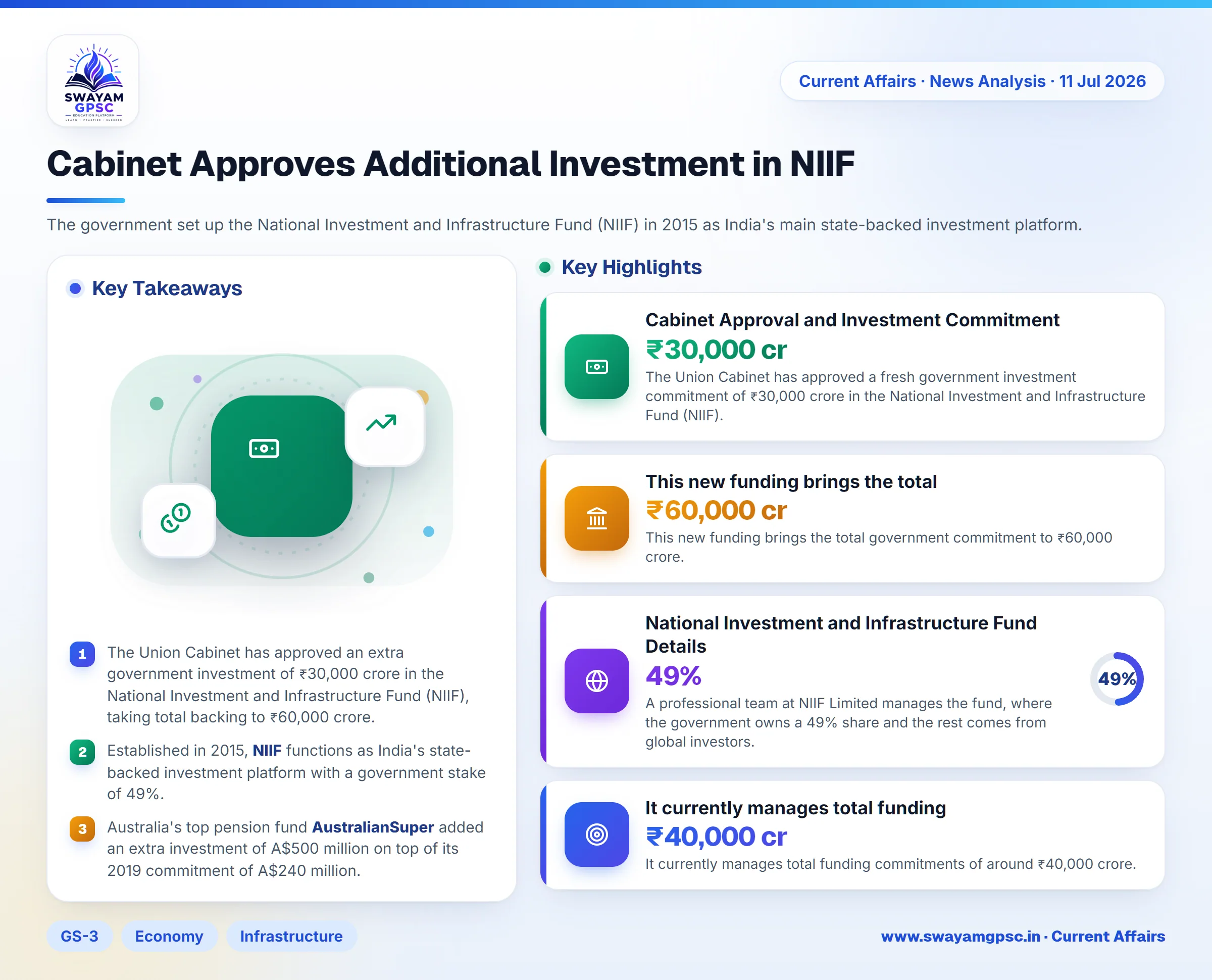
- The Union Cabinet has approved an extra government investment of ₹30,000 crore in the National Investment and Infrastructure Fund (NIIF), taking total backing to ₹60,000 crore.
- Established in 2015, NIIF functions as India's state-backed investment platform with a government stake of 49%.
- Australia's top pension fund AustralianSuper added an extra investment of A$500 million on top of its 2019 commitment of A$240 million.
- The additional funds aim to accelerate infrastructure development and support India's vision of becoming a Viksit Bharat by 2047.
Cabinet Approval and Investment Commitment
- The Union Cabinet has approved a fresh government investment commitment of ₹30,000 crore in the National Investment and Infrastructure Fund (NIIF).
- This new funding brings the total government commitment to ₹60,000 crore.
- A large part of this extra money will support the NIIF Infrastructure Fund II.
- This fund plans to have a target size of about ₹30,000 crore.
- The money will go into fields like transportation, energy, digital networks, city growth, and electric vehicles.
National Investment and Infrastructure Fund Details
- The government set up the National Investment and Infrastructure Fund (NIIF) in 2015 as India's main state-backed investment platform.
- Its main job is to bring in global financial institutions and raise long-term funds for building infrastructure and other key national sectors.
- A professional team at NIIF Limited manages the fund, where the government owns a 49% share and the rest comes from global investors.
- It currently manages total funding commitments of around ₹40,000 crore.
- It has successfully returned nearly ₹12,000 crore to its investors through major asset sales and exits.
- The fund has drawn money from top sovereign wealth funds, pension funds, and development banks across countries like Australia, Canada, Japan, Singapore, the UAE, and the United States.
- Australia's biggest pension fund, AustralianSuper, recently added an extra investment of A$500 million (about US$346 million).
- This new amount is on top of its previous commitment of A$240 million made in 2019.
Role and Strategic Importance
- NIIF investments match closely with major national programs like PM Gati Shakti, Digital India, Make in India, FAME, PM E-DRIVE, national climate goals, and Atmanirbhar Bharat.
- It also helps government agencies by giving expert advice on public-private partnerships, asset monetization, and strategic funding rules.
- This extra financial push will attract more private money, speed up infrastructure work, create jobs, and support India's mission of becoming a Viksit Bharat by 2047.