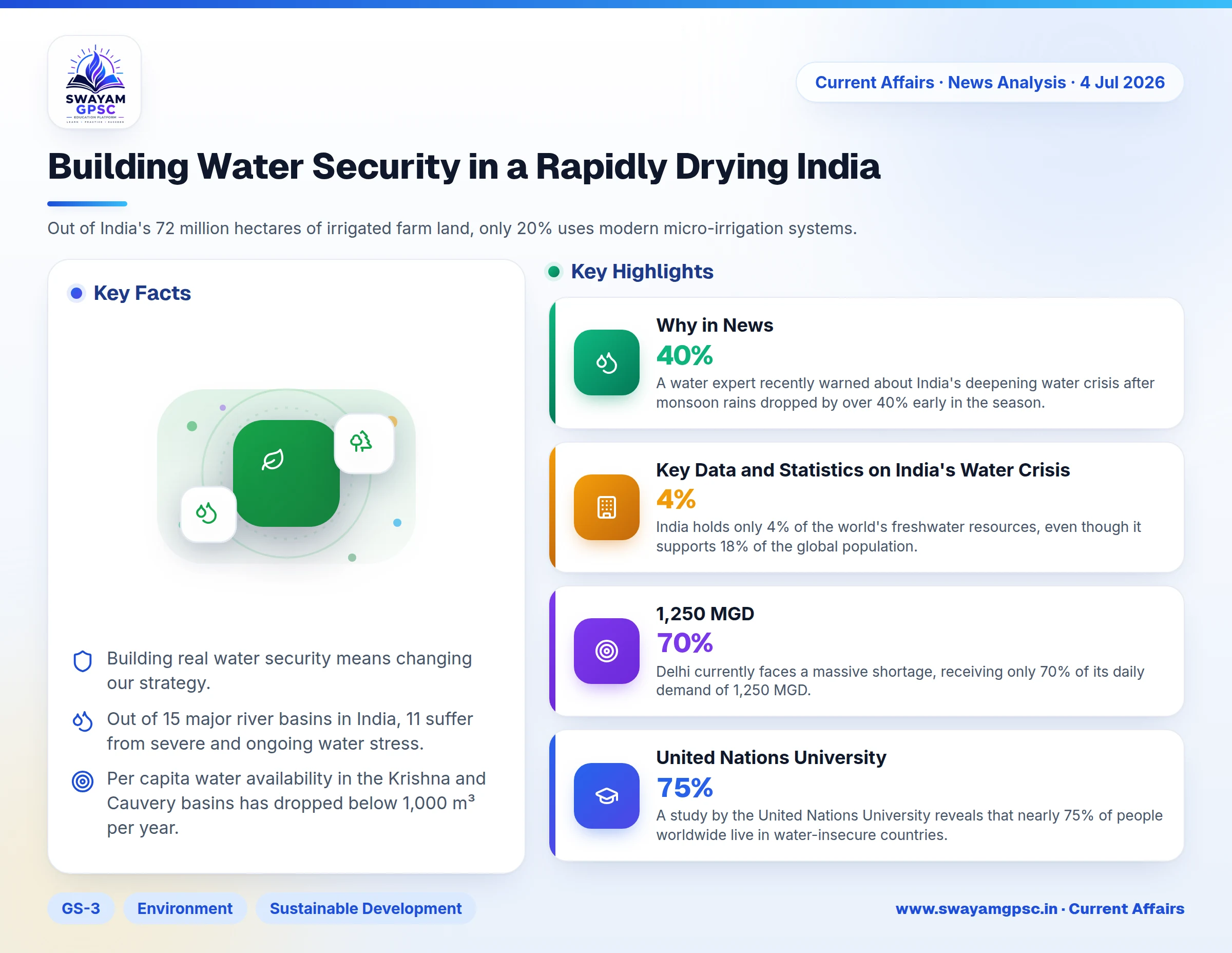
Building Water Security in a Rapidly Drying India
#GS-3 #Environment #Sustainable Development #Climate Change #Economy #Infrastructure #Agriculture #Current Events #National
Why in News
- A water expert recently warned about India's deepening water crisis after monsoon rains dropped by over 40% early in the season. He emphasized that India needs long-term structural fixes instead of relying only on seasonal rain.
What is Water Security?
- Building real water security means changing our strategy. Instead of just trying to find more water, we must manage existing water through conservation, recycling, and smart allocation based on real data.
Key Data and Statistics on India's Water Crisis
- India holds only 4% of the world's freshwater resources, even though it supports 18% of the global population.
- Out of 15 major river basins in India, 11 suffer from severe and ongoing water stress.
- Per capita water availability in the Krishna and Cauvery basins has dropped below 1,000 m³ per year.
- Delhi currently faces a massive shortage, receiving only 70% of its daily demand of 1,250 MGD.
- A study by the United Nations University reveals that nearly 75% of people worldwide live in water-insecure countries.
- Out of India's 72 million hectares of irrigated farm land, only 20% uses modern micro-irrigation systems.
- According to CEEW, recycling wastewater can build a ₹3 lakh crore market and create 1 lakh green jobs by 2047.
The Imperative Need for Strong Water Security
- Fast-growing urban hubs like Bengaluru and Mussoorie experience severe dry spells during summer. We must protect and preserve urban water reserves to prevent citywide water shortages.
- Traditional flood irrigation wastes huge amounts of water through evaporation and leakage. Because of this, farming remains the largest consumer of freshwater.
- Uncontrolled groundwater pumping for farming has pushed water tables way below safe recharge levels.
- Without accurate water measurement across river basins, people continue to extract groundwater freely until the source completely dries up.
- Financial stress hampers local municipal bodies. They need performance-based funding models to cover utility costs and stop physical water leakage.
Key Initiatives Taken So Far
- The Jal Jeevan Mission is a central scheme that builds rural pipeline networks to deliver clean drinking water directly to homes.
- The Pradhan Mantri Krishi Sinchayee Yojana (PMKSY) focuses on extending irrigation access across farmland and encouraging drip and sprinkler systems.
- Tools like the Urban Challenge Fund (UCF) help cities like Visakhapatnam secure ₹1,501 crore to improve water supply pipelines and storm drains.
- India has installed over 4.93 crore smart power meters nationwide. This successful drive offers a practical playbook for setting up digital water meters.
Key Structural Challenges Associated with Water Assets
- Old water pipelines lose huge volumes of clean water because of damaged valves and poor regular upkeep.
- Most municipal sewage in cities is dumped into rivers and lakes without basic treatment, leading to widespread pollution.
- Cities lack precise local climate risk data. As a result, planners cannot identify which coastal areas or key hospitals need urgent flood defenses.
- Current drip irrigation subsidies use 1 hectare as the minimum eligibility unit. This makes modern systems too expensive for small farmers holding under 0.4 hectares.
- Guaranteed government buying pushes farmers to grow thirsty crops like paddy and sugarcane instead of low-water crops.
Way Forward
- Cities should install smart bulk water meters backed by artificial intelligence networks, following the model used in Bhubaneswar, to catch pipeline leaks fast.
- State governments should mandate using treated urban wastewater for non-drinking needs, such as cooling high-density AI data centers and watering public parks.
- Policy makers should lower the minimum subsidy benchmark to 0.4 hectares so small farmers can afford sprinkler and drip units.
- City administrative bodies must use Urban Challenge Fund grants to map flood risks and safeguard schools, power stations, and hospitals.
- The government should encourage farmers to grow pulses and oilseeds by linking crop switching with quick insurance payouts under the Pradhan Mantri Fasal Bima Yojana.
Conclusion
- Large infrastructure programs like the Jal Jeevan Mission have significantly improved tap access. However, untreated sewage and distribution leaks show that building pipes is only half the solution.
- To secure its water future, India must combine smart digital metering with wastewater recycling and expand micro-irrigation across farms.