Building Viksit Bharat Through Empowered Panchayats
#GS-2 #Local Self Governance #Government Policies & Interventions #Indian Polity & Constitution #Governance & Social Justice #Economy
Key takeaways
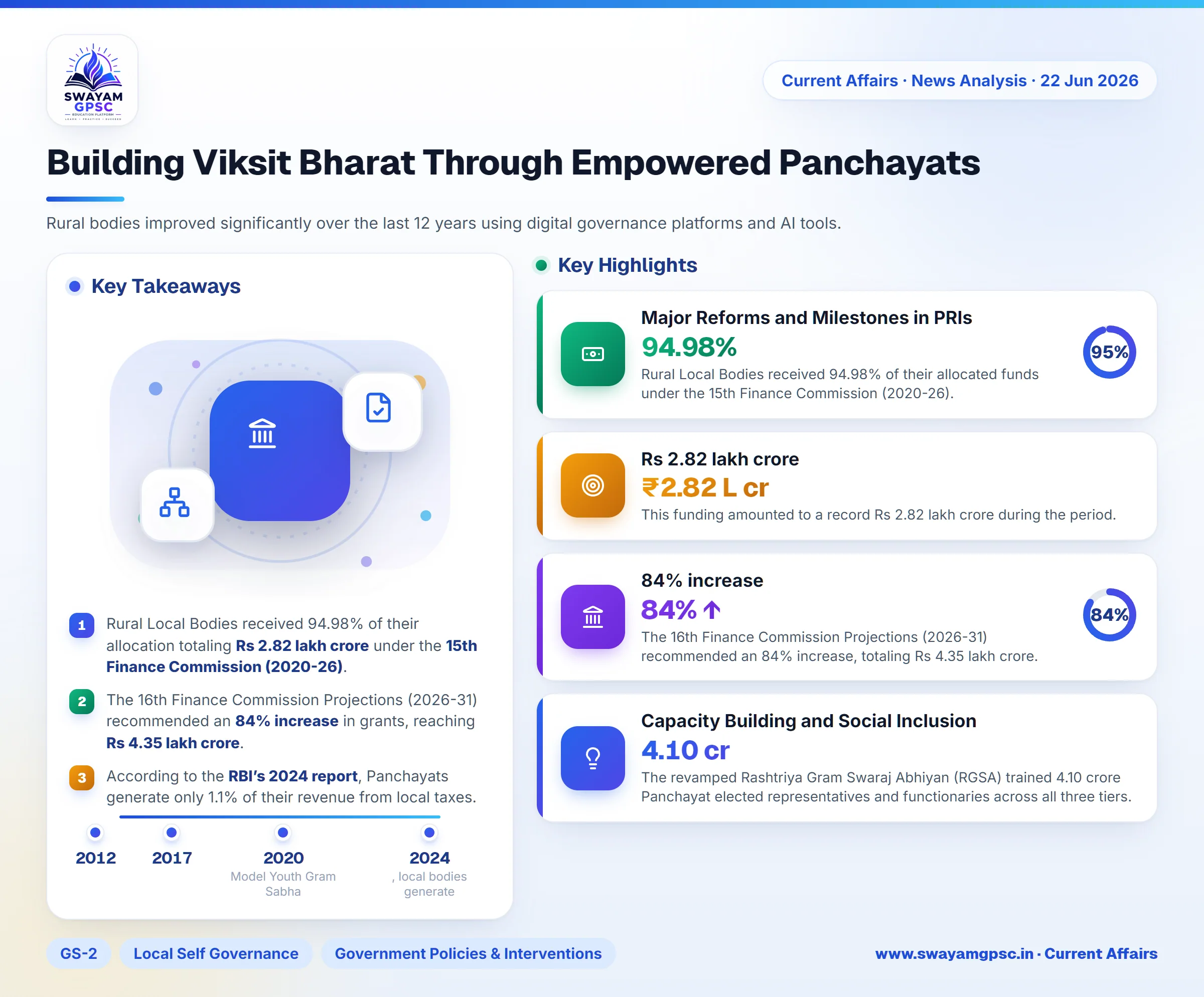
- Rural Local Bodies received 94.98% of their allocation totaling Rs 2.82 lakh crore under the 15th Finance Commission (2020-26).
- The 16th Finance Commission Projections (2026-31) recommended an 84% increase in grants, reaching Rs 4.35 lakh crore.
- According to the RBI’s 2024 report, Panchayats generate only 1.1% of their revenue from local taxes.
- The revamped Rashtriya Gram Swaraj Abhiyan (RGSA) successfully trained 4.10 crore Panchayat elected representatives and functionaries.
- Over 33.55 lakh women elected representatives received governance training between FY 2022-23 and FY 2025-26.
Why in News
- The Ministry of Panchayati Raj reviewed twelve years of rural governance recently.
- The review highlights progress in empowering Panchayati Raj Institutions (PRIs) through better funds and digital tools.
- This progress supports the larger national goal of achieving Viksit Bharat.
Overview of Rural Governance
- Rural bodies improved significantly over the last 12 years using digital governance platforms and AI tools.
- Women, youth, and tribal communities now participate much more actively in local decision-making.
- Despite these gains, deep challenges like the 3Fs deficit slow down grassroots progress.
Major Reforms and Milestones in PRIs
- Rural Local Bodies received 94.98% of their allocated funds under the 15th Finance Commission (2020-26).
- This funding amounted to a record Rs 2.82 lakh crore during the period.
- The 16th Finance Commission Projections (2026-31) recommended an 84% increase, totaling Rs 4.35 lakh crore.
- The government launched the SAMARTH Panchayat Portal and the Atmanirbhar Panchayat Program to help local bodies collect their own taxes.
Capacity Building and Social Inclusion
- The revamped Rashtriya Gram Swaraj Abhiyan (RGSA) trained 4.10 crore Panchayat elected representatives and functionaries across all three tiers.
- More than 33.55 lakh women elected representatives received training between FY 2022-23 and FY 2025-26.
- The Panchayats (Extension to Scheduled Areas) Act, 1996 (PESA) draws from the Bhuria Committee (1995) recommendations.
- The new PESA-GPDP Portal aligns local development plans with PESA guidelines and tribal cultural needs.
- India launched its first PESA Ranking Framework to evaluate states and districts on objective performance metrics.
- The Sashakt Panchayat-Netri Abhiyan and Model Youth Gram Sabha (MYGS) build strong grassroots leadership in line with the National Education Policy, 2020.
Technological and AI-Driven Governance
- The SabhaSaar Platform uses Artificial Intelligence to generate meeting minutes in 23 Indian languages.
- The Panchayat Advancement Index (PAI) benchmarks performance against nine themes of Localised Sustainable Development Goals (LSDGs).
- A partnership with the Indian Meteorological Department created India's first Gram Panchayat-level weather forecasting system.
- The Meri Panchayat App recorded more than one crore downloads to connect rural citizens with local authorities.
Digital Governance and Algorithmic Administration
- The e-GramSwaraj portal digitizes local planning, budgeting, and accounting for rural bodies.
- More than 2.59 lakh Gram Panchayats onboarded the portal by mid-2026.
- Integration with the Public Financial Management System (PFMS) processed over ₹3.16 lakh crore in digital transactions.
- The Gram Manchitra and GPSDP frameworks bring spatial planning and GIS mapping to rural development.
Challenges
- Rural bodies depend on state grants for up to 95% of their total revenue.
- According to the RBI’s 2024 report on ‘Finances of Panchayati Raj Institutions’, local bodies generate a mere 1.1% of revenue from local taxes.
- State governments failed to devolve all 29 subjects listed in the 11th Schedule completely.
- States often bypass elected bodies by creating special committees or parastatals for executing projects.
- States sometimes delay Panchayat elections despite Article 243E requiring timely polls.
- A shortage of technical staff forces local bodies to depend heavily on state bureaucrats.
- The 'Sarpanch Pati/Pradhan Pati' practice undermines women reservation mandates through proxy rule.
- Entrenched caste and gender divisions keep Gram Sabha participation critically low.
- Delays in setting up State Finance Commissions (SFCs) hurt the financial planning of local bodies.
Way Forward
- The government must operationalize a '4Fs' framework adding freedom to functions, funds, and functionaries.
- Panchayats should monetize local assets and use credit ratings to mobilize internal revenue.
- States must replace vague delegations with strict Activity Mapping for village, block, and district levels.
- High-performing PRIs can issue bonds inspired by Indonesia’s Dana Desa system.
- Independent social audit units must be set up nationwide following the Mani Shankar Aiyar Committee (2012) report and Meghalaya’s Community Participation and Public Services Social Audit Act 2017.
- Advanced technology and weather tools must protect the rural economy from climate risks.